Express Werke
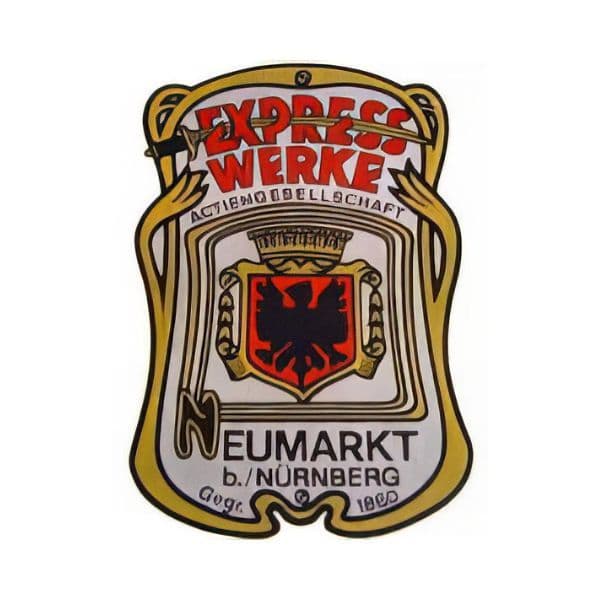
There's a particular kind of German factory building — brick, tall windows, a name painted high on the wall in letters meant to be read from the street — that once stood for a whole industry of small manufacturers nobody outside the region remembers today. Nuremberg had several. Express Werke's was one of them, and for three quarters of a century it turned out bicycles, mopeds, and small motorcycles that rarely made headlines but reliably got people to work.
Origins in Neumarkt
Express-Werke traces back to 1884, founded in Neumarkt, Bavaria, by Josef Goldschmidt, his brother Adolf, and a mechanic named Eduard Pirzer. The firm's early years were modest by design: in its first year of operation it built around twenty bicycles with a workforce of sixteen. This was the velocipede business at its most literal — wheels, frames, and the promise of personal mobility for people who had never had it before.
It's worth clearing up a persistent mix-up here, because the two names get tangled in secondhand accounts. Carl Marschütz worked for the Goldschmidts and managed the company's Nuremberg branch in its early days, but he was not the founder of Express Werke, whatever some retellings suggest. Marschütz split from the firm in 1886 and went on to found Hercules-Werke AG, a separate and eventually much larger Nuremberg manufacturer. The two companies would cross paths again decades later, under circumstances neither man could have anticipated, but Express Werke's founding belongs to Goldschmidt and Pirzer, not to Marschütz.
By the turn of the century the bicycle business had matured enough that Express began looking at powered transport. Between 1899 and 1905 the product line expanded into motorcycles and, for a time, automobiles — a common pattern among European bicycle makers of the era, most of whom eventually settled on two wheels as the more durable business.
The Early Motorcycle Years
Express's first serious motorcycle push came in the early 1900s, built around small two-stroke engines — 100cc and under — sourced from Fafnir, the well-known German proprietary engine maker. This was standard practice at the time; few small manufacturers built their own powerplants, and buying in from a specialist like Fafnir let a firm like Express concentrate on frames, assembly, and sales. Alongside the motorcycles, Express also built three-wheelers using French-sourced engines, chasing the same market for affordable powered transport that was reshaping European cities.
That first run of motorcycle production ran until 1907, after which Express stepped back from powered two-wheelers for a period. Sources differ on exactly when the company returned to motorcycle manufacturing — some accounts point to lightweight machines using 75cc F&S engines in the years before the war, while others suggest the real resumption came later, around 1948–49, and there's no fully reliable way to settle which is correct from the available record. What can be said with more confidence is that by 1935 Express was building the K 100 and K 120 models, and that a defined family of small machines — the 1936 Motorfahrrad SL 104, SL 105, and the 1937 SDL 108, followed by the 1938 Kleinkraftrad SL98, SDL98, SL74, and SDL74 — carried the company through the second half of the 1930s. The K100 arrived in 1939, on the eve of a war that would redirect the whole industry.
During the war years, Express's manufacturing effort, like that of most German motorcycle makers, was turned over to supplying the military — in Express's case, primarily motorized bicycles rather than combat machines. It was utilitarian work, and it kept the factory running through years when civilian production had effectively stopped.
The Postwar Golden Era
Express returned to motorcycle production after the war, and 1948 marks the real beginning of the company's best-remembered period. The lineup broadened to include machines from 125cc up through 250cc, and by the height of its postwar output Express Werke was offering seven distinct displacement classes — 50, 100, 125, 150, 175, 200, and 250cc — a spread wide enough to cover nearly every kind of rider a small German manufacturer could hope to reach, from first-time commuters to buyers wanting something with real road presence.
The standout of this era, and the model most collectors still look for today, was the Radex 151. Powered by a Sachs 147cc engine putting out 6.5 horsepower, the Radex — the name a contraction of "Rad Express" — sold well enough that the factory reportedly struggled to keep pace with orders. That's a good problem for any small manufacturer to have, and for a few years in the early 1950s it seems Express had it. The company also introduced the M52 moped, notable as the first Express two-wheeler to use an engine of its own design rather than a bought-in unit from Sachs, Fichtel & Sachs successor firms, or Fafnir before them.
The mid-to-late 1950s brought further development: the Express 175 Sachs in 1955, alongside the Radex 175S, a well-regarded machine in the increasingly competitive 175cc class. By 1958, Express was building the Type 252, powered by a JLO twin, and the Type 255, another JLO twin, this one fitted with Earles-style leading-link forks — the same fork design favored by BMW and several other European makers of the period for its stability under braking. These later machines show a company still investing in its lineup right up to the point where events outside its control overtook it.
Nuremberg remained the company's home throughout, and Express Werke machines from this period were sold widely across the European market, riding the same wave of affordable motorization that lifted Sachs, Puch, NSU, and dozens of similar firms through the 1950s.
Racing
Unlike NSU or DKW, Express Werke does not appear to have built its reputation through competition. There's no well-documented record of factory racing efforts, notable riders, or championship results tied to the Express name. That absence is worth stating plainly rather than papering over — Express seems to have competed on price, reliability, and everyday practicality rather than on the track, which tracks with its position as a maker of mopeds and lightweight commuter machines rather than a builder of sporting motorcycles.
Merger and the End of Independence
The Radex years turned out to be Express Werke's last as an independent company. In 1958, facing the same cost pressures and shrinking margins that were squeezing the entire German lightweight motorcycle industry as cars became affordable to ordinary buyers, Express merged with DKW and Victoria to form Zweirad Union. It was a defensive consolidation, three once-competing marques pooled together in hopes that shared manufacturing and distribution could keep all of them viable.
It didn't save the Express name. Zweirad Union ended Express production in 1959, folding the brand's remaining model lines into the group's broader output. Zweirad Union itself didn't stay independent long — Fichtel & Sachs, the engine maker whose powerplants had driven so many Express models over the decades, bought the company in 1963 and merged it with Hercules, the firm founded generations earlier by Carl Marschütz after he'd parted ways with the Goldschmidts. It's a strange, quiet closing of a loop: the man who never founded Express Werke ended up with his own company absorbing what was left of it, by way of two intervening owners, eight decades after he first walked out of Neumarkt.
Where Express Werke Stands Today
Express Werke builds nothing now and hasn't for well over sixty years. There was no later revival, no small workshop reviving the name for a limited run of retro-styled machines, the way some German marques have seen happen. What survives is what riders and collectors kept: postwar Radex mopeds and lightweights, 175cc and 250cc models in particular, scattered through Germany and the wider European market in the hands of people who value them for exactly what they are — honest, well-built small motorcycles from a company that never chased glamour.
Among collectors of German lightweight motorcycles, Express Werke occupies a specific and respected niche. The company isn't spoken of in the same breath as NSU or DKW, and it never had the racing pedigree or technical ambition of those bigger names. But the Radex 151 and its siblings represent something real about the postwar German motorcycle industry — small, well-engineered machines built to get ordinary people moving again, from a company that had been doing exactly that, in one form or another, since bicycles were still the state of the art.