BSA has had two great symbols, and most accounts of the logo muddle them.
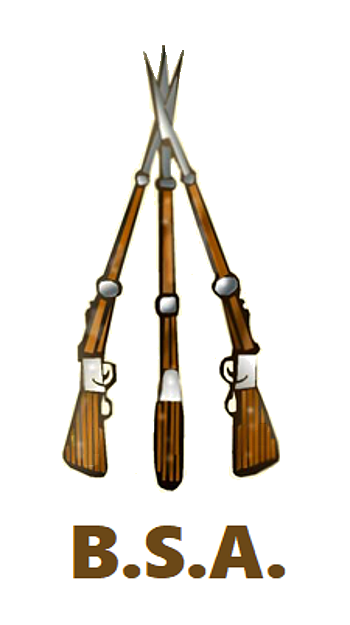
The first is the piled arms: three rifles stacked muzzle-to-muzzle into a tripod, the way a platoon stacks its weapons when it halts. It is a gunmaker's mark. It was registered in 1881, it went onto rifles, bicycles, motorcycles and cars, and it is still used today, but by the air rifle company, not the motorcycle one.
The second is the winged B: the letters BSA in a heavy italic, with a feathered wing trailing from the B. It became the standard mark on BSA motorcycles from 1946, it lasted until production ended in 1973, and it is the logo the revived BSA chose in 2021.
Between them sit the dotted "B.S.A" of the inter-war years, a run of star badges that gave BSA its most famous model name, and dozens of tank badges that restorers still use to date a machine.
This page tells the whole story, era by era. Where the popular logo websites get it wrong (and several errors were on earlier versions of this page), we say so and give the evidence. Where good sources disagree, we give both versions rather than picking the tidier one. For the company's full story, see our history of BSA.
The Short Version
- 1861: The Birmingham Small Arms Company is formed by Birmingham gunmakers on 7 June 1861.
- 1881: The piled arms trade mark is officially registered, having already been "used as the Company's sign for some time."
- 1910: The first BSA motorcycle goes on sale, with a green-and-yellow tank.
- 1920s–30s: The dotted "B.S.A" lettering appears on tank transfers, and star emblems mark the sporting models: Blue Star, Empire Star, then Gold Star in 1937.
- 1946: The winged B becomes standard across the post-war motorcycle range. It was not introduced by the A7, whatever the logo sites say.
- 1954–62: A round red badge combines both marks, with the piled arms in a garter above a winged BSA.
- 1958–72: Pear-drop, star and chrome winged badges carry BSA through the unit-construction twins, the Rocket 3 and the oil-in-frame bikes.
- 1973: BSA motorcycle production ends. The last "BSA" badge goes onto a rebadged Triumph.
- 1986: The gun business, sold separately, keeps the piled arms.
- 2021: The revived BSA under Mahindra's Classic Legends unveils a flat red winged-B logo.
Two Marks, Three Owners
It helps to know who owns what before going era by era, because today the name BSA is split three ways.
BSA Company Ltd, owned since October 2016 by Classic Legends (part of the Mahindra group), holds the motorcycle marque, including the winged B. BSA Guns (UK) Ltd, sold to the Spanish airgun maker Gamo in 1986 "including the logo and the right to use the initials 'BSA'" for guns, holds the piled arms and still makes air rifles in Birmingham. And in India, TI Cycles of the Murugappa Group, founded in 1949 with Britain's Tube Investments, sells BSA bicycles.
So when you see the piled arms on a new product, it is almost certainly an air rifle. When you see the winged B, it is a motorcycle.
1861–1881: The Piled Arms
BSA did not begin as a motorcycle company or even as a bicycle company. It was formed on 7 June 1861 by a group of Birmingham gunmakers "to manufacture guns by machinery," competing with the government's mechanised Royal Small Arms Factory at Enfield. Many short histories say the company was founded during the Crimean War. It wasn't. That war ended in 1856; what it left behind was the lesson that Birmingham's hand-craft gun trade could not supply rifles at scale.
The emblem the gunmakers chose was the one they knew best. "Piling arms" is a drill movement: at the halt, soldiers hook their rifles together by the upper bands or bayonets so that three stand up as a self-supporting tripod. BSA Guns' own account says the gunmakers adopted "the sign of three crossed rifles … as an emblem of their craft." As a symbol it works on two levels. It says rifles, which was the whole business. And piled arms are arms at rest: ready, not in use.
When did it become a trade mark? The BSA Owners Club's factory history is the clearest source: in 1881, "the design of the three crossed rifles, which had been used as the Company's sign for some time, was officially registered." That fits the timing of British trade mark law, because a national register had existed only since 1876. There are two competing dates, and neither stands up as well:
- Several reference works tie the mark's adoption to 1880, when BSA built its first road vehicles, the Otto Dicycles.
- In 1982 BSA Guns issued 1,000 AirSporter rifles engraved "BSA Piled Arms Centenary 1982," which implies a date of 1882.
The safest statement is that the piled arms was in use by about 1880 and registered in 1881.
What exactly does it show? Three rifles, butts splayed and muzzles meeting at the top, usually with bayonets or blades crossing above the muzzles. On period transfers it was often enclosed in a buckled belt, known in the transfer trade as the "garter" (listed as "Crossed Rifles with Garter" and "Garter Piled Arms"). We have not found a reliable source identifying the rifle model the drawing represents, so we are not going to guess.
Image: modern redrawing of the early trade mark by ACTVR, via Wikimedia Commons, CC BY-SA 3.0.
1880–1950s: The Mark Goes on Wheels
The piled arms reached a road vehicle almost as soon as it was registered. BSA built 953 Otto Dicycles between 1880 and 1883, and in 1880–81 it resolved to make bicycles and tricycles. Then, in 1887, it gave up building complete cycles to make Lee-Metford rifles. When it came back in 1893, it came back as a component maker.
That is where the first consumer-facing BSA branding comes from. BSA sold "fittings" (hubs, bottom brackets, cranks, chainwheels and pedals) to other frame builders, and bicycles assembled from them carried a seat-tube transfer reading "Guaranteed built with a set of B.S.A. fittings." In 1902 the War Office adopted "B.S.A. Fittings" for military bicycles. Complete machines built by BSA itself, which returned around 1908–10 (sources differ on the exact year), wore the piled arms transfer. From 1908 the chainrings carried the letters BSA.
In the bicycle trade the initials were written with stops: B.S.A. That dotted form carried straight over to the first motorcycles.
BSA also used wing imagery before the motorcycle winged B existed. From 1934 its Golden Wings and Silver Wings bicycle ranges wore large winged seat-tube transfers. There, though, the wings belonged to a model name, not to the letter B.

1910–1939: B.S.A with Dots
The first BSA motorcycle, a 499cc single known simply as "the 3½ h.p.," was shown at Olympia in November 1910. By 1911 it was on sale, and it was instantly recognisable, less for any logo than for its paint. Grace's Guide notes that early BSAs were "easily distinguishable … by their yellow and green painted tanks." Some logo sites say green and cream; the better sources say green and yellow.
The mark that most people picture for the inter-war years is the dotted oval: heavy upright capitals, B.S.A, in red outlined in black, on a gold or buff oval with a red border. It is a straightforward piece of sign-writing, bold and legible from across a showroom, and it matches the dotted initials of the bicycle trade.
A caution on dates. Logo aggregator sites give this oval the precise bracket 1919–1946. We have found no primary source for either end of that range. What we can say is that the dotted form was in use on tank transfers between the wars (a Wikimedia Commons scan of the pre-war tank logo is dated 1932) and that it gave way to the winged B after the Second World War. Tank transfers also changed over the period, with round-tank, flat-tank and saddle-tank machines all wearing different designs. Anyone restoring a specific pre-war model should work from that model's transfer set, not a generic logo.
1930–1939: The Stars
BSA's most famous model name started out as a paint mark.
Around 1930, works-tuned engines were distinguished from standard ones by stencilling a red star on the timing case (reported by Old Bike Mart and Classic Bike). When BSA turned the idea into a sporting range, the stars became model names:
- Blue Star (1931–32 to 1936): high-compression, special-cam engines that "carried their distinctive painted emblem on the timing case." Sources differ on whether the range began in 1931 or 1932.
- Empire Star (1935–36 to 1939): named for King George V's Silver Jubilee. Here "the 'Star' now formed the centrepiece of the petrol tank transfer, a golden star with the BSA logo in its centre, against a pale green enamel background." Reproduction transfer sets pair it with garter piled arms on the oil tank and headstock, and gold piled arms on the rear mudguard.
- Gold Star (from 1938): this star was a real award. On 30 June 1937, Wal Handley won a race at Brooklands on a 496cc Empire Star with a fastest lap of 107.57 mph. That earned him the Gold Star badge the British Motor Cycle Racing Club awarded for lapping at over 100 mph during a race. BSA made the badge a model, and the M24 Gold Star appeared at the 1937 Motor Cycle Show.
Few motorcycle names come directly from a physical badge, and the Gold Star is one of them. It also explains why star badges recur on BSA tanks for the next thirty years. When the revived BSA put a Gold Star logo on the chromed tank of its 2021 Gold Star, its press release said it was "inspired by Wal Handley's 1937 Brooklands achievement."
1946–1953: The Winged B
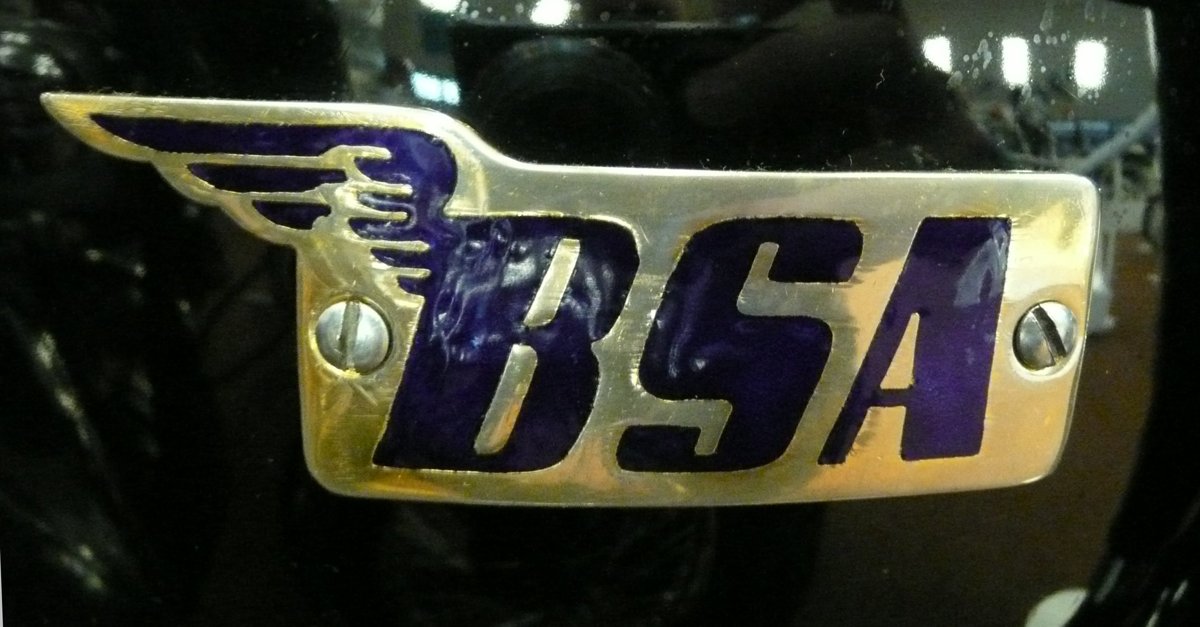
After the war, BSA's motorcycles got a new face: the winged B. The letters BSA, without stops, are set in a heavy, forward-leaning italic, and a stylised wing of horizontal feathers streams back from the top of the B. Its message is obvious and effective: speed. BSA had just spent six years building rifles, machine guns and more than a hundred thousand military motorcycles, and it was selling to a public that wanted to go places.
The badge in the photograph is the early post-war tank plate, a cast plate with the wing and italic letters picked out in enamel. The parts books show how widely it was used:
- 29-7910, "chrome & blue enamel," is listed for the B, C and M ranges, 1946–51.
- 67-8017, "enamel/red/gold," is listed for the A7 twin, 1947–51. The specialist Draganfly notes that this one is no longer available and that 29-7910 can be used instead.
- The 1948 D1 Bantam, BSA's two-stroke, carried a "Maroon Winged BSA" tank transfer.
Enthusiasts use the wing as a rule of thumb: in the words of one BSA collector, "the wing added to the 'B.S.A' initials appears to be an easy reference guide to whether an item is pre or post WW2."
The A7 myth. Many logo websites say the winged B arrived with the launch of the A7 twin, and until now so did this page. The parts evidence doesn't support it. The A7 was announced in September 1946, and the same winged badge was going onto BSA singles (the B31 and B33, the M20 and the C-range lightweights) from 1946, with the Bantam following in 1948. The winged B was a range-wide identity, not an A7 badge.
Did the wing exist before the war? Possibly, in places. A photograph on Geograph shows a winged "B.S.A" radiator mascot on a BSA three-wheeler car, a type built from 1929 to 1936, though we cannot confirm the mascot is original to the car. BSA's Golden Wings and Silver Wings bicycles also used wings from 1934. On the motorcycles, the winged B is a post-war mark.
Why a US trade mark says 1952. BSA Company Ltd's US registration no. 4,610,749 describes "the letters 'BSA' with a wing on the letter B" and claims first use on 31 December 1952. That date is sometimes quoted as the year the logo was introduced. It isn't. The application was filed in 2013, and a US "first use" date only has to be no later than the date claimed, for US commerce. It does not contradict British use from 1946.
Photo: Thruxton, via Wikimedia Commons, CC BY 3.0.
Model badges of the early 1950s
In the early 1950s BSA began giving its star models their own tank art, and the plain winged plate gained a series of variants.
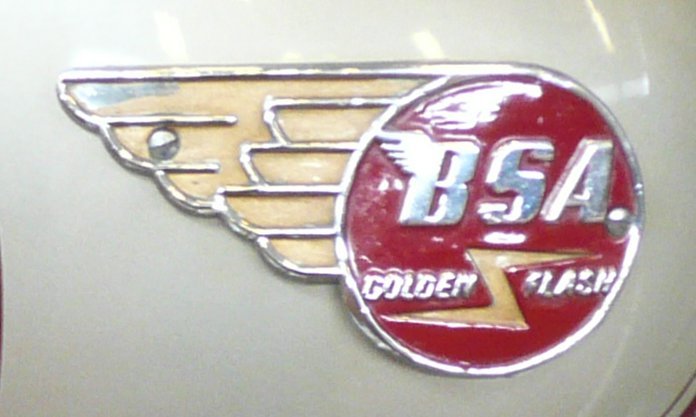
- A7 Star Twin: a "Star Twin" star transfer in gold, red and black for 1949–50, then a cast-alloy version of the "tin star" badge for 1951–52.
- A10 Golden Flash (1950–57): handed left and right winged badges (67-8070 and 67-8071). Draganfly lists them in gold and red and also in black. The Golden Flash was named for its gold paint, and the badge is one of the best-known pieces of BSA tank jewellery.
- 1952–53 "long barred" badges: a longer version of the winged plate for A7 and B/C/M models. In 1953 some singles used a "less centre" badge with a separate GRP (glass-fibre) centre section.
- 1953 Gold Star: a large red badge, which the specialist Draganfly's parts list describes, memorably, as "big and red and blousy."
One more detail helps with dating. According to Classic Transfers, which reproduces BSA transfer sets, "BSA changed their company name from B.S.A. Cycles to B.S.A. Motor Cycles Ltd in late 1953," and the wording on the garter piled arms transfers changed with it. A garter transfer with the wrong company name is a quick sign that a restoration has used the wrong set.
1954–1962: Both Marks on One Badge
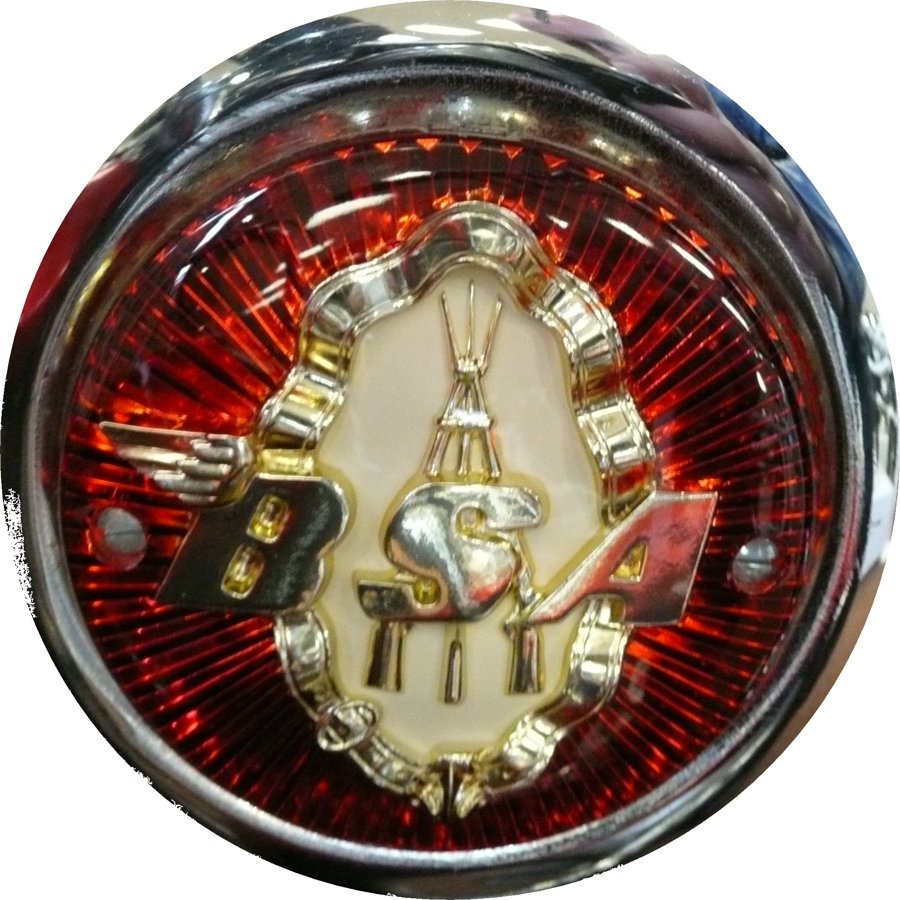
For the swinging-arm range of 1954, BSA brought its two marks together. The new tank badge is round and red, with a sunburst ring in red plastic. In the centre, on a cream ground, the piled arms in its garter sits above a winged BSA in gold. It is the gunmaker and the motorcycle maker on one badge, and it is probably the most elaborate piece of jewellery BSA ever put on a tank.
The parts details:
- 65-8220, "piled arms, red," is listed by Draganfly for swinging-arm A7 and A10 twins from 1954 to 1962 and for B, C and M singles from 1954 to 1960. It notes the badge is not for the large tanks of 1960–62. Classic Motorcycle Spares describes it as 82mm across, with "red and white background with vivid gold writing and the famous piled arms logo," and lists it for the B31 from 1957. The suppliers' year ranges differ, which is common, so check the factory parts book for your model.
- Shooting Star and Super Flash: a large round badge in green and gold (67-8116) for 1953–57, then black and gold (42-8105) for 1958–62.
- Gold Star: 4-inch round badges in red and gold or black and gold.
- C10L (1954–57): its own BSA badge, originally cast alloy.
The photograph is captioned 1957 on Wikimedia Commons, the middle of this badge's run.
Photo: TR001, via Wikimedia Commons, CC BY 3.0.
1958–1967: Pear Drops and Stars
The unit-construction era brought new tanks and new badges. The piled arms quietly left the motorcycle tanks, while the winged B stayed at the centre of every design.
- Pear-drop badges: teardrop-shaped, in red and gold (40-8014 and 40-8015) or black and gold (40-8122 and 40-8123). Draganfly lists the red pair for large-tank A-group twins from 1960 to 1962. Classic British Spares fits them to the C15, B40, C25, A50, A65 and A10 "through approximately 1967" where the tank suits, and rubber backing pads are listed for 1958–68.
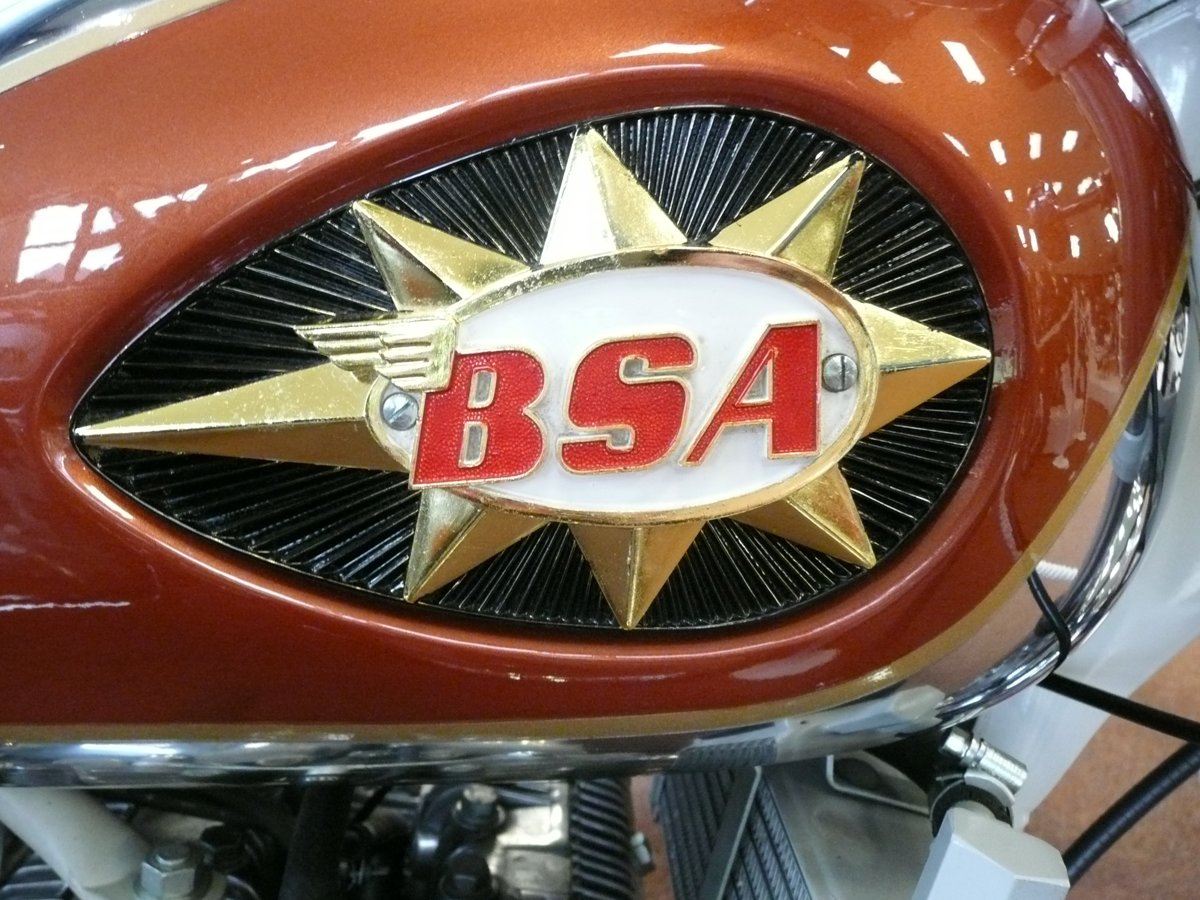
- Star badges: the photograph shows the 1960s form, a gold star behind a cream oval carrying a red winged BSA, set on a black sunburst. It is a direct descendant of the pre-war Star transfers. We have not been able to tie this exact badge to specific models and years, so check before fitting one.
- Bantam: from 1964 the two-stroke's tank transfers gave way to plastic tank badges.
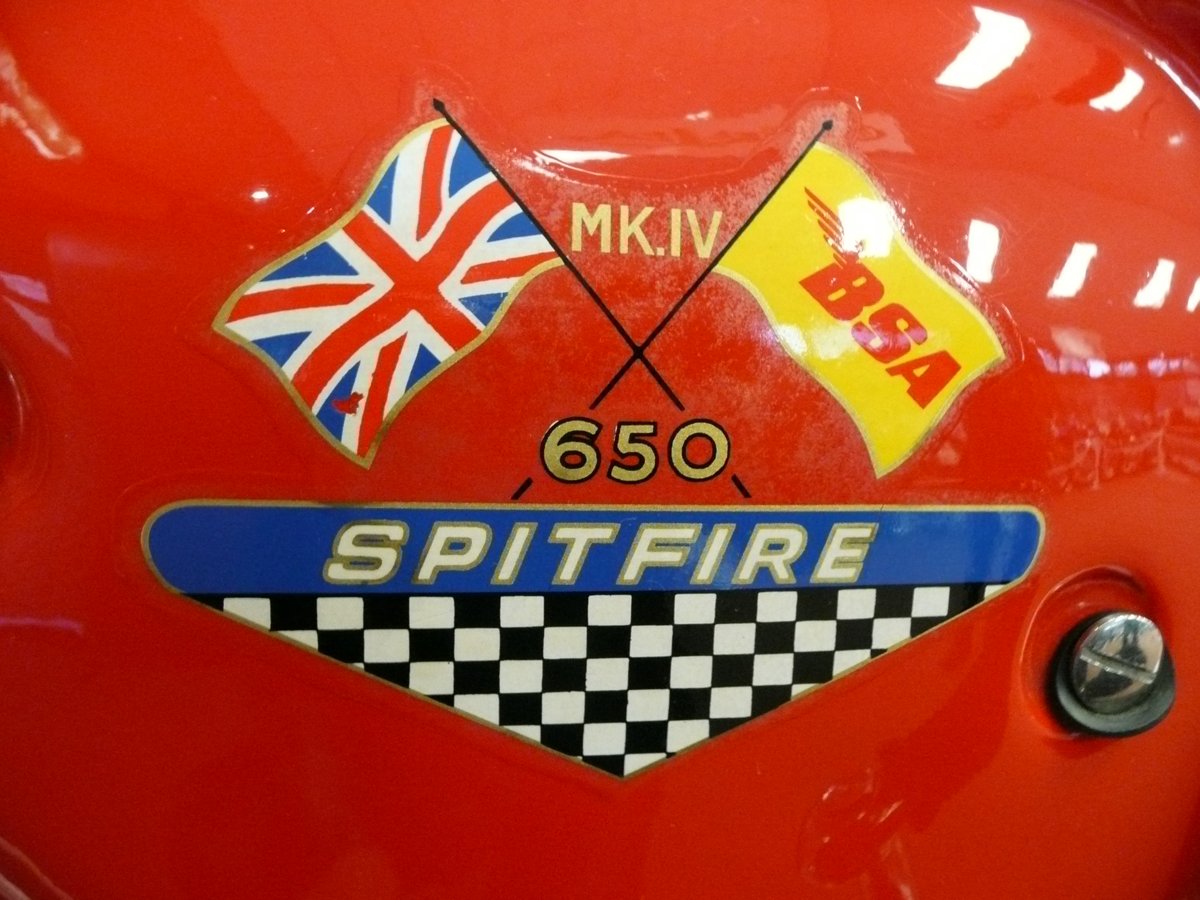
The model decals of the period got bolder. The A65 Spitfire Mk IV carried a pair of crossed flags, a Union flag and a yellow BSA flag bearing the winged B, above a chequered "Spitfire" panel. The Hornet had a winged BSA on a white starburst.
Photo: TR001, via Wikimedia Commons, CC BY 3.0.

1968–1973: The Last Badges
BSA's last six years brought some of its most interesting badge decisions.
- 1968–70: metal badges (82-9695 and 82-9696) for the A65 Royal Star, Thunderbolt, Lightning and Firebird, the B25 and C25 singles, and the B44SS.
- Rocket 3 (from 1968): badges 82-8610 and 82-8611 carry "the famous winged BSA logo." According to Classic Bike Guide, BSA "hadn't initially intended to market the triple with their name on the tank," because Triumph was the bigger name in America, but BSA's US dealers wanted a big bike of their own. Ogle Design's boxy "bread bin" tank was later swapped for an A65-style tank on US machines.
- 1971–72: the oil-in-frame twins (Lightning, Thunderbolt, Firebird, and the stillborn Fury) wore a chrome winged badge, 60-2568. The whole range was launched as "The Power Set" at the Royal Lancaster Hotel, London, on 10 November 1970, styled at BSA's Umberslade Hall research centre.
BSA-badged production ended in summer 1973. The last machines to carry the name were not BSAs at all: 200 to 300 Triumph TR6 Trophys, rebadged as the BSA T65 Thunderbolt to fill export orders for Spain and Australia. After more than twenty years of the Triumph–BSA combine, the badge went on the other company's bike.
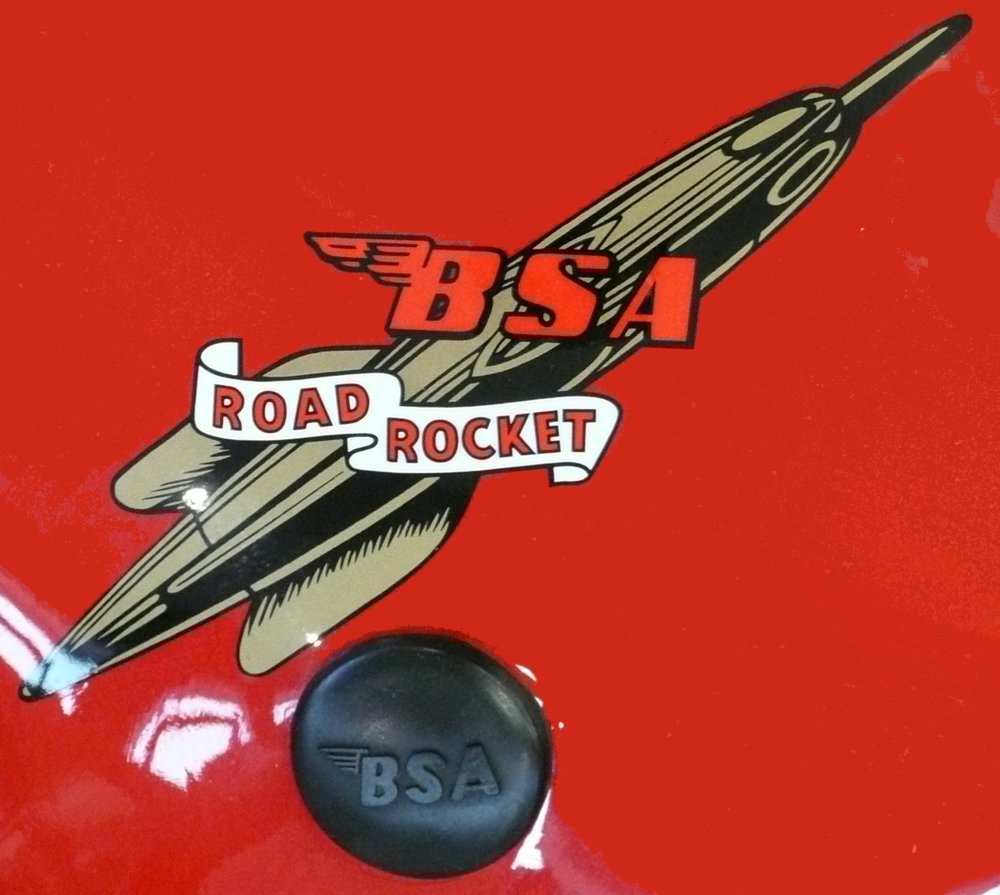
The red wordmark shown here is the winged B in its familiar printed form, the version reproduced on countless transfers, T-shirts and parts catalogues since. BSA's own advertising used it too: a 1959 brochure carries a white winged BSA on a red slanted panel with the slogan "The most popular motor cycle in the world," a claim BSA had been making since at least 1952.
1973–2016: The Name Splits Up
When BSA's motorcycle business was folded into Norton Villiers Triumph in 1973, the piled arms and the winged B went separate ways.
- Motorcycles: after NVT was liquidated in 1978, a management team under William Colquhoun formed the BSA Company and bought the motorcycle brand rights. It built military and off-road machines, and by 1986 it had moved to Blockley, Gloucestershire. It merged with Andover Norton in 1991 to form a new BSA Group, was taken over by BSA Regal in 1994, and in 1997–2003 sold the 400cc and 500cc Gold SR retro single, more than 200 of which went to Japan.
- Guns: the gun business was sold to Gamo in 1986, along with the logo and the right to use the initials BSA on guns. That is why the piled arms survives on air rifles today. BSA Guns still works from Armoury Road, Birmingham, where a giant piled arms made of air rifles hangs in reception.
- Bicycles: BSA had already sold its bicycle business to Raleigh in 1957. In India, BSA bicycles are made today by TI Cycles.
We have not found reliable documentation of the logos used in the BSA Regal and Gold SR years, and we are not going to reconstruct them from memory.

2016–Present: The Wing Returns
In October 2016, Classic Legends, a subsidiary of Mahindra & Mahindra, bought BSA Company for £3.4 million. At the time, the brand earned about $34,000 a year in licensing fees.
The new logo was revealed on BSA Motorcycles' social media around 24 November 2021, with the line "Return of a Legend. We've evolved, but our DNA remains unaltered." It is the winged B, simplified: solid red, heavy italic "BSA", with a three-feather wing from the B, and no outlines, dots or badge frame. It is flatter and cleaner than the enamel badges it descends from, and it is built to work on a phone screen as well as a petrol tank. The choice itself is telling. The revived company went back to the post-war motorcycle mark, not to the piled arms, which belongs to the gun company in any case.
The first new model, the Gold Star, was unveiled on 4 December 2021 at Motorcycle Live, NEC Birmingham, a few miles from Small Heath. Its chromed tank carries a Gold Star logo, so the 1937 Brooklands badge is back on a BSA tank. The motorcycle mark is registered in the US to BSA Company Ltd as "the letters 'BSA' with a wing on the letter B."
We have found no public record of who designed the 2021 logo or whether BSA has published brand guidelines.
Typography and Colour
The lettering is custom, not a typeface. The dotted B.S.A of the inter-war years is heavy, upright, sign-written block capitals. The post-war winged B is hand-drawn, heavy italic capitals. Both were drawn for BSA.
Logo websites often "identify" the fonts as Kiez Slanted, Indecise Semi Expanded Bold Italic, Arial Std Black or Britannic Bold. At best, those are modern look-alikes a designer might use to imitate the style. Kiez is a retro signage font released in 2016, and Arial dates from 1982. None of them could have been used on a 1946 tank badge.
The colours are documented, but the symbolism is not. The recorded colours are:
- Green and yellow for the 1910–11 tanks.
- Red on gold for the inter-war oval.
- Pale green behind the Empire Star transfer.
- Maroon for the 1948 Bantam's wing.
- Blue, or red and gold, enamel on the early winged plates.
- Red and gold, green and gold, and black and gold for the round and pear-drop badges.
- Red for the 2021 logo.
Aggregator sites say BSA's red means passion and its white means loyalty. There is no BSA source for any of that. The colours were chosen to match the paint schemes of the machines and to stand out on a showroom floor.
How to Date a BSA by Its Badge
Tank badges are one of the fastest ways to check whether a BSA has been restored to the right specification. This table is drawn from the specialist parts lists of Draganfly, Classic British Spares and Classic Motorcycle Spares. Suppliers sometimes disagree on year ranges, so treat it as a first check and confirm against the factory parts book for your model.
| Years | Models | Badge or transfer | Part numbers |
|---|---|---|---|
| 1946–51 | B, C, M singles | Winged plate, chrome and blue enamel | 29-7910 |
| 1947–51 | A7 | Winged plate, enamel red and gold | 67-8017 |
| 1948 | D1 Bantam | Maroon winged BSA transfer | Transfer |
| 1949–50 | A7 Star Twin | "Star Twin" star transfer, gold/red/black | 67-8050 |
| 1951–52 | A7 Star Twin | Cast-alloy "tin star" badge | 67-8051 |
| 1950–57 | A10 Golden Flash | Winged "Golden Flash" badges, gold/red or black | 67-8070 / 67-8071 |
| 1952–53 | A7, B, C, M | "Long barred" winged badges | 65-8207/09, 65-8157/58 |
| 1953 | B31, B33, C, M | "Less centre" badge with GRP centre | 65-8208/10, 65-8211 |
| 1953 | B32, B34 Gold Star | Large red badge | 65-8193 |
| 1953–57 | A7 Shooting Star / Super Flash | Large round, green and gold | 67-8116 |
| 1954–62 | Swinging-arm A7, A10 (singles to 1960) | Round red piled arms over winged BSA | 65-8220 |
| 1958–62 | A7 Shooting Star | Large round, black and gold | 42-8105 |
| c.1958–67 | Large-tank twins and unit singles | Pear drop, red/gold or black/gold | 40-8014/15, 40-8122/23 |
| 1964 on | Bantam | Plastic tank badges replace transfers | Various |
| 1968–70 | A65, B25, C25, B44SS | Metal badges | 82-9695 / 82-9696 |
| 1968 on | A75 Rocket 3 | Winged BSA badges | 82-8610 / 82-8611 |
| 1971–72 | Oil-in-frame twins | Chrome winged badge | 60-2568 |
Red flags when buying:
- A round 1954-on piled arms badge on a rigid or plunger-framed bike from 1946–53.
- Pear-drop badges on a tank that predates them.
- A garter transfer reading "B.S.A. Motor Cycles Ltd" on a machine built before late 1953, or "B.S.A. Cycles" on one built after.
Most reproduction badges on the market are made in Taiwan, and even the suppliers call them "everyday rider" quality. That's fine for a bike you ride. On a concours machine or a high-value model like a Gold Star or Rocket Gold Star, originality affects price. Current prices by model are on our BSA valuations page.
What the Logo Websites Get Wrong
Most BSA logo histories online copy one another, and several errors are now so widespread they look like facts. These are the ones we've checked:
| Claim | The evidence |
|---|---|
| "The winged B was introduced with the BSA A7." | The same winged badge was listed for B, C and M singles from 1946 and the Bantam from 1948. It was a range-wide identity. |
| "BSA was founded during the Crimean War." | The company was formed on 7 June 1861; the Crimean War ended in 1856. |
| "BSA moved into bicycles in 1919." | BSA built Otto Dicycles from 1880, resolved to make bicycles and tricycles in 1880–81, and sold cycle fittings from 1893. |
| "The company began as the Birmingham Small Arms Manufacturers' Association." | The trade body was the Birmingham Small Arms Trade Association of the 1850s. The company was a separate joint-stock firm. |
| "The dotted logo was used 1919–1946; the winged logo 1946–1972." | The winged B's 1946 start is supported by parts records. The 1919 date, and the neatness of both brackets, are not supported by any source we've found. |
| "The font is Kiez Slanted / Arial Std Black / Britannic Bold." | All BSA lettering was custom. Kiez (2016) and Arial (1982) didn't exist when it was drawn. |
| "The red stands for passion and the white for loyalty." | No BSA source supports any colour symbolism. |
| "The piled arms is the current BSA motorcycle logo." | The motorcycle company uses the winged B. The piled arms belongs to BSA Guns. |
For the same myth-checking applied to the whole company, including the 1903 "motorcycle division" date BSA's own website repeats, see our history of BSA.
BSA Logo Timeline
The Birmingham Small Arms Company is formed by Birmingham gunmakers on 7 June.
BSA builds Otto Dicycles and resolves to make bicycles; the piled arms, already the company's sign, is officially registered in 1881.
"B.S.A. fittings" transfers on other makers' bicycles; the BSA letters on chainrings from 1908.
The first BSA motorcycle, with a green-and-yellow tank.
A red star stencilled on the timing case marks works-tuned engines, the start of the Star models.
The Empire Star's tank transfer: a golden star with the BSA logo on pale green.
Wal Handley earns a Brooklands Gold Star badge on 30 June; the M24 Gold Star follows for 1938.
The winged B becomes standard across the post-war motorcycle range.
The D1 Bantam wears a maroon winged BSA transfer.
The A10 Golden Flash arrives with its winged roundel badge.
Transfers change from "B.S.A. Cycles" to "B.S.A. Motor Cycles Ltd."
The round red badge combines the piled arms and the winged B.
Pear-drop and star badges on the unit-construction range.
Plastic badges replace transfers on the Bantam.
Chrome winged badges on the oil-in-frame "Power Set."
BSA production ends; the last BSA badges go on rebadged Triumph TR6s.
The gun business, and with it the piled arms, goes to Gamo.
Classic Legends (Mahindra) buys BSA Company in October.
The new red winged-B logo is revealed in November; the Gold Star returns in December with a Gold Star logo on its tank.
BSA Logo FAQ
What does the BSA logo stand for?
BSA stands for Birmingham Small Arms, the Birmingham Small Arms Company founded by gunmakers in 1861. "Small arms" means rifles and other hand-held guns, which is what the company was set up to make.
What do the three rifles in the BSA logo mean?
They are "piled arms": three rifles stacked into a tripod, the way soldiers stack their weapons at the halt. The gunmakers who founded BSA adopted it as the emblem of their craft, and it was officially registered as a trade mark in 1881. It appeared on BSA rifles, bicycles, motorcycles and cars, and it is still used today by BSA Guns.
Why does the BSA logo have a wing?
The wing stands for speed. The winged B, a feathered wing trailing from the B of an italic BSA, became standard on BSA motorcycles from 1946 and was used until production ended in 1973. The revived BSA adopted a simplified red version in 2021.
Did the BSA A7 introduce the winged logo?
No. That claim is widespread online, but parts records list the same winged tank badge for BSA's B, C and M singles from 1946, the year the A7 was announced, and the Bantam wore a winged BSA transfer from 1948. The winged B was a range-wide identity.
What font is the BSA logo?
None. BSA's lettering, both the dotted B.S.A of the inter-war years and the italic winged BSA after 1946, was drawn specifically for the company. Modern fonts such as Kiez Slanted are sometimes named as matches, but they are look-alikes created decades later.
Who owns the BSA logo today?
It depends which logo. The winged-B motorcycle mark belongs to BSA Company Ltd, owned by Classic Legends, part of the Mahindra group, since 2016. The piled arms and the BSA name on guns belong to BSA Guns, sold to Gamo in 1986. In India, BSA bicycles are made by TI Cycles.
When was the new BSA logo released?
The revived BSA revealed its red winged-B logo on social media around 24 November 2021, ahead of unveiling the new Gold Star at Motorcycle Live in Birmingham on 4 December 2021.
Sources
This page was researched from specialist, club and primary sources, and checked against the logo aggregator sites where they disagree. The main sources:
- BSA Owners Club, factory history (1881 registration of the piled arms)
- BSA Guns, About BSA Guns, and Grace's Guide, BSA: Guns, BSA: Bicycles and BSA: Motorcycles
- Old Bike Mart, When was it that BSA's star… (the Star badges)
- The Classic MotorCycle, A–Z reference: BSA
- BSA Gold Star Owners Club, history
- Draganfly, BSA tank badges (part numbers and years); Classic British Spares, pear-shape badges and Gold Star badges; Classic Motorcycle Spares, piled arms badge
- Classic Transfers, A Bantam story and 1937 Empire Star transfer set
- BSA & Military Bicycle Museum, 1905 BSA fittings bicycle and BSA ephemera
- US trade mark registration 4,610,749 (winged B, BSA Company Ltd)
- Wikipedia, BSA Company, BSA Thunderbolt, BSA AirSporter and Gamo
- Rushlane, BSA Motorcycles is back with new logo; BSA, Gold Star launch press release; Cycle News, Mahindra buys 100 percent of BSA
- Classic Bike Guide, BSA Rocket 3
Read the full history of BSA, browse BSA models and values, or see our curated BSA apparel and gear. For the other half of the BSA–Triumph story, see the Triumph logo history.