MV Agusta's badge wasn't drawn for a motorcycle company. It was drawn for a small subsidiary of an aircraft maker, and its three main parts say so: a cog for engineering, wings for speed, and, soon after, a banner carrying the family name, AGUSTA.
Over eighty years the badge has changed less than the company. MV Agusta has been an aviation offshoot, the most successful team in Grand Prix racing, a dormant name owned by the Italian state, part of Cagiva, part of Harley-Davidson, and a company owned by a Russian-British family and then partly by KTM. Through most of that, the crest on the tank has been the one introduced in the late 1940s. It has been redrawn and recoloured, and in the 1970s it gave up the tank to italic and chrome wordmarks, but only once, for an anniversary, has MV Agusta designed a new emblem to take its place.
This page traces the badge from the first MV 98 to the Ottantesimo models of 2025. It relies on the most direct evidence we could find: museum catalogue records, the company's own statements, a 2005 anniversary postcard, photographs of surviving machines, and the US trade mark register. Where the popular logo websites are wrong, we say so. For the company story, see our history of MV Agusta.
The Short Version
- 1923: Count Giovanni Agusta founds the aircraft maker Costruzioni Aeronautiche Giovanni Agusta at Samarate, near Varese.
- 19 January 1945: His son Domenico and the family register Meccanica Verghera, named after the village of Verghera. MV stands for Meccanica Verghera.
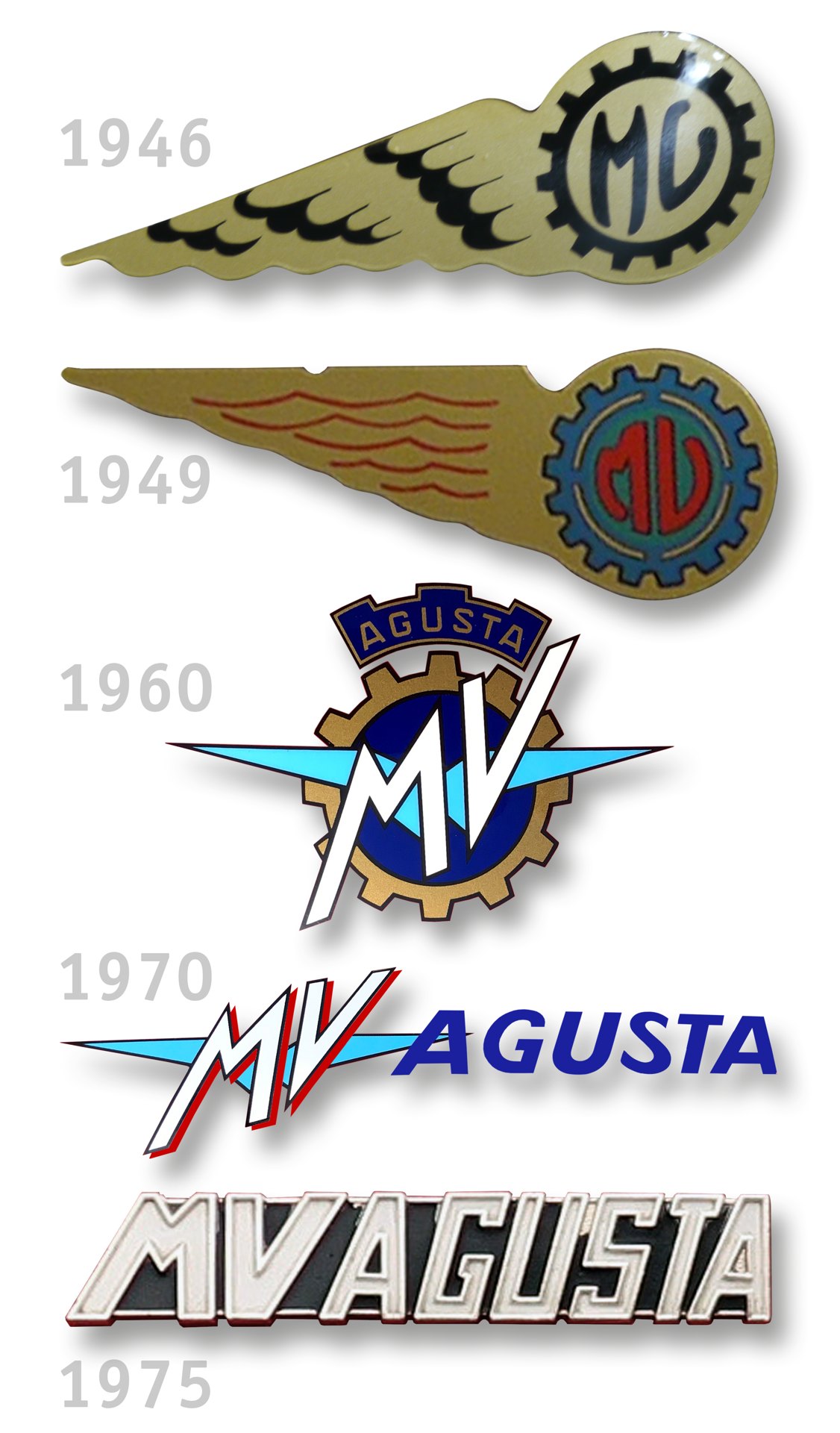
- 1945–c.1950: The first badge is a winged cog: a long feathered wing ending in a toothed wheel, with the rounded letters MV inside it.
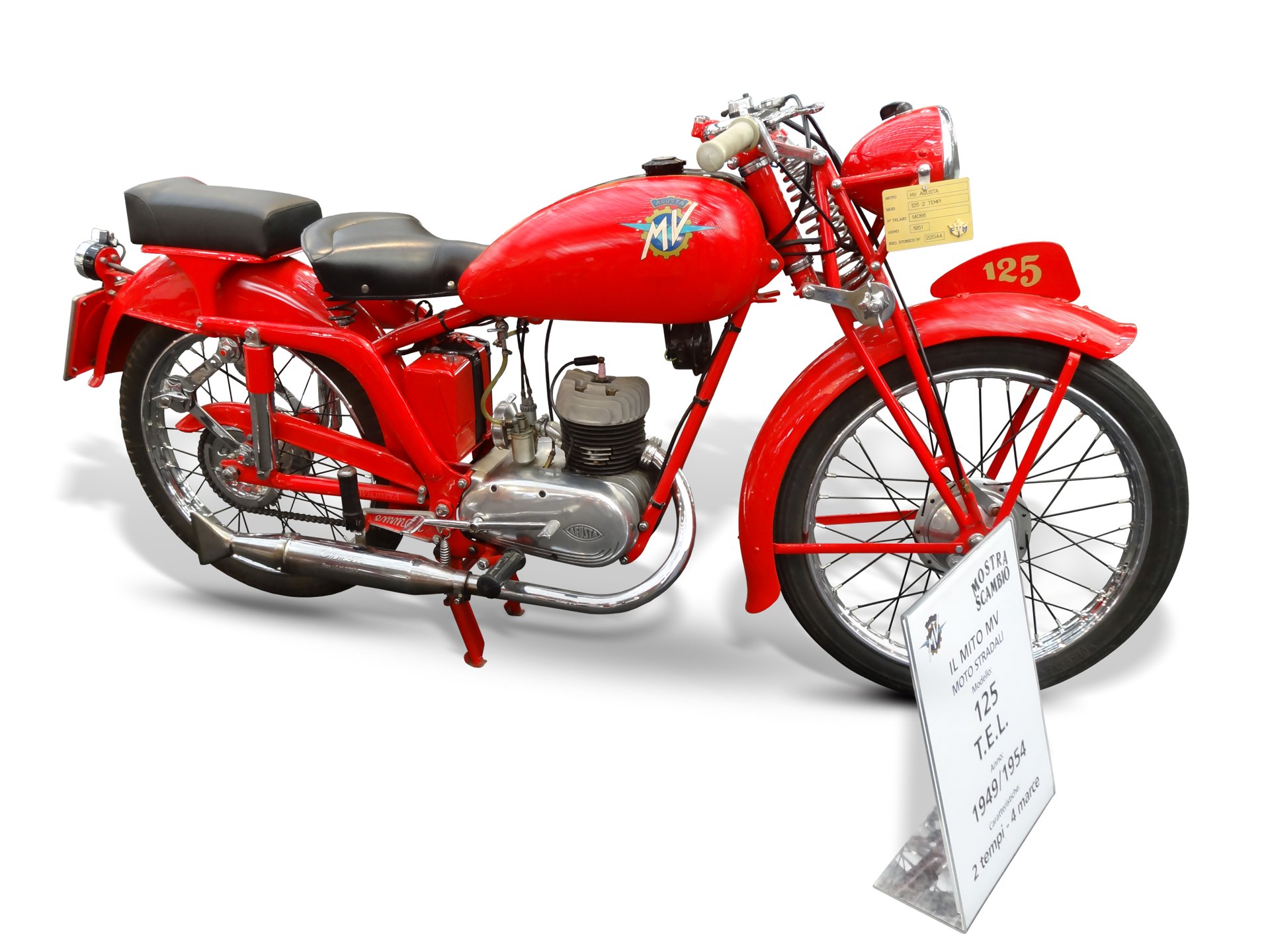
- c.1947–1951: The crest appears: AGUSTA in a banner, over a gold cog on a blue disc, crossed by pale-blue arrow wings and a large white italic MV. A 1951 works racer in Milan's science museum carries it on both sides of the tank.
- 1950s–60s: The crest appears as a transfer, as a painted emblem and, on some 1960s road bikes, as a round enamel badge on a red field.
- Late 1960s–1970s: An italic "MV AGUSTA" wordmark with the MV on a pale-blue arrow appears on the racers' fairings and the 750 S. The 750 S America of 1975 adds a chrome "MVAGUSTA" badge.
- 1977–1980: Production ends; stock is sold until about 1980.
- 1991–92: Cagiva buys the dormant MV Agusta name. The crest returns on the F4 750 Serie Oro, unveiled in 1997 and built from 1999.
- 2010s: A glossier, shaded version of the crest spreads across MV's marketing and new models.
- November 2024: For the 80th anniversary, MV's Centro Stile redraws the historic logo as a gold MV monogram in a cog, with no wings and no banner, for the Ottantesimo collection.

1945–c.1950: The Winged Cog
The company behind it. Count Giovanni Agusta flew his first aircraft in 1907 and founded Costruzioni Aeronautiche Giovanni Agusta at Samarate, near Varese, in 1923. He died in 1927, and the business passed to his widow, Countess Giuseppina, and his son Domenico. During the Second World War the firm built aircraft parts and repaired aircraft. By 1943 it was already working on a small two-stroke motorcycle engine; MV Agusta itself dates its first engine to that year.
With aircraft production about to become impossible in post-war Italy, the family set up a separate company for the motorcycle. On 19 January 1945, according to MV Agusta, the Italian Wikipedia and the local press, the Società Anonima Meccanica Verghera was founded at Cascina Costa di Samarate. (Some sources describe it as an S.r.l., and anniversary memorabilia uses a different date, 12 February 1945; 19 January is the date MV Agusta itself gives.) Verghera is the hamlet where the first machines were built. The initials were the company: MV. Engines and parts were even engraved with the word "EMMEVI", which is how the letters are said in Italian, "to teach the correct pronunciation of the MV acronym", as MV Agusta puts it.
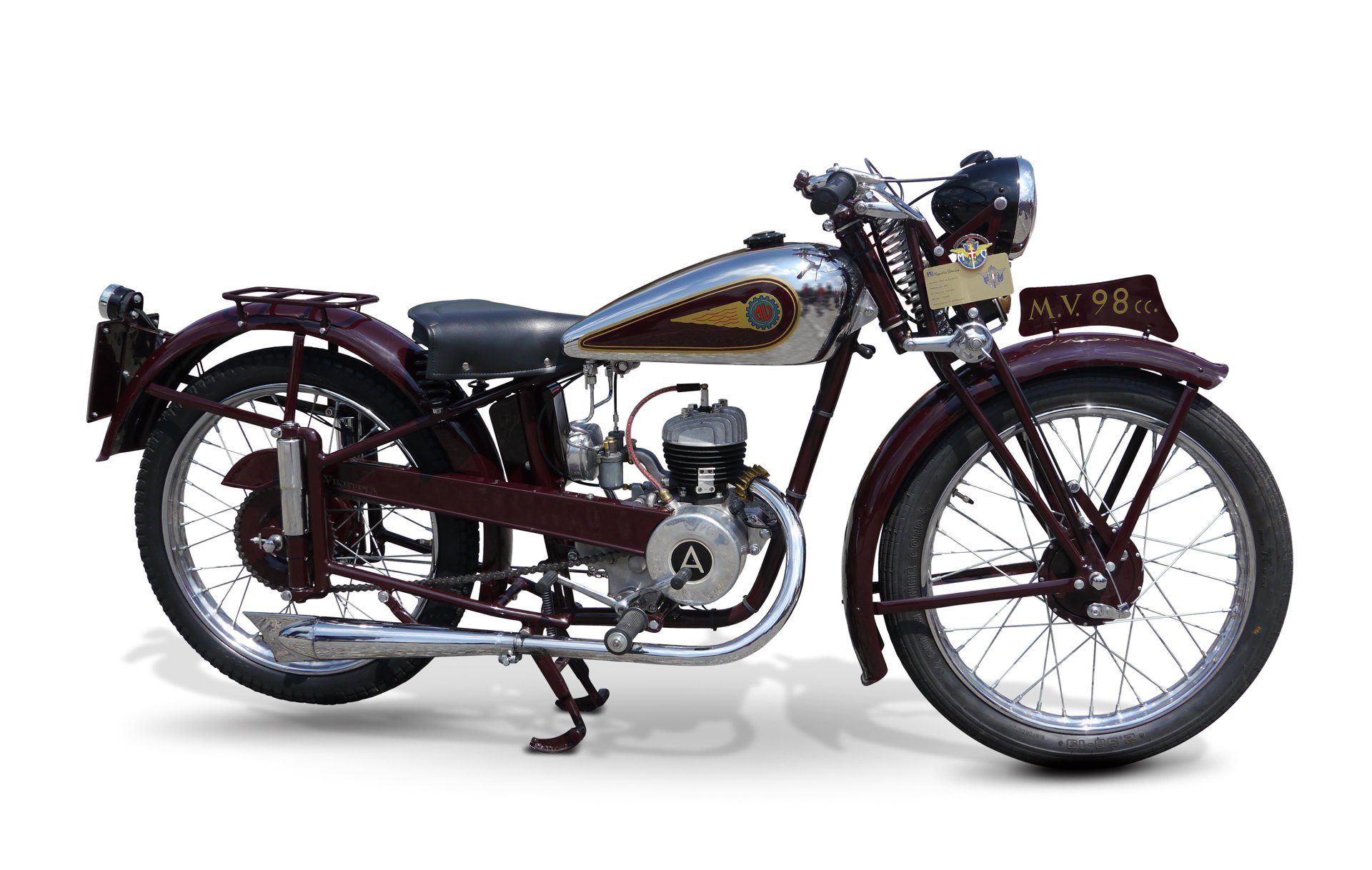
The name that had to change. The first motorcycle was shown as the "Vespa 98". The name was not free: it had been registered in the 1930s by the Milan maker Miller-Balsamo and passed to Piaggio, which wanted it for its new scooter. The bike became the MV 98, though according to Old Bike Mag the first machines delivered still carried a Vespa nameplate on the front mudguard, removed after pressure from Piaggio. Sources give different dates for the launch, from October to December 1945. Deliveries began in 1946.
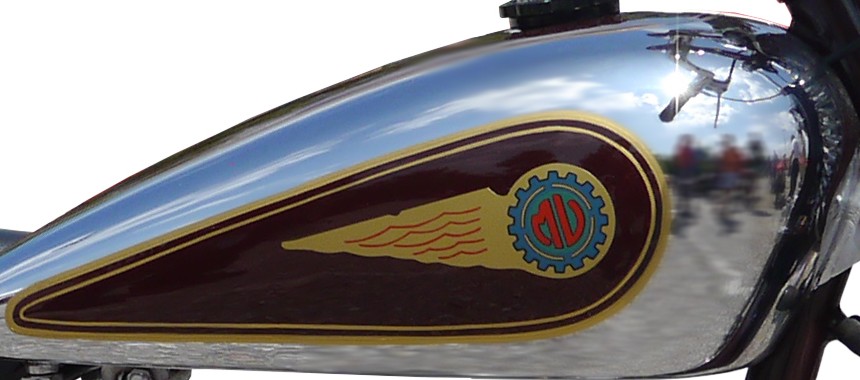
The first badge. MV Agusta's own description of its first logo is: "the two letters MV (Meccanica Verghera), inside a gearwheel, symbolizing the company's dedication to mechanics. This logo was paired with wings, seemingly spread by the force of wind generated by the motorcycle's speed." Old Bike Mag's account of the MV 98 says the same: "On the petrol tank sat the company's insignia, with the letters M and V sitting inside a toothed gear with wings."
What that looked like is clear from surviving machines and from a 2005 postcard marking the company's 60th anniversary. The postcard was issued with a special postmark at Samarate and is credited, in Luciano Salari's philatelic study of MV, to the Gruppo Lavoratori Seniores Agusta – MV, the company's retired workers. It shows the logo's evolution "from 1945 to 1975". Its 1945 version, and the badge on the restored MV 98 shown below, is:
- a long, gold feathered wing, sweeping back from
- a blue cog, with
- the letters MV in a rounded red monogram inside a white ring.
That is the badge on the left. A photograph of a surviving badge in the Wikimedia Commons archive shows a second version, with dark feathers on a pale wing and a black cog, labelled 1946 by the collector who photographed it. We have not been able to date the two versions independently, and both may have been used in the first years.
Where the wings came from. It is tempting to read the wings as a salute to Agusta's aircraft. MV Agusta itself does not say so: its own description is of wings "spread by the force of wind generated by the motorcycle's speed". The link to aviation is a reasonable guess, not a documented one. We found no record of who drew the badge.

c.1947–1950s: The AGUSTA Crest
Within a few years the winged cog gave way to the badge MV Agusta still uses. The 2005 postcard dates it to 1947. Its elements:
- AGUSTA, in capitals, in a blue banner with a scalloped, crown-like top edge;
- a gold cog with a dark blue disc at its centre;
- a pair of long, flat, pale-blue arrow shapes running through the cog horizontally, the descendants of the old feathered wing;
- two huge, white italic letters, MV, drawn as sharp strokes that break out of the cog top and bottom.
The feathered wing had become an arrow, the round monogram had become a pair of lightning-quick italics, and the family name had been added over the top.
The first hard evidence. The earliest securely dated example we have found is in Milan. The Museo Nazionale della Scienza e della Tecnologia holds a 1951 MV Agusta 500 four-cylinder works racer, designed by Piero Remor. Its catalogue record lists two trade marks on the sides of the tank and describes them as the "MV" lettering in capitals "superimposed on wings and a toothed wheel", with "the word 'Agusta' in capital letters" above the wheel. The same museum's 125 Bialbero of about 1957 carries the same mark. Several restored 125s of 1949 wear it too, though restorations are not proof.
Why "AGUSTA"? No source explains why the family name was added. The obvious answer is that by the late 1940s the company was selling in earnest and racing, and the Agusta name carried prestige that "Meccanica Verghera" did not. It remains an answer, not a fact.
Is it a coat of arms? The Agustas were counts, and the banner's shape looks a little like a coronet, so it is often said that the crest comes from the family's heraldry. We found no source for that, from MV Agusta, the Agusta museum or elsewhere. A US registration of the crest filed in 2007, and cancelled in 2017, described the top element as "a stylised crown including the word AGUSTA". That is a description of the shape, not a claim about its origin.
1950s–1960s: Transfers, Enamel and 'Emeuve'
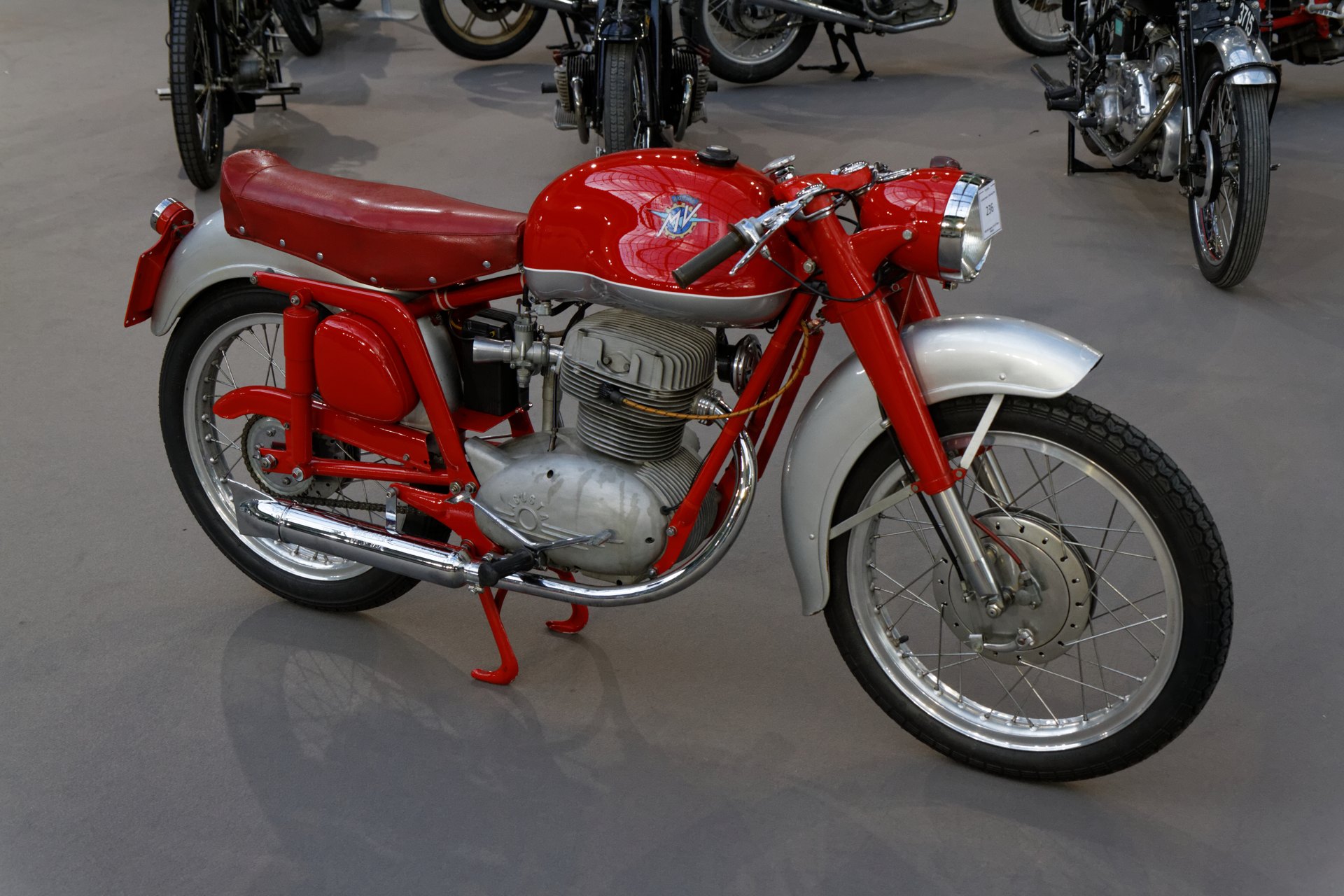
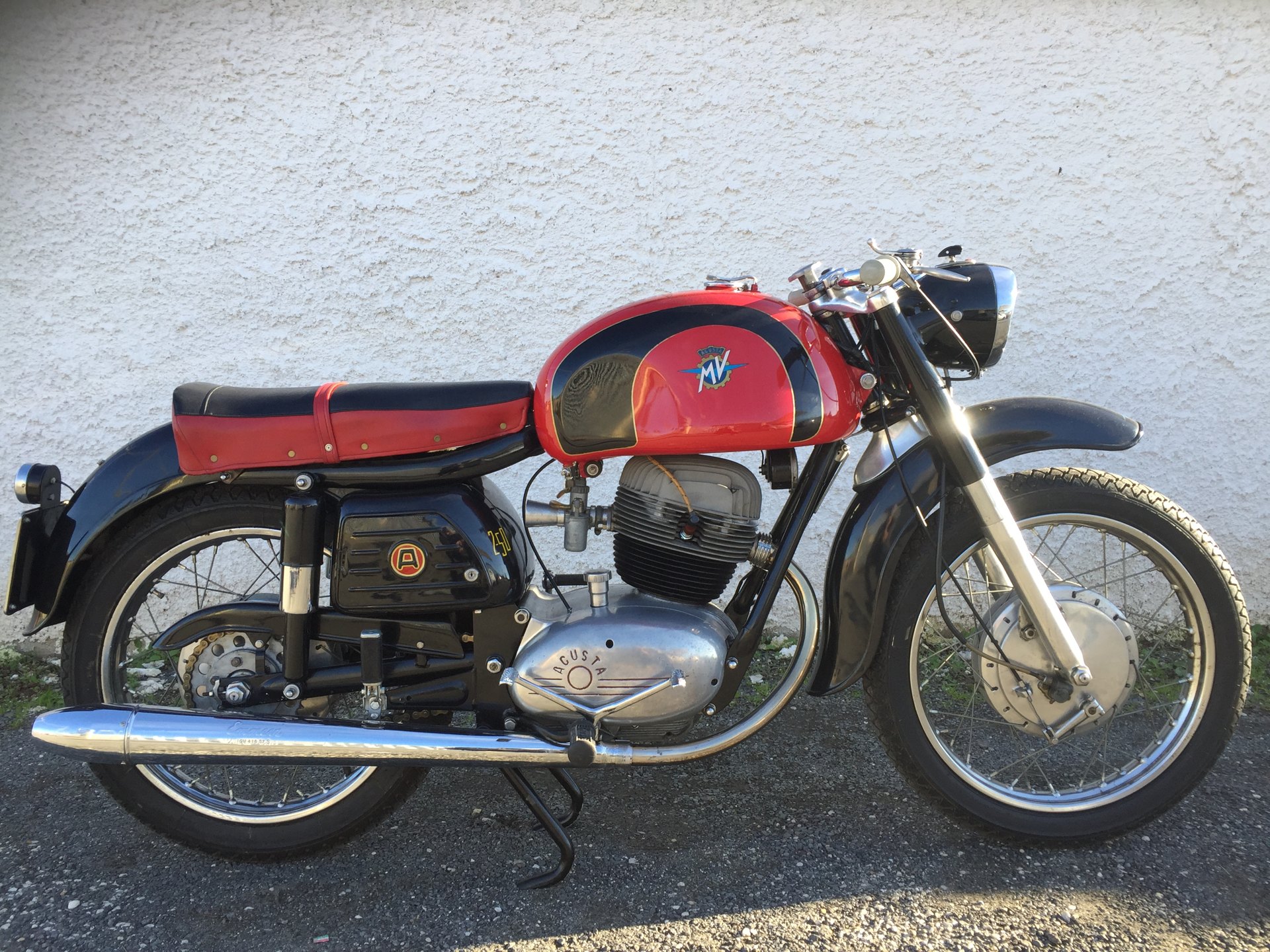
In the 1950s MV Agusta sold a wide range of machines, from the 125 Pullman and the CGT scooter to the 175 CS "Disco Volante" and the 250 and 300 Raid. Almost all of them carried the crest, though never in exactly the same way.
How it was applied:
- Transfers. Most tanks carried the crest as a water-slide transfer, usually on red, sometimes on a panel lined in gold. Reproduction transfers for these models are widely sold, and restorers argue over year-by-year details.
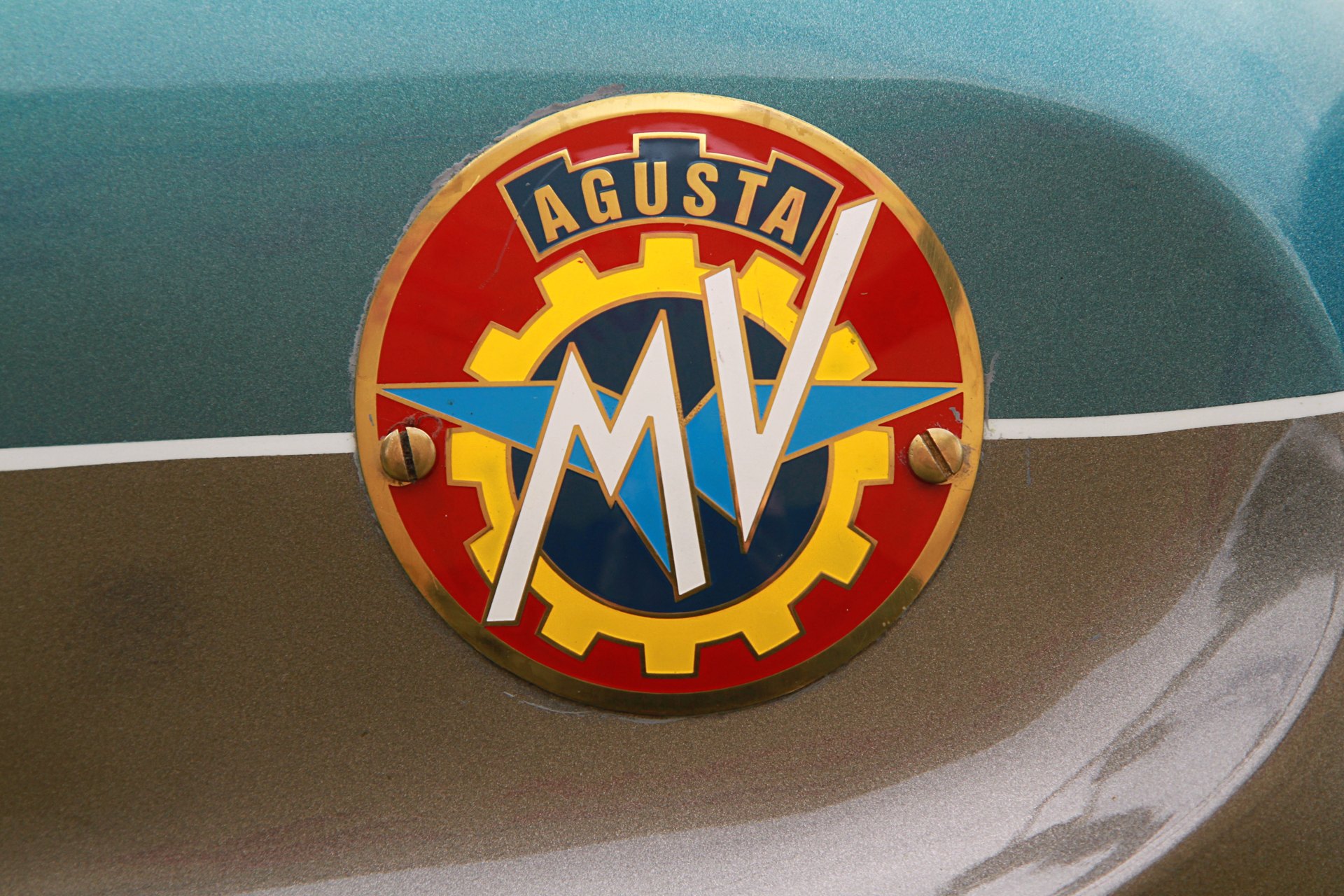
- Enamel badges. Some early-1960s road bikes, including 150s, carried a round enamel badge screwed to the tank. It puts the crest on a red field inside a brass rim, with a brighter yellow cog and the AGUSTA banner lettered in gold.
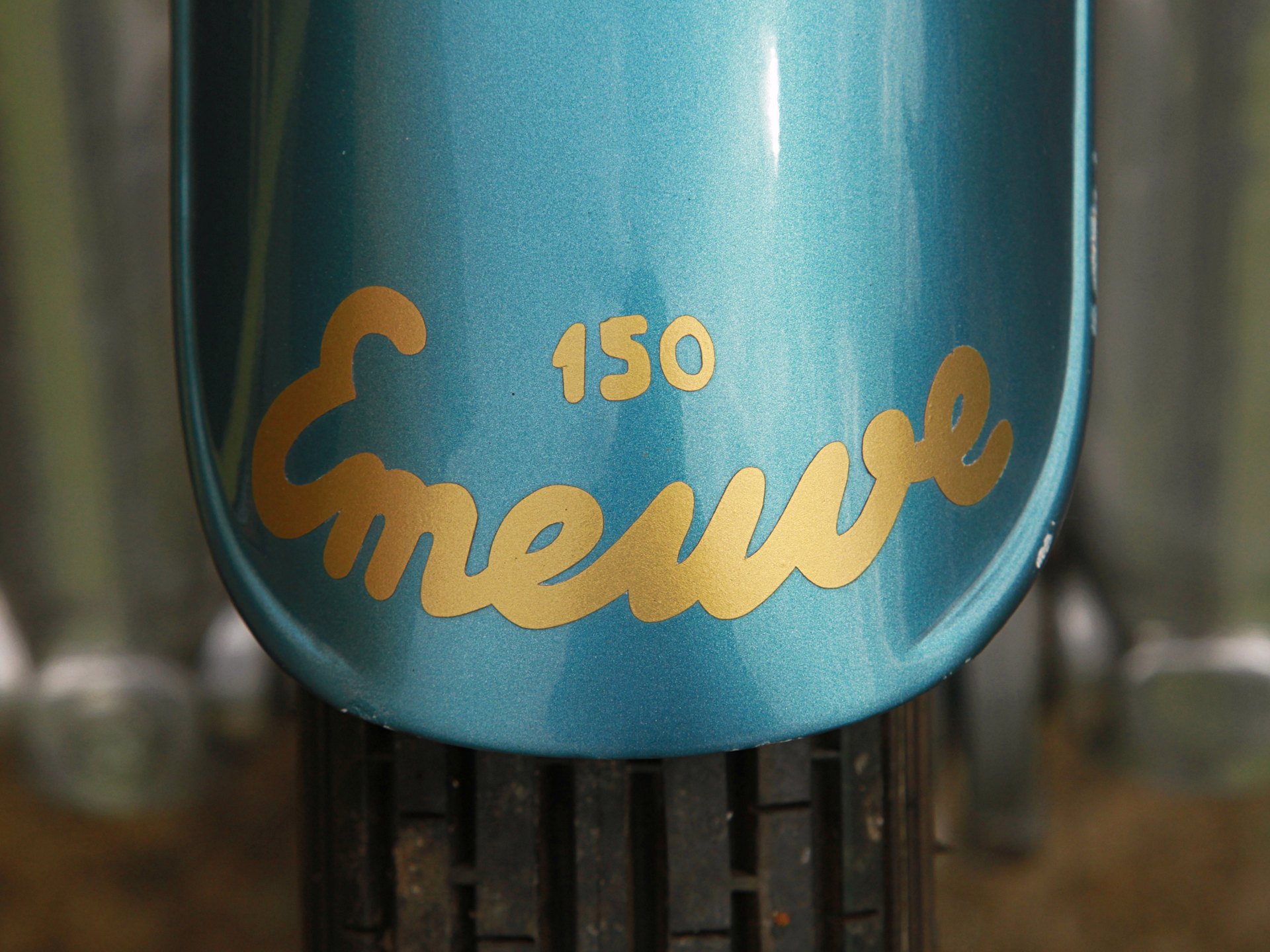
- "Emeuve". Some 1960s road bikes also spelt the name out. The front mudguard of the 150 shown below carries a gold script "Emeuve 150", yet another way of writing "MV" as it is said.
Colours. The badge has always been blue, gold and white. No source we found gives those colours a meaning, and the explanations on logo websites are invented. What MV Agusta has explained are the colours around the badge. In 2024 it said of its traditional red and silver livery: "the red symbolizes Italy's motorsport heritage, the silver pays homage to aviation, where wartime planes often left with their aluminum fuselages unpainted to save weight". That is a modern reading, not a period one, but it is the company's own.
Scooters. MV's 1950s scooters used their own emblems. The CGT, for example, has a winged "A" on its side panel. We have not found enough dated material on them to cover them here.

1950s–1976: The Racers and the Arrow Wordmark
Between 1952 and 1974 MV Agusta won 38 riders' and 37 manufacturers' world titles, by its own count, with riders including Carlo Ubbiali, John Surtees, Gary Hocking, Mike Hailwood, Giacomo Agostini and Phil Read. The red and silver racers were the most famous things the badge ever sat on.
On the racers. The 1951 four in the Milan museum shows that the works bikes carried the full crest on the tank from early on. Later racers kept it: photographs of the 500 four of 1964 show small crest transfers on the red tank and on each side of the fairing, and no lettering on the flanks.
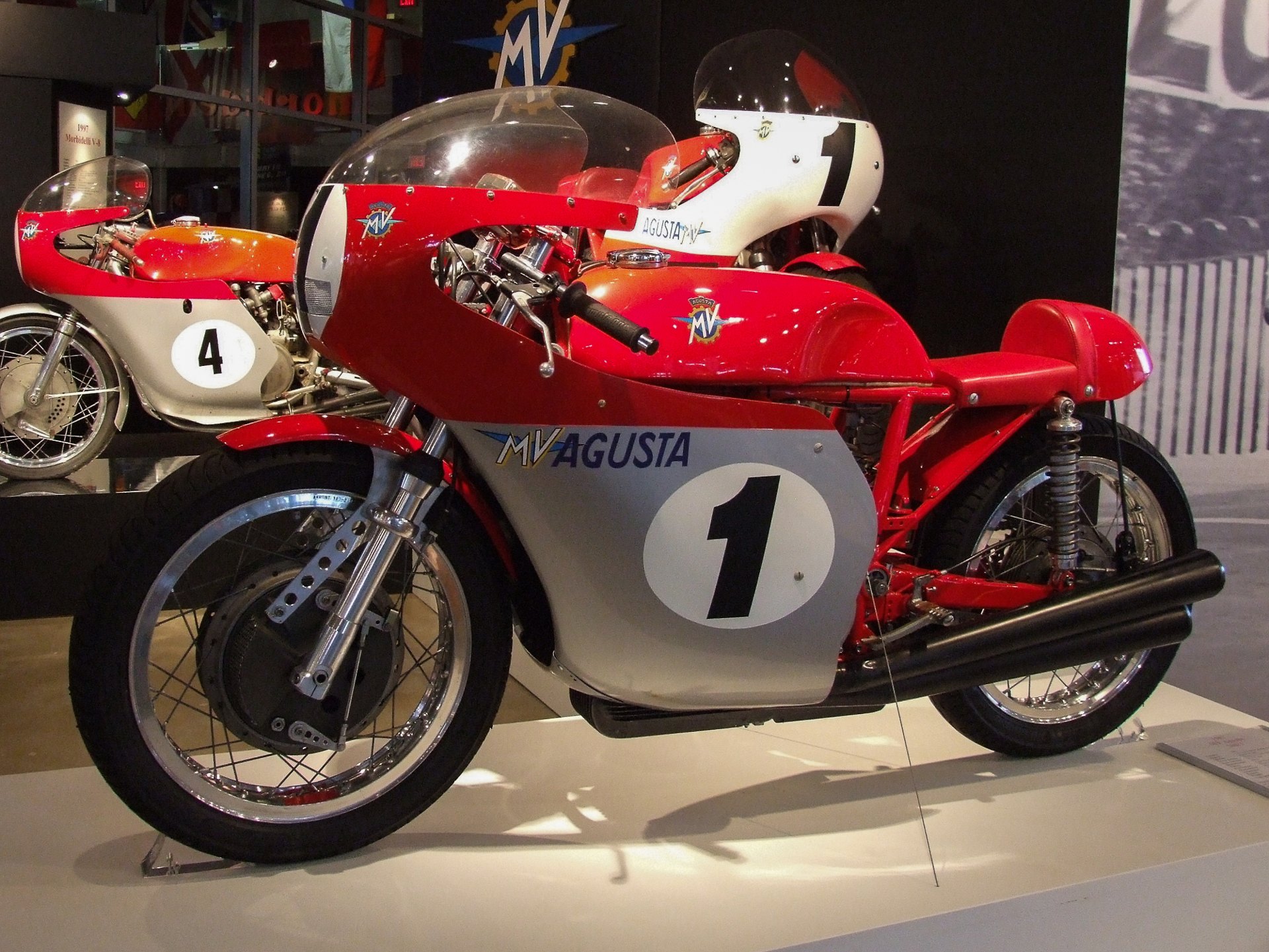
The arrow wordmark. By the late 1960s a second mark appeared: an italic "MV AGUSTA" wordmark. The MV is the crest's white italic pair, outlined in red and laid on a pale-blue arrow; AGUSTA follows in heavy blue italic capitals. The 500 triple of 1967 in the Barber museum carries it on the silver side of its fairing, next to its number. The retired workers' postcard dates this wordmark to 1970, and it is the version on the left.
It was also written the other way round. On several racers, and on some 750 S tanks, the word AGUSTA comes first and the MV on its arrow follows: "AGUSTA MV". We have not found a rule for which order was used where.
The last wins. Phil Read won MV's last world championship, the 500cc title, in 1974. Giacomo Agostini won MV's last Grand Prix, at the Nürburgring in 1976.
1967–1980: The Fours, the Chrome Badge and the End
Domenico Agusta died on 2 February 1971, and his brother Corrado took over. By then MV was already selling its first road-going four, the 600, which reached customers in 1967, and the 750 S followed at the start of the 1970s.
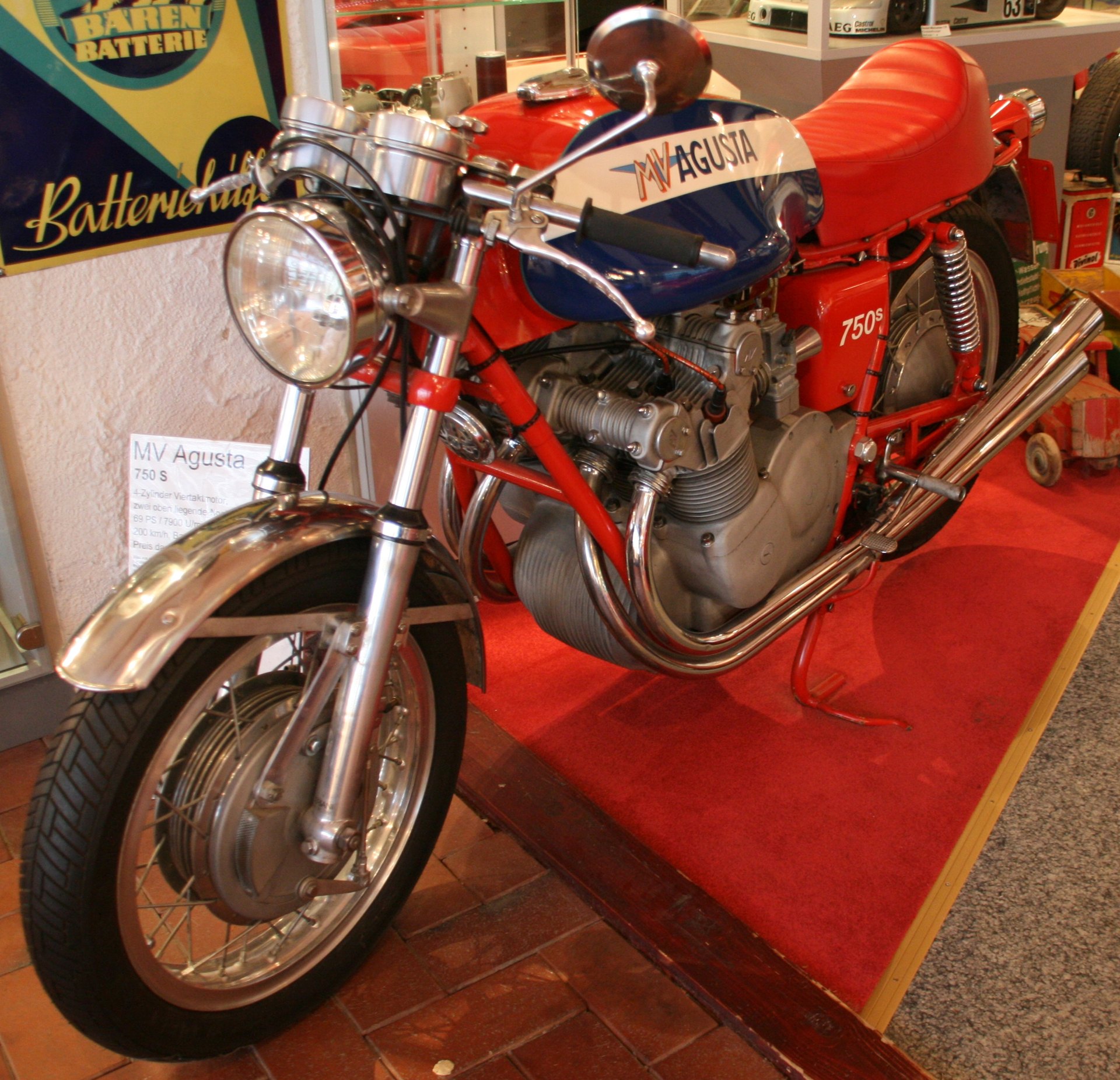
The 750 S. The 750 S carried the arrow wordmark on its tank. In the red, white and blue livery the MV AGUSTA (or AGUSTA MV) wordmark sits in the white band across the tank, with "750 S" on the side cover.
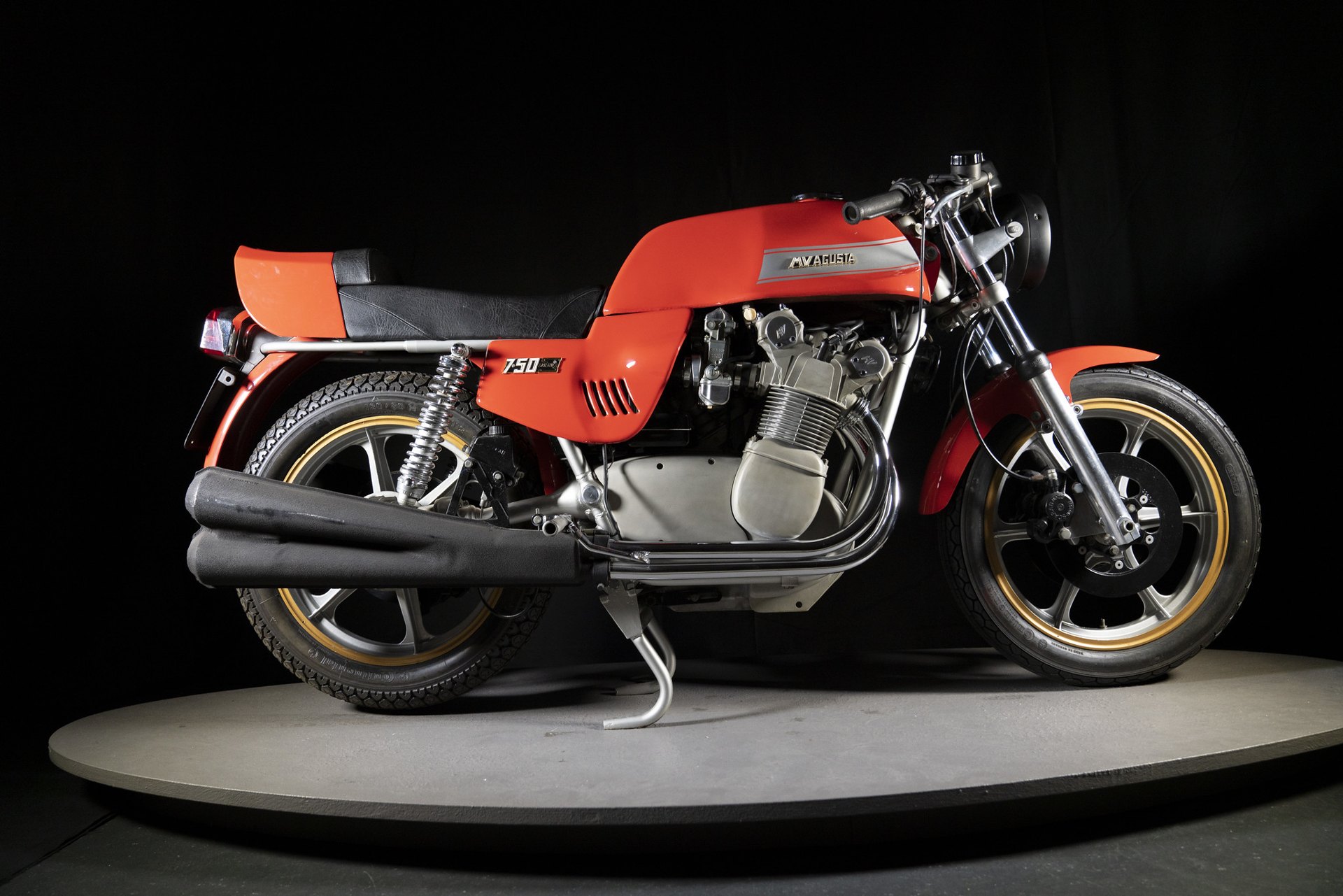
The 750 S America. In 1975 MV built the 750 S America for the US market, at the suggestion of its American importers. Its angular tank carried a new kind of badge: "MVAGUSTA" as one word, in raised, squared chrome capitals on a silver stripe. The retired workers' postcard dates this lettering to 1975. The America, and the 850 SS "Monza" and 800 "Super America" that followed, sometimes carried the chrome badge on the tank and the painted arrow wordmark on the fairing, as in photographs of the America below.
The end. In 1973 the family sold control of MV to EFIM, the Italian state holding company. In MV Agusta's own words, EFIM "in 1977 decided it was time for the motorcycle part of the business to take a break, after 37 World Championships titles and 260,000 bikes produced". The last machine built was a 125 Sport, in 1977. The stand at the Milan show that year was left empty, and dealers sold the remaining stock until about 1980.
1991–2009: Cagiva and the Crest Reborn
For more than a decade MV Agusta was only a name. In 1991–92 it was bought by Cagiva, the Varese company run by the brothers Claudio and Gianfranco Castiglioni, which already owned Ducati and Husqvarna. Sources disagree on the year: Cagiva's own Wikipedia history says 1991, and MV Agusta and the Italian sources say 1992. The likeliest explanation is a deal struck in 1991 and completed or announced in spring 1992. Cycle World was reporting "the purchase by Cagiva of the rights to use the MV Agusta name" by June 1992.
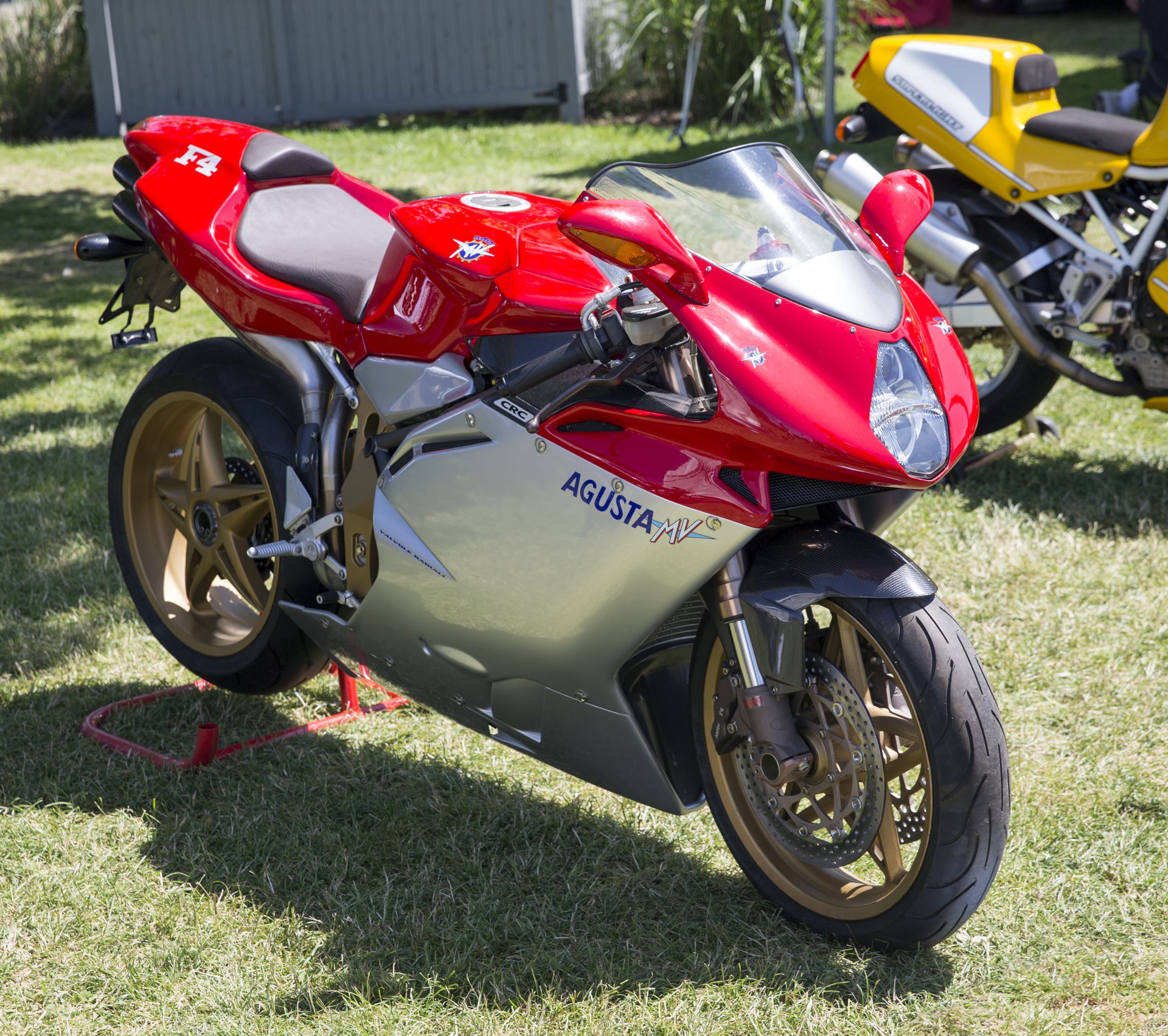
The crest on paper. The US trade mark register shows MV Agusta protecting the crest just as the new bike was unveiled. Two applications for the crest, in line drawings, were filed on 12 September and 10 October 1997. The first was registered in 2007 and the second in 2008; both are still live, and both are owned by MV Agusta Motor S.p.A.. They show the crest of the 1950s: banner, cog, arrow wings and italic MV. There is no evidence that it was redesigned for the revival.
The F4. The new MV was the F4 750 Serie Oro, designed by Massimo Tamburini at Cagiva's research centre in San Marino. It was unveiled at the Milan show in 1997, and production began in 1999. On the tank it wore the full-colour crest. On the silver lower fairing it wore the old racers' wordmark, in the AGUSTA MV order, with the MV on its pale-blue arrow and AGUSTA in dark blue. "Oro" means gold, and it was the magnesium parts that were anodised gold to match the name, not the badge.
A company named MV. By 1997 the Castiglionis' company was recorded as MV Agusta Motor S.p.A. in trade mark records, and in 1999 the group was reorganised with MV Agusta as its main brand. The name on the tank became the name of the company that built it.
Changes of owner. Over the following decade MV Agusta changed hands repeatedly. Malaysia's Proton bought a majority in December 2004 and sold it to the Italian finance company GEVI in 2005. Harley-Davidson agreed to buy MV Agusta in July 2008 and sold it back to the Castiglioni family in August 2010. The crest did not change.
2010–2024: The Modern Crest
Back under the Castiglionis from 2010, MV Agusta rebuilt its range around the three-cylinder F3, Brutale 675/800, Rivale, Turismo Veloce and Dragster, alongside the four-cylinder F4 and Brutale 1090. Mercedes-AMG bought 25% of the company in October 2014. From 2016–17 the Russian-born investor Timur Sardarov and his family's companies bought in, and by 2019 they controlled MV Agusta.
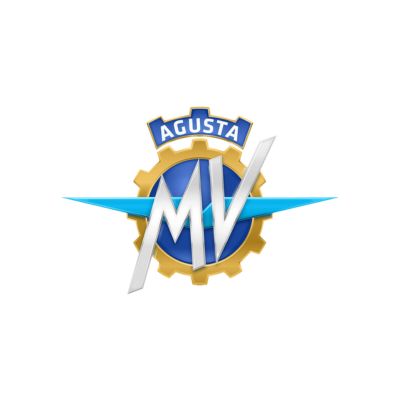
The crest goes glossy. Over this period a shaded, three-dimensional rendering of the crest became common: chrome-silver MV letters, a bright blue centre with a highlight, glassy arrow wings and a gold cog, usually with the tagline "Motorcycle Art". It is the version on the left. MV Agusta has never announced it as a new logo, and we found no designer or date for it. The claim on one logo website that "the new logo was performed in 2015" is unsourced. The flat crest has stayed in use alongside it, on the tank of a 2019 F3 for example.
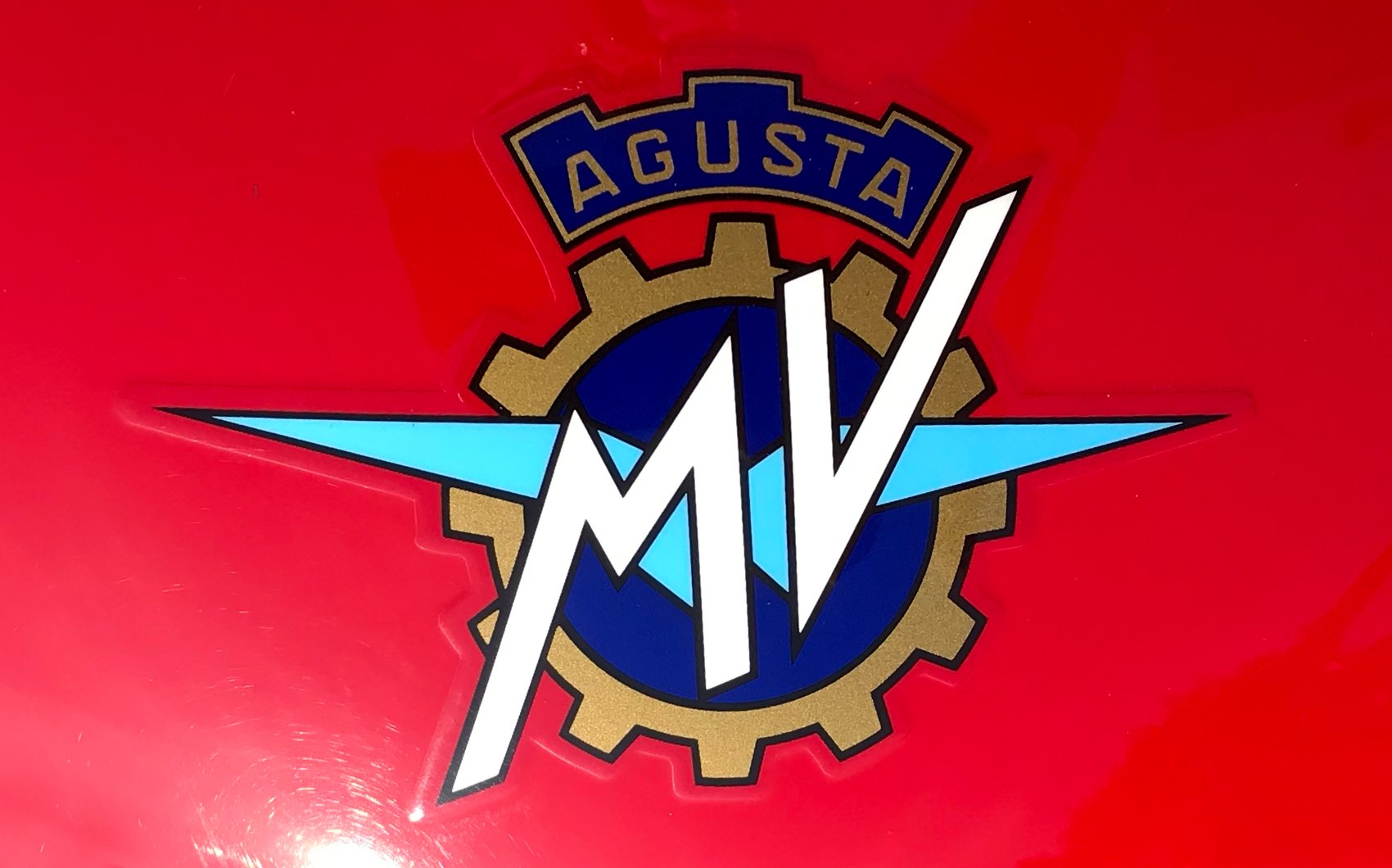
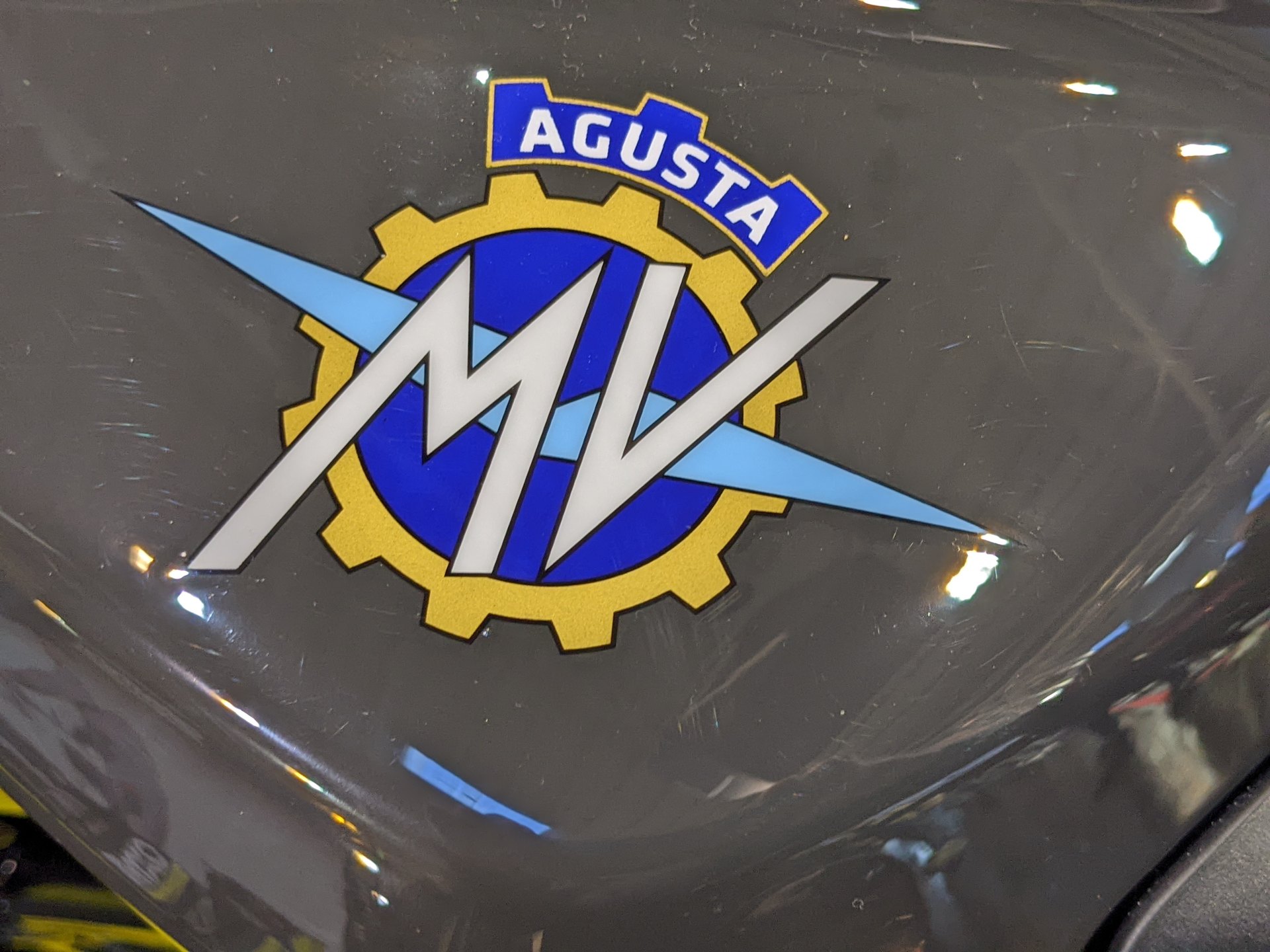
On the motorcycles the crest is still a decal, and its colours vary: bronze and navy on an F3 of 2019, and yellow-gold and bright blue on the Rush of 2023. Monochrome versions appear on some models.
Wordmarks and variants. MV also kept the racing wordmark alive. The Superveloce of 2018, designed by Adrian Morton as a tribute to the 1960s and 70s triples, spells MV on the pale-blue arrow beside its own name. In 2013 MV applied to register, in the US, a mark consisting of the italic MV between two pointed shapes, the arrow wings, with no cog or banner. It was registered in 2014 and is still live.
Words. Under the Sardarovs the company filed "MV AGUSTA ART OF MOBILITY" as a word mark in 2020. It is a slogan, not a logo.
2024–Present: KTM, Independence and the Ottantesimo Logo
KTM and back. Pierer Mobility, the owner of KTM, bought 25.1% of MV Agusta in November 2022 and raised it to 50.1% in March 2024. When Pierer ran into financial trouble later that year, it agreed on 31 January 2025 to sell its stake back to the Sardarov family's Art of Mobility S.A.. In early July 2025 MV Agusta announced "the successful closing of the transaction that returns 100% ownership of the company to Art of Mobility". The logo was unaffected.
The Ottantesimo logo. For its 80th anniversary, MV Agusta did something new. On 4 November 2024 it unveiled the Ottantesimo ("eightieth") collection: six models, the Brutale 1000, Brutale 1000 RR, Brutale RR, Dragster RR, F3 RR and Superveloce S, each limited to 500 examples. Announcing the collection, MV said that its Centro Stile "has redesigned the historic logo, which replaces the traditional MV Agusta logo on all the motorcycles in the Ottantesimo Collection. The new logo draws from the past".
It does. The Ottantesimo logo goes back to the first badge of 1945, not the crest. As photographed on the bikes, it is a flat, gold line drawing of the rounded MV monogram inside a ring, with cog teeth around part of the rim. There are no wings, no arrows and no AGUSTA banner. MV calls it the Heritage logo, and it appears in gold on the collection's special paint schemes. It is the first new emblem MV Agusta has designed since the crest appeared in the late 1940s. It is a limited-edition emblem; the crest remains MV Agusta's logo.
Where things stand. In September 2026 MV Agusta said it was using Italy's negotiated crisis settlement procedure (composizione negoziata della crisi), a voluntary, out-of-court restructuring process, and that Art of Mobility still owned 100% of the company. None of this has changed the badge.
Lettering and Colour
Two different MVs. MV Agusta has used two quite different sets of letters. The 1945 badge and the 2024 Ottantesimo logo use a rounded monogram, with the M and V curling into one another inside a circle. The crest and the wordmarks use sharp italic capitals, each letter drawn as a pair of thin, pointed strokes. If the MV is round, the badge is either very early or very recent.
The arrow. The pale-blue shape through the crest began as a feathered wing and became a flat, pointed arrow. The same arrow carries the MV in the 1970s wordmark and on the Superveloce.
AGUSTA in capitals. Every version of the name AGUSTA, from the 1940s banner to the chrome badge of 1975, is in capitals. The banner's shape, flat along the bottom and scalloped along the top, is what one US trade mark registration called a "stylised crown".
Colours. The crest has always used blue, gold and white, but the shades vary widely: navy or royal blue, bronze, brass or yellow gold, sometimes on a red field. There is no official palette that we could find, and no documented meaning for any of the colours in the badge. MV's own explanation is for its red and silver paint: red for Italian racing, silver for aircraft.
How to Date an MV Agusta by Its Logo
This is a first check, not a verdict. MV Agusta transfers are easy to reproduce, most surviving classic MVs have been restored, and many were repainted with whatever badges were available. Always check frame and engine numbers.
| Period | Logo or badge | Typical models |
|---|---|---|
| 1945–c.1950 | Winged cog: feathered wing, cog, round MV monogram | MV 98, early 125 |
| c.1947–1960s | Crest as a tank transfer: AGUSTA banner, gold cog, arrow wings, italic MV | 125 TEL, Pullman, 175 CS, Raid, works racers |
| Early 1960s | Crest on a round enamel badge, red field; "Emeuve" script on some mudguards | 150s and other small road bikes |
| Late 1960s–1976 | Crest on the tank, "MV AGUSTA" or "AGUSTA MV" arrow wordmark on fairings | 350 and 500 triples and fours |
| 1970–1975 | Arrow wordmark on the tank | 750 S |
| 1975–1980 | Chrome "MVAGUSTA" raised-letter badge; arrow wordmark on the fairing | 750 S America, 850 SS Monza, 800 Super America |
| 1999–2000s | Crest decal on the tank; "AGUSTA MV" on the fairing | F4 750 Serie Oro, F4, early Brutale |
| 2010s–present | Crest in flat or shaded colours; monochrome variants | F3, Brutale, Rivale, Dragster, Turismo Veloce, Superveloce, Rush |
| 2025 | Gold "Heritage" MV monogram in a cog, no wings | Ottantesimo collection |
Red flags:
- A chrome "MVAGUSTA" badge on anything before 1975.
- The arrow wordmark on a 1950s road bike.
- A winged cog on a 1960s machine: it may be a restorer's choice.
- The gold Heritage monogram on a bike that is not one of the numbered Ottantesimo models.
For current prices by model, see our MV Agusta valuations.
What the Logo Stories Get Wrong
| Claim | The evidence |
|---|---|
| "The wings were added to the badge in 1947." | The first badge of 1945 already had a wing. What changed around 1947 was the shape: the feathered wing became an arrow, and the AGUSTA banner was added. |
| "The original 1945 logo was a gear with MV in a circle, and aviation wings were added later." | Same error. MV Agusta's own description of the first logo includes the wings. |
| "The badge has never changed." | It has changed twice in substance: from the winged cog to the crest in the late 1940s, and to the Ottantesimo monogram on the 2025 anniversary models. The wordmarks of the 1970s were added alongside it. |
| "The crest comes from the Agusta family coat of arms." | We found no source for this. A US trade mark registration described the banner as a "stylised crown", which describes its shape only. |
| "The wings honour Agusta's aircraft." | Plausible, but MV Agusta describes them as wings "spread by the force of wind generated by the motorcycle's speed". |
| "MV Agusta introduced a new logo in 2015." | We found no announcement or record of a 2015 redesign. The shaded crest spread gradually in the 2010s. |
| "The MV Agusta logo has a heraldic eagle." | No MV Agusta badge has ever had an eagle. |
| "Meccanica Verghera Augusta." | The family and company name is Agusta, without a "u". |
| "The first bike was called Vespa, until Piaggio registered the name." | The name had been registered in the 1930s by Miller-Balsamo and passed to Piaggio. The first MV 98s delivered still carried a Vespa nameplate, which was removed after pressure from Piaggio. |
MV Agusta Logo Timeline
Count Giovanni Agusta founds Costruzioni Aeronautiche Giovanni Agusta at Samarate.
Meccanica Verghera is registered on 19 January. The MV 98 is shown with a winged cog badge.
The crest appears: AGUSTA banner, gold cog, arrow wings and italic MV.
The 500 four works racer carries the crest on both sides of its tank.
MV Agusta wins 38 riders' and 37 manufacturers' world titles, with the crest on the tank.
Round enamel crest badges on red appear on some road bikes.
The italic "MV AGUSTA" arrow wordmark appears on the racers and then on the 750 S.
The 750 S America introduces the chrome "MVAGUSTA" badge.
Production ends. The last stock is sold by about 1980.
Cagiva buys the MV Agusta name.
The crest is filed in the US and returns on the F4 750 Serie Oro.
A shaded, three-dimensional rendering of the crest spreads.
The Ottantesimo collection brings a gold Heritage monogram based on the 1945 badge.
MV Agusta returns to full ownership by Art of Mobility.
MV Agusta Logo FAQ
What does MV stand for in MV Agusta?
Meccanica Verghera: "Verghera mechanics", after the hamlet near Samarate, north-west of Milan, where the first motorcycles were built. Agusta is the family name of the company's founders.
What do the cog and the wings in the MV Agusta logo mean?
According to MV Agusta, the gearwheel symbolises "the company's dedication to mechanics", and the wings are "seemingly spread by the force of wind generated by the motorcycle's speed". A link to the Agusta aircraft business is often suggested, but the company does not make it.
Who designed the MV Agusta logo?
No source we found names the designer of the 1945 badge or of the crest. The 2024 Ottantesimo logo was redrawn by MV Agusta's in-house design centre, the Centro Stile.
When was the MV Agusta crest introduced?
A 2005 anniversary postcard published by retired Agusta workers dates it to 1947. The earliest securely dated example we found is on a 1951 works racer in Milan's science museum.
Has the MV Agusta logo changed?
The crest has been in use, with changes of shade and rendering, since the late 1940s. Before it came the winged cog of 1945. The 1970s added italic and chrome wordmarks, and the 2025 Ottantesimo models replaced the crest with a gold monogram based on the 1945 badge.
Why is the MV Agusta logo blue and gold?
No documented reason exists. MV Agusta has explained only its red and silver paint: red for Italian racing and silver for unpainted wartime aircraft.
Sources
- MV Agusta, History; MV Agusta celebrates its 80th anniversary (founding date, red and silver, the Ottantesimo logo); Ottantesimo collection (the first logo, "EMMEVI", the Heritage logo); Superveloce 98: a tale to tell; MV Agusta back to running on its own
- Luciano Salari, MV Agusta philatelic study, Il Postalista, reproducing the 2005 "60° Fondazione Meccanica Verghera" postcard and postmark by the Gruppo Lavoratori Seniores Agusta – MV
- Lombardia Beni Culturali, catalogue records for the Museo Nazionale della Scienza e della Tecnologia: MV Agusta 500 4 cilindri, 1951 and MV Agusta 125 Bialbero, c.1957
- Jim Scaysbrook, MV Agusta 98, Old Bike Mag
- Wikipedia: MV Agusta (English) and MV Agusta (Italian); Cagiva; MV Agusta F4 series; MV Agusta Superveloce
- Cycle World, The return of MV Agusta, June 1992
- ANSA, Daimler buys 25% of MV Agusta, 31 October 2014
- Pierer Mobility, ad hoc notices on the majority stake in MV Agusta, 15 March 2024, and the sale of shares in MV Agusta, 31 January 2025; Cycle News, MV Agusta returns to full independence, July 2025; RideApart, MV Agusta is officially an independent motorcycle company again
- GPOne, MV Agusta fa chiarezza, 18 September 2026
- MCNews, MV Agusta Ottantesimo Collection introduces new MV logo, 5 November 2024; Moto.it, Le MV Agusta che celebrano gli 80 anni del marchio
- USPTO trade mark records: serials 75355732 (Reg. 3,360,095), 75371378 (Reg. 3,527,860), 79040794 (Reg. 3,708,758), 79126242 (Reg. 4,535,199) and 79291537 (Reg. 6,937,973)
- Canadian Intellectual Property Office, CAGIVA trade mark TMA322666 (owner history, including MV Agusta Motor S.p.A. in 1997)
Read the full history of MV Agusta, browse MV Agusta models and values, or compare with the badge stories of fellow Italian marques Ducati and Moto Guzzi.