
In 1949 almost everyone in motorcycle racing believed that the new 125cc world championship class belonged to the two-stroke. Small engines, the reasoning went, needed the two-stroke's power stroke on every revolution. Then a family firm from Milan that had spent the 1930s making three-wheeled delivery trucks turned up with a jewel-like twin-cam four-stroke single, and won every championship race it entered for three years.
That family firm was FB Mondial. Between 1949 and 1957 it won five riders' world titles and five constructors' titles, 18 Grands Prix, the Milano–Taranto and the Motogiro. Then, at the height of its success, it withdrew. What followed was two decades of decline, a closure, a Honda-powered superbike that ended in a courtroom, and a revival that has put the name on a new generation of small and middleweight motorcycles.
This is the full story, built from Italian and English primary and specialist sources: the Italian motorcycling federation (FMI), Bologna's city archive, the owners' register founded by the Boselli family, Honda's own heritage records, period race results and court reporting. It also corrects the errors that circulate in almost every short account of Mondial, including several that appeared on earlier versions of this page. Where sources genuinely disagree, we say so. For the story of the badge itself, see our FB Mondial logo history.
Fratelli Boselli: Milan and Bologna, 1929–1945
FB stands for Fratelli Boselli, the Boselli brothers. The family were landowners from the province of Piacenza, originally from Ancarano near Rivergaro, and Italian sources name five siblings: Carlo, Luigi, Ettore, Giuseppe and their sister Ada. (English Wikipedia, and auction catalogues that copy it, make Giuseppe the father of the others. Every Italian source makes him a brother. Other accounts speak of "four brothers" or even "two founding brothers"; the five-sibling version is the Italian consensus.)
The driving force was Giuseppe Boselli, a competition rider and part-owner of the Bologna motorcycle maker G.D. The family business began in Milan in 1929 as a shop and workshop that sold and serviced G.D. and C.M. motorcycles, nicknamed by the family in Milanese dialect el negusiet, "the little shop".
From the mid-1930s the Bosellis built motocarri, three-wheeled goods vehicles, with engines of 250 to 600cc. The FMI's account is precise about the arrangement: offices and warehouse in Milan, manufacture in Bologna, at the works of the engine builder Oreste Drusiani, Via Milazzo 32. A 1936 brochure headed "MotoTrasporti F.B., F.lli Boselli, Milano" survives. (A few sources date the company's founding to 1936, which is probably the brochure's date. The 1929 date refers to the shop, the mid-1930s to the motocarri.)
The Drusiani connection shaped everything that followed. Oreste Drusiani died suddenly, G.D. closed, and his works passed to his children Giannina and Alfonso Drusiani, working with Mario Cavedagni of C.M. Alfonso (1905–1969) was a gifted engine designer.
The war stopped the business twice over. Plans for small motorcycles of up to 250cc were shelved, and on 24 July 1943 an Allied raid on Bologna's railway station destroyed the Via Milazzo works. (Italian sources say the machinery had already been moved after an earlier raid; English sources say what survived was requisitioned. Both may be partly true.) After the war the Bosellis financed the business's move to Milan and took control of it.
The Twin-Cam 125 (1947–1948)
The machine that made Mondial began in Bologna, not Milan. According to the FMI, Alfonso Drusiani designed a 125cc twin-cam racing single at the Drusiani works, with Marcello Laurenti and Nerio Biavati, and Giuseppe Boselli "hurried to buy it, together with the design". Other accounts say Boselli commissioned it; the FMI's version, that Drusiani built it first and Boselli bought it, is supported by several independent sources.
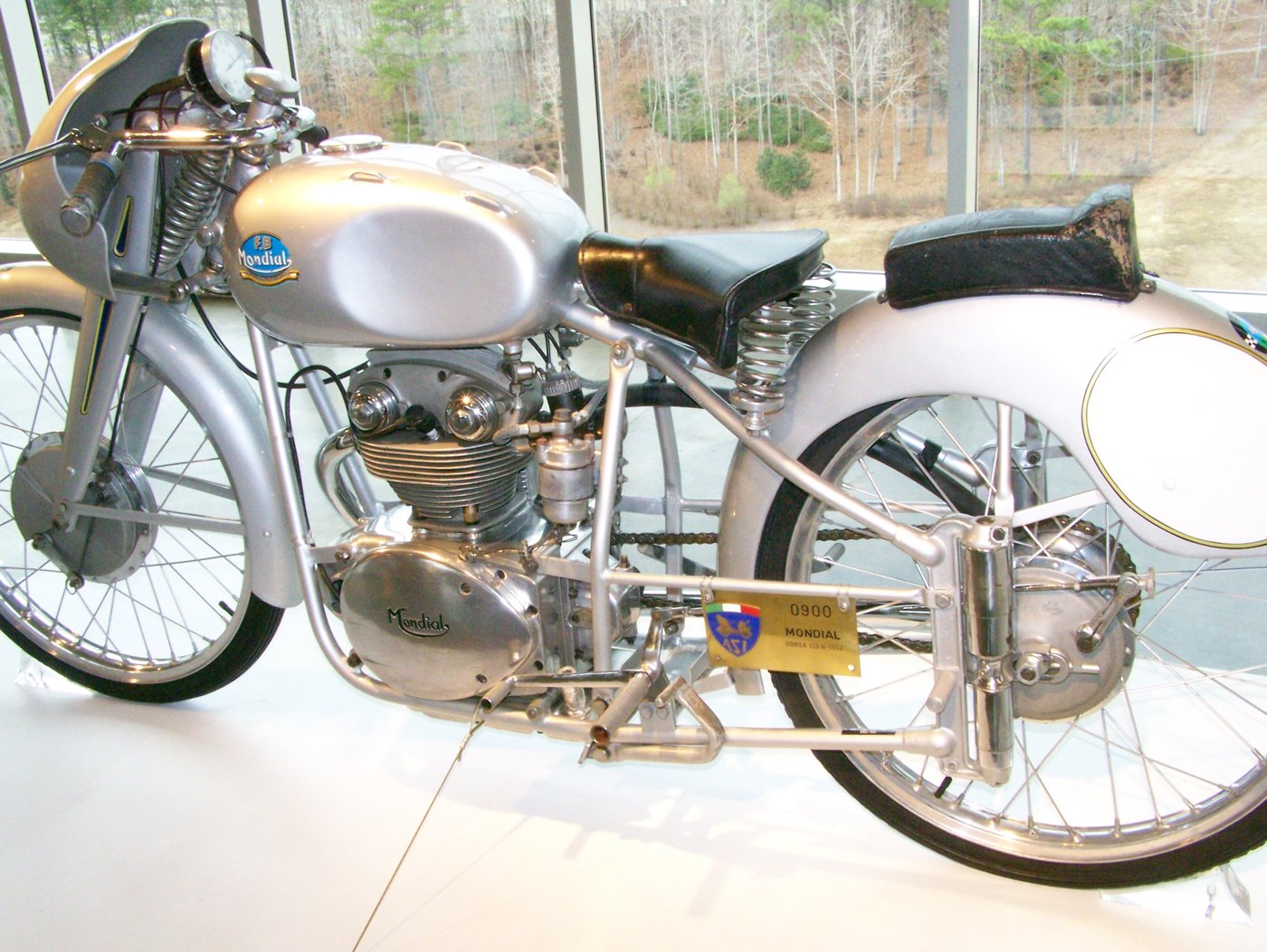
It was a remarkable engine for its size:
- a single cylinder of 53 × 56.4 mm (about 123.5cc), in alloy with a cast-iron liner;
- double overhead camshafts, driven by a vertical shaft and bevel gears and then a train of gears across the head;
- a one-piece "tunnel" crankcase with an outside flywheel, dry-sump lubrication and a four-speed gearbox;
- about 10 hp at 8,000 rpm in its 1948 form, rising to around 15 hp by 1952 and 18 hp by 1957.
Honda, which later measured one, recorded 16.5 PS from a 1956 example.
It is often called "the first four-stroke 125", which is not right: Ducati's Cucciolo and Gilera's 125 were already four-strokes. What the Mondial did was more important. The FMI puts it well: in 1949 everyone expected the two-strokes of Morini, MV, Montesa and Puch to rule the 125 class, and the Mondial proved the four-stroke superior, pushing its rivals to change course.
The racer made its debut at the Gran Premio delle Nazioni at Faenza on 12 September 1948, "with the F.B. Mondial mark on the tank", according to the FMI. Francesco Lama led and set the fastest lap before retiring. Its first win came at Monza on 24 October 1948, ridden by Nello Pagani. (Several accounts say the Mondial won "the 1948 Nations GP at Monza". The 1948 Nations GP was at Faenza, and the Mondial retired.) In October 1948 a rider named Cavanna set four 125cc world records over the standing and flying kilometre and mile; the rider's first name is given variously as Luigi, Gino and Giovanni.
Why "Mondial"? It is the French word for "worldwide". No source from the period explains the choice, and the popular story that it commemorates the 1948 world records is not supported by any source we have found.
Three Titles in Three Years (1949–1951)
The 125cc class was part of the first motorcycle world championship in 1949, and Mondial dominated it. Its 125s won every counted championship race from 1949 to 1951, ten out of ten.
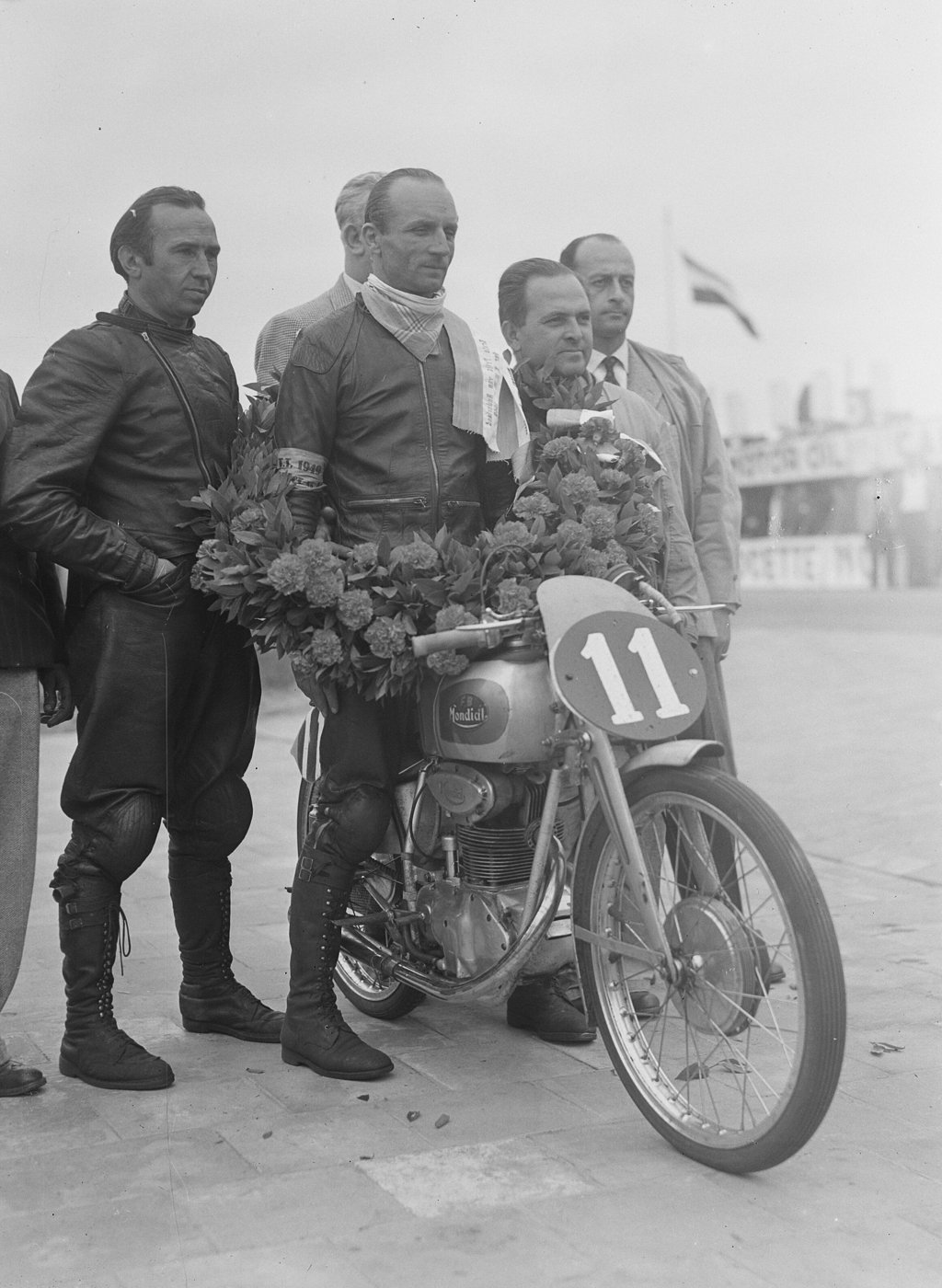
1949: Nello Pagani. Pagani won the 125 races at Bremgarten (3 July) and Assen (9 July), and his teammate Gianni Leoni won at Monza. Pagani took the first 125cc world title, and Mondial the constructors' title. On the same afternoon as his Assen 125 win, Pagani also won the 500cc race on a Gilera, and he finished the 500 championship one point behind Les Graham. Mondial's other riders that year included Umberto Braga and Leoni, with four more Mondials in the championship top ten.
1950: Bruno Ruffo. Ruffo won at Assen, Carlo Ubbiali at Clady in Ulster and Gianni Leoni at Monza, and Ruffo took the title. He was under contract to Moto Guzzi, which let him ride a Mondial in a class Guzzi was not contesting. (He is sometimes described as Mondial's 250 champion; his 1949 and 1951 250 titles were won on Guzzis.)
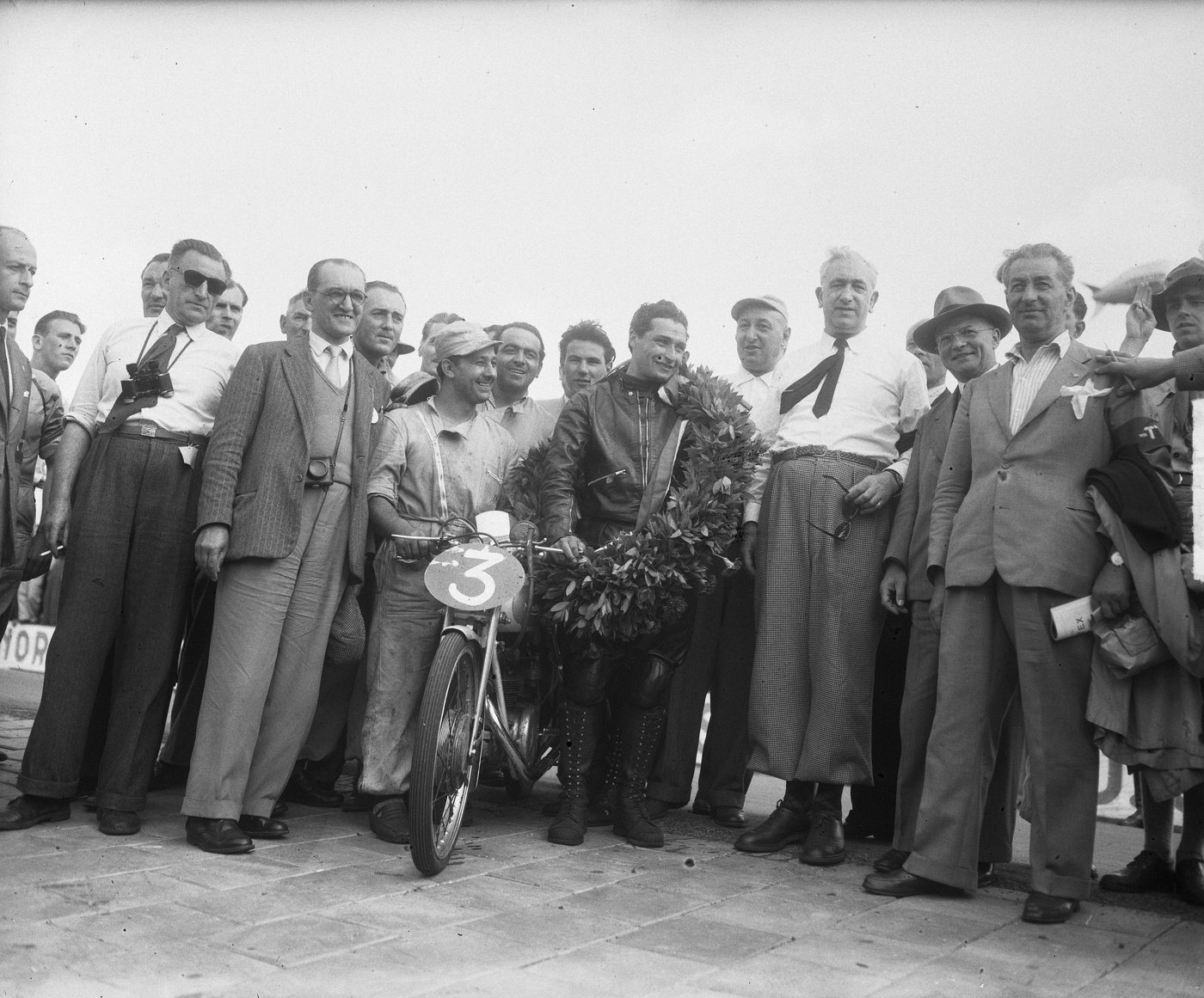
1951: Carlo Ubbiali. Guido Leoni won the opening round at Montjuïc. At the first 125cc Isle of Man TT, Cromie McCandless won and Mondials took the first four places. Gianni Leoni won at Assen and Ubbiali at Monza, and Ubbiali took the title with 20 points. It was the only one of his nine world championships won on a Mondial; the other eight came with MV Agusta. (Mondial's own website says Ubbiali won "for a third consecutive year". It was Mondial's third consecutive title, and Ubbiali's first.)
The season also brought tragedy: Gianni Leoni was killed at the Ulster Grand Prix after colliding with his teammate Sante Geminiani. Guido and Gianni Leoni, despite the shared surname, were not related.
A Company Without a Factory: The Road Bikes
Mondial's championships came from a company that could barely build motorcycles. The FMI notes that Mondial had no factory capable of series production. Engines were contracted out, first to ORAM and Aerocaproni of Trento and later to Rocca and Michelini of Bologna, and machines were assembled in a rented building on Via San Giusto in Milan. The popular idea that Mondial built its bikes almost entirely by hand is true in spirit, but it was because of how small and dispersed the operation was, not a deliberate boutique strategy.
The first road 125 (1949–53). Demand after the 1949 title was such that Mondial put a road 125 on sale. It was a pushrod single, not a twin-cam, in Turismo, Sport and Super Sport versions of about 6 to 8 hp, with girder forks and plunger rear suspension. The Registro Internazionale FB Mondial, the family's owners' register, estimates that "probably just under 2,000" were built up to 1953. That is the only hard production figure for the period; the "1,000 to 2,000 a year" often quoted online has no source.
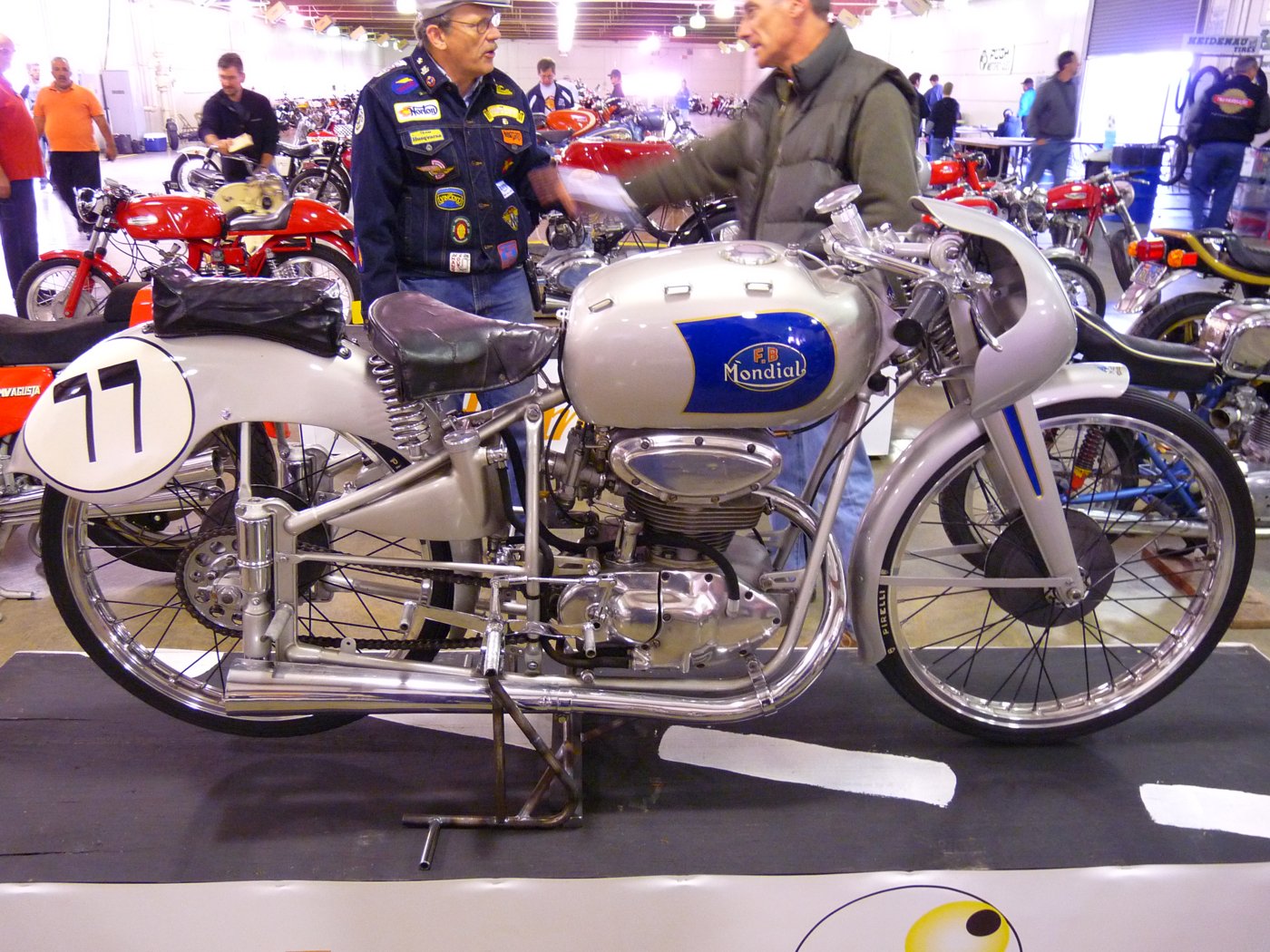
The 125 Monoalbero (1952–54). Shown at the Milan show in January 1952, this was a production racer with a single overhead camshaft driven by gears: 14 hp at 11,000 rpm, 97 kg and 140 km/h. About 100 were made. At the first Motogiro d'Italia in 1953, Mondials won all six stages.
The two-strokes and the Sogno. In 1952 Mondial added a 160cc two-stroke, its engine bought from FBM (Fabbrica Bolognese Motori, Vittorio Minarelli's company). The Sogno ("dream"), a small-wheeled machine that sat between scooter and motorcycle, used the 160 engine; it was shown in 1953 and built in numbers from 1954.
The 200 (1951–58). Presented at the 1951 Geneva show, the 200 four-stroke came as the Lusso, Sport and Extra Lusso, probably the most built. A 200 Super Sport tuned by Giuseppe Carrù, bored out to 253cc for the bigger class, carried Emilio Ostorero to the Italian 250cc motocross title in 1956 and both the 250 and 500 titles in 1957.
The 175s. In December 1954 Mondial launched the 175 TV and Sport, overhead-camshaft singles designed by Pietro Prampolini. A 175 had already made headlines: in 1954 Remo Venturi won the Milano–Taranto outright on one, ahead of two more Mondial 175s, beating machines of up to 500cc. The pushrod 175 Super Turismo, built by Michelini, followed in 1957, and a gold-trimmed Serie Oro range in 1960. Production ended in 1961, after Michelini's early death.
The small bikes. The 49cc Mondialino, with a two-speed gearbox, appeared in 1954. The pushrod 125 Champion of 1955–56 became, according to both the company and the Registro, Mondial's best-selling model. The 75cc Scugnizzo two-stroke followed, with a few 88s and about a thousand 98s, and in the early 1960s the Nova 125, of which only a few hundred were built.

The Wilderness Years and Fabio Taglioni (1952–1956)
A press release dated 26 March 1952 announced that F.B. Mondial would stop racing officially to concentrate on series production. Ubbiali still finished second in the 1952 125 championship on a Mondial, then left for MV Agusta, and for five seasons Mondial won almost nothing at world level.
The exception was one of the oddest wins in Grand Prix history. At the 1954 Spanish Grand Prix in Barcelona, Tarquinio Provini found the works twin-cam unsuited to the circuit in practice and raced a production 125 Monoalbero, brought along for the local dealer. He won. Italian Wikipedia calls it the only world championship Grand Prix it knows of won by a series-production motorcycle. The same year, Provini won the Motogiro d'Italia.
Two engineers passed through in these years. Alfonso Drusiani left around 1952 to found his own company, B.D.B. Brevetti Drusiani, maker of the Moto Comet, before returning to design the 1957 engines. And in 1953 Giuseppe Boselli hired a young engineer named Fabio Taglioni, who worked on the 125 and 175 overhead-cam racers, including the 175 "Bilancerino" with its exposed valve springs, before leaving for Ducati in May 1954. (See our musing on Fabio Taglioni and the Ducati desmo.)
Did Mondial build a desmodromic engine? Yes, but not the way it is usually told. The Registro records that "in 1956–57 a twin-cam 175 with desmodromic valve gear made a sporadic appearance, but was never used in a race", and Moto.it describes a 1955–56 prototype that gave no gain over conventional springs. It was not the first desmodromic motorcycle engine: Azzariti built desmo engines in the 1930s, and Ducati raced its desmo 125 in 1956.
Did Mondial pioneer the disc brake? No. Douglas used disc brakes on racing motorcycles in the early 1920s, and we have found no evidence of a disc brake on a Grand Prix Mondial. The claim probably grew from something real but much smaller: Mondial's 50cc Record, shown at the 1965 Milan show, had a mechanical front disc, a genuine novelty on a sporting 50.
1957: The Double
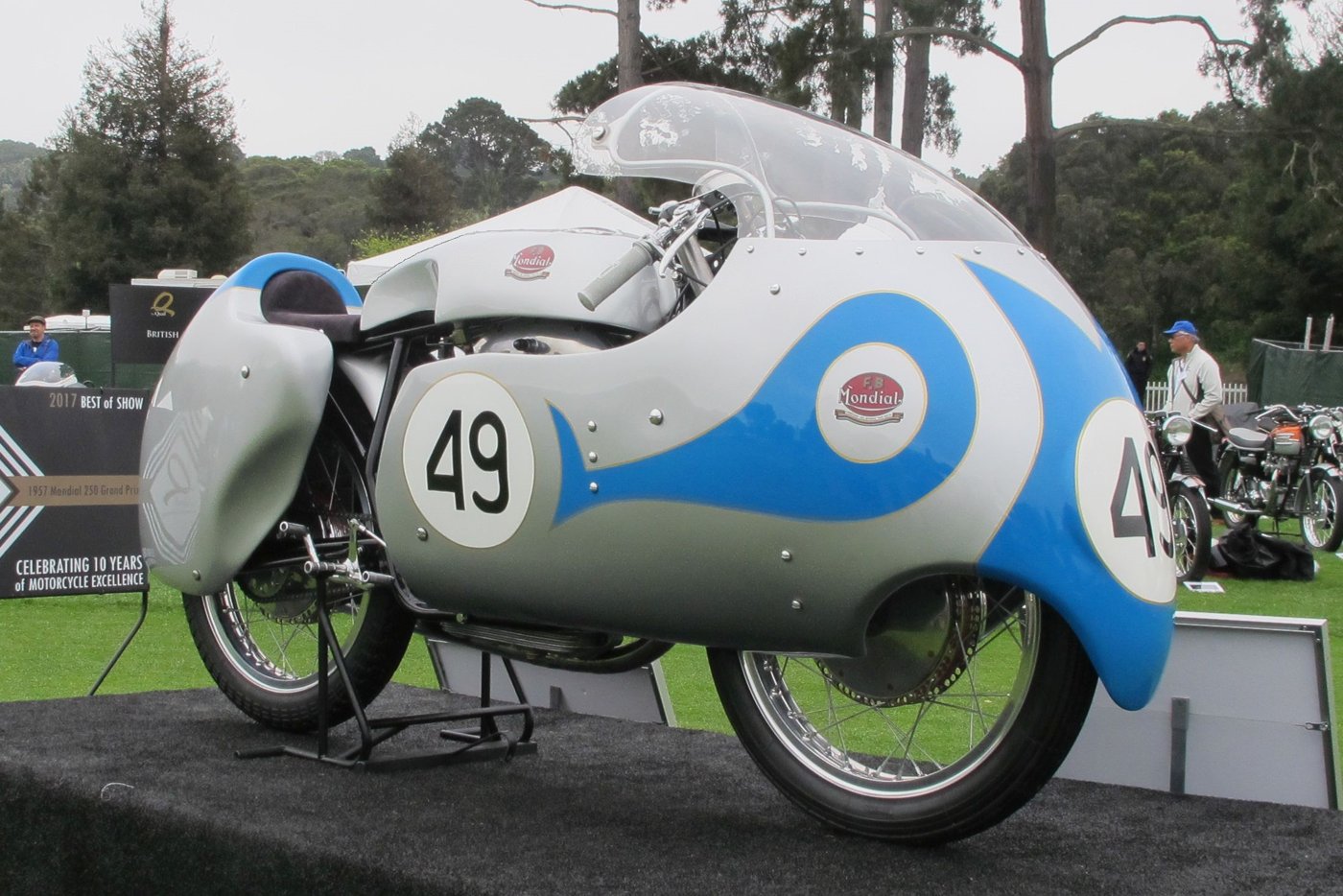
For 1957 Mondial came back in force. Drusiani designed new twin-cam engines, developed with Lino Tonti, who had joined in 1956. The 250 grew out of the 175 by stages (a 250 twin built from two 125s had proved too heavy) and ended as a single of 75 × 56.4 mm. In the words of Alan Cathcart, who later tested one, it made about 29 bhp at 10,800 rpm with twin plugs and a 32 mm Dell'Orto, weighed around 100 kg, and wore an Elektron "dustbin" fairing.
The riders were Tarquinio Provini, the Northern Irishman Sammy Miller, and the Englishman Cecil Sandford, who had been MV Agusta's first world champion in 1952.
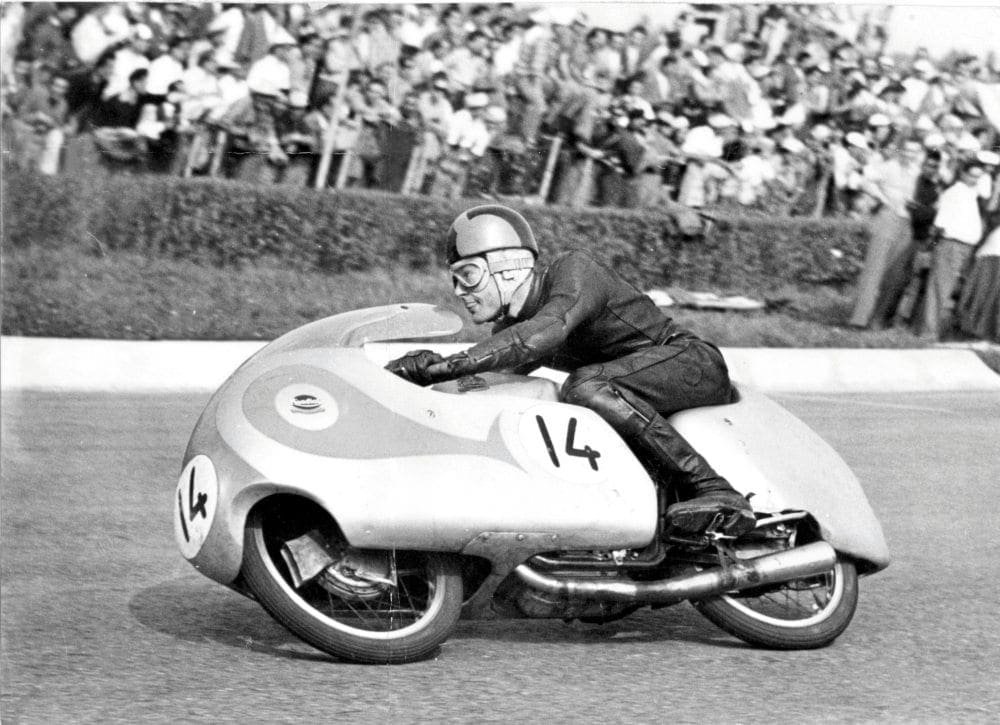
- 125cc: Provini won at the Isle of Man TT, Assen and Spa, and took the title. Mondial and MV finished level on constructors' points, and Mondial took that title too on aggregate race times.
- 250cc: Sandford won at the TT and in Ulster; Provini won at Assen and Monza. Sandford was champion, Provini second and Miller third, a clean sweep of the podium. (Miller had been leading the 250 TT on the last lap when he crashed at Governor's Bridge; he pushed in fifth.)
That made five riders' and five constructors' titles in all: the 125 in 1949, 1950, 1951 and 1957, and the 250 in 1957. This is the "10 volte campione del mondo", "ten times world champion", that Mondial has printed on its badges ever since. It is sometimes read as ten riders' championships; it is five and five.
The Withdrawal
At the end of the 1957 season, Mondial, Gilera and Moto Guzzi jointly announced that they would stop racing "from 1958". MV Agusta initially agreed, then changed its mind, and went on to dominate the next decade.
The joint statement, quoted in full on Italian Wikipedia under Patto di astensione ("abstention pact"), gave four reasons:
- the Italian factories' wins had lacked real foreign opposition;
- "uncertainties" created by the authorities and public opinion in Italy;
- the growing risk to riders as performance rose;
- the need to concentrate on production for the new European Common Market.
Sources date the announcement variously to the day after the Nations Grand Prix (1 September), 15 September and 26 September 1957. Giuseppe Boselli's own explanation, as he recalled it to Alan Cathcart decades later, was simpler: "Having achieved such success, we could only lose it if we continued racing. So I decided to stop."
The racing department did not simply vanish. In 1958 Lino Tonti and the mechanic Giuseppe Pattoni bought its tooling and prototypes and founded Paton, which built racing motorcycles for decades afterwards. Stan Hailwood bought two ex-works 250s for his son Mike, who rode them to the 1959 British 250 championship and fifth in the world, including second at the Ulster Grand Prix.
Honda and the Mondial (1958)
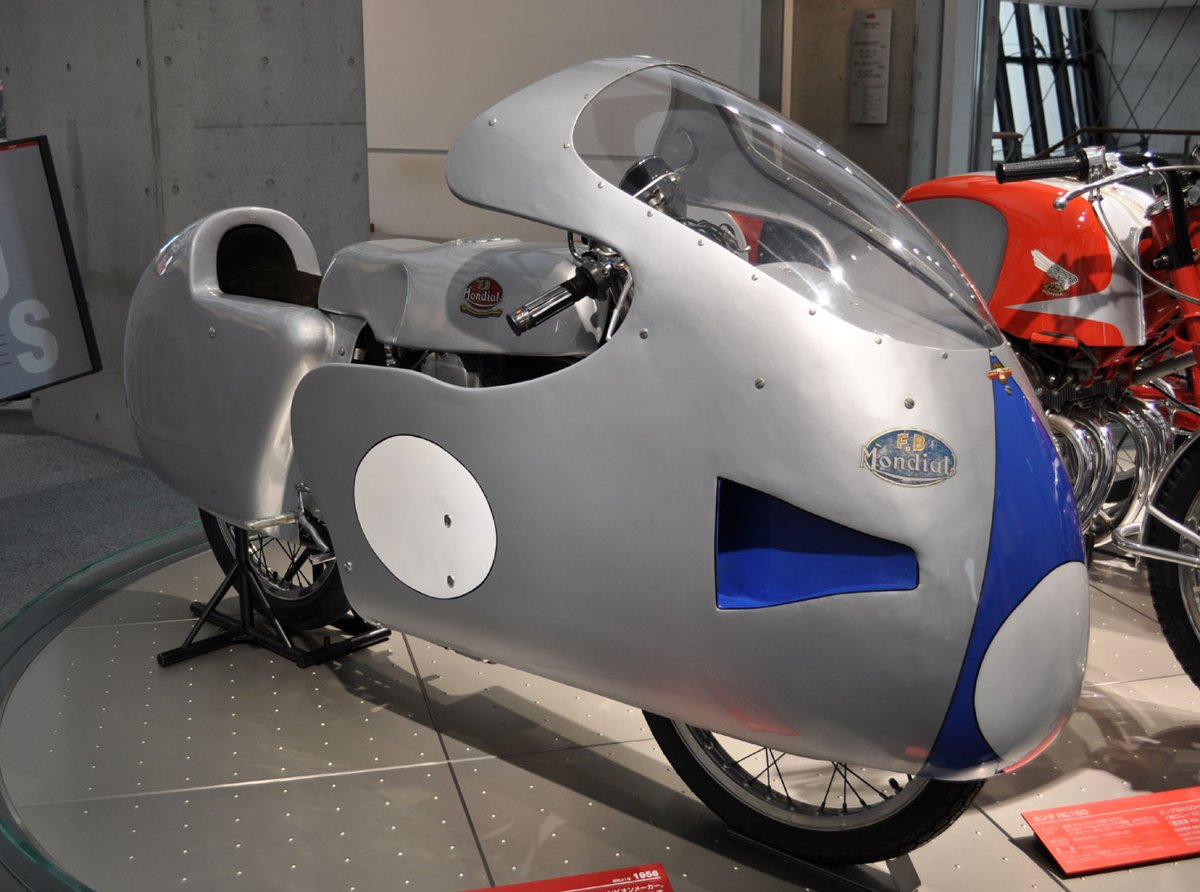
One of Mondial's most important legacies went to Japan. Honda's own heritage history records that in September 1958, as its engineers prepared for the Isle of Man TT, "they acquired an Italian production racing machine. It was a 125 cc F.B. Mondial." Kiyoshi Kawashima, later Honda's president, is quoted: "It was a 1956 model… we were able to build our first Isle of Man TT competition racer thanks to that machine."
Honda chose two cylinders, not one. Its first TT racer, the RC141, made 15.3 PS, still short of the three-year-old Mondial's 16.5 PS; the four-valve RC142 reached 17.4 PS. Both raced at the 1959 TT, the start of Honda's racing history in Europe.
The story is usually told with two errors. The machine was a 1956 model acquired in 1958, not "the 1957 championship-winning bike". And it was probably bought, not given: Honda says only "acquired", and the most detailed account, from Honda Europe's Silvio Manicardi as quoted by Cathcart in 2005, says Soichiro Honda "was cheeky enough to ask Count Boselli to sell him one of the GP bikes". A 1956 Mondial 125 in a dustbin fairing is displayed at the Honda Collection Hall at Motegi.
Decline and Closure (1958–1978)
Without racing, Mondial's sales faded. The Italian motorcycle market shrank as cars became affordable. Michelini's early death ended 175 production in 1961, the engine builder Rocca reportedly failed around the same time, and Mondial increasingly bought in whole engines.
The competition spirit survived at national level. Francesco Villa won the Italian 125 senior title on the old twin-cam in 1961, 1962 and 1963, and in 1964 gave Mondial's first two-stroke racer its debut at Modena. In France, where Mondial was popular, Jacky Onda won the national 125 title in 1965, which is why 1960s Mondial transfers boast of French championships.

In 1965 Giuseppe Boselli stepped back for health reasons, and his nephew Massimo Boselli took over. Massimo concentrated on 50cc road bikes and 125cc motocross machines with Sachs engines; a 125 Touring of 1973 used a Minarelli two-stroke. The last new model was a 50cc motocross racer, and in 1978 production stopped. Pierluigi Boselli, Giuseppe's son, later said the company "voluntarily ceased production in 1978". (English sources often say 1979.) The company, Mondial Moto s.r.l., survived as the owner of the name.
The Piega: A Honda-Powered Superbike (1999–2004)
Pierluigi Boselli kept the name alive. In the early 1990s he built 125 sport prototypes and entered the Italian Supermono championship. The US trade mark "Mondial" was filed in 1995. Then, around 1999–2000, the family licensed the name to a new company, Mondial Moto S.p.A. of Manerbio, near Brescia, backed by Roberto Ziletti, head of the Lastra printing-plate group. (He is often called a "newspaper tycoon"; Lastra made printing plates for the graphic arts.)
The product was the Piega, an Italian superbike powered by the 999cc V-twin from Honda's VTR1000 SP-1. It was styled by Sandro Mor and engineered by the ex-Aprilia engineer Nicolò Bragagnolo, with a chrome-moly trellis frame and carbon-fibre tail, and it made around 140 hp. It was shown as a concept at Intermot in 2000; the first customer machine was delivered in November 2002, at a price of about €23,900. (One source calls the engine an Aprilia; it was Honda's.)
According to OddBike, a Suzuki engine deal had collapsed first, and Honda agreed to supply its engine. Honda Europe's Silvio Manicardi described it as repaying "a debt of honour" for the Mondial Honda had bought in 1958. It was also reported that Honda had never before supplied a complete engine to another manufacturer, although we have not been able to confirm that.
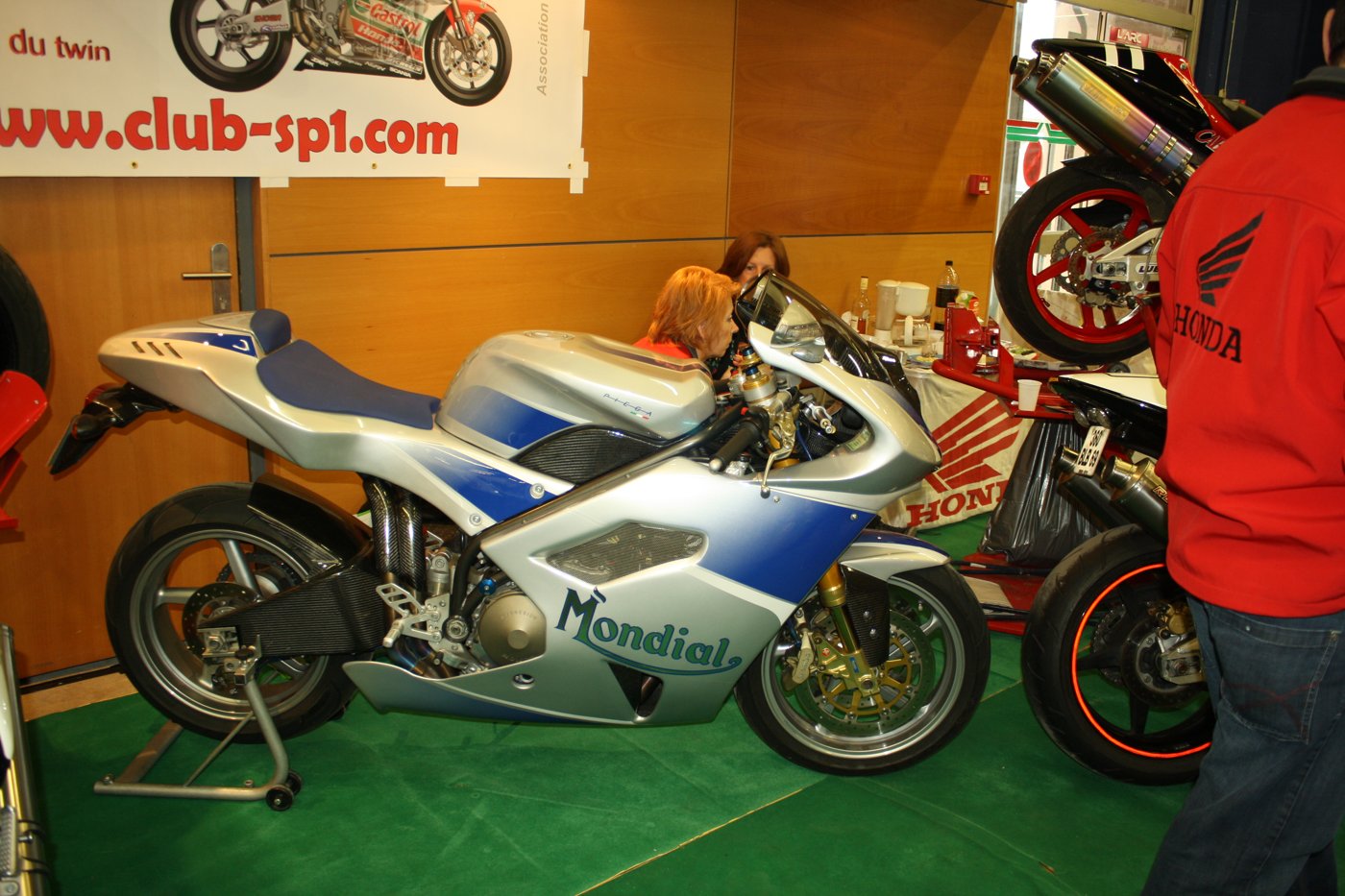
It did not end well. The company built a plant at Arcore, near Monza, planned hundreds of bikes a year and built far fewer. How many is disputed: estimates range from 35 to about 155, depending on whether bikes completed after the bankruptcy are counted. Swiss investors replaced Ziletti in 2003. The plant was frozen in July 2004 and the company was declared bankrupt by the Monza court on 24 September 2004. In 2012 the same court convicted Ziletti and a Swiss director of fraudulent bankruptcy; the sentences were covered by an amnesty, but they were ordered to pay damages to creditors.
In 2005 the court sold the company's assets, and Gruppo Mondial, formed by Piero Caronni, assembled more Piegas from the remaining parts, including Starfighter and EVO variants. Pierluigi Boselli says the family bought back its share of the trade mark the same year. Years of confusion followed, including a series of claims from the businessman Andrew Wright to be relaunching Mondial, and in 2018 the EU trade mark office rejected an application for "Mondial Moto" from a company associated with him.
FB Mondial Returns (2014–2026)
In 2014, Pierluigi Boselli and Cesare Galli, former technical director of Fantic and head of Pelpi International, a distributor based near Como, agreed a plan to bring the brand back. Mondial Moto Srl kept the trade mark and Pelpi became its exclusive licensee. (Some coverage calls Pelpi the owner; the Boselli company says it is not.)
The first new model, the HPS 125 ("Hipster"), was shown at EICMA in Milan in November 2015. Its engine was a 124cc liquid-cooled four-valve single from the Piaggio group, built at Piaggio's Chinese joint venture with Zongshen, and it sold in Italy for €3,790. The range grew quickly:
- 2016: HPS 300.
- 2017: SMX 125.
- 2018: Sport Classic Pagani 125 and 300, named after Nello Pagani.
- 2019: Flat Track.
- 2020: the Imola scooter.
- 2021: Piega 125, designed by Rodolfo Frascoli.
- 2022: Spartan.
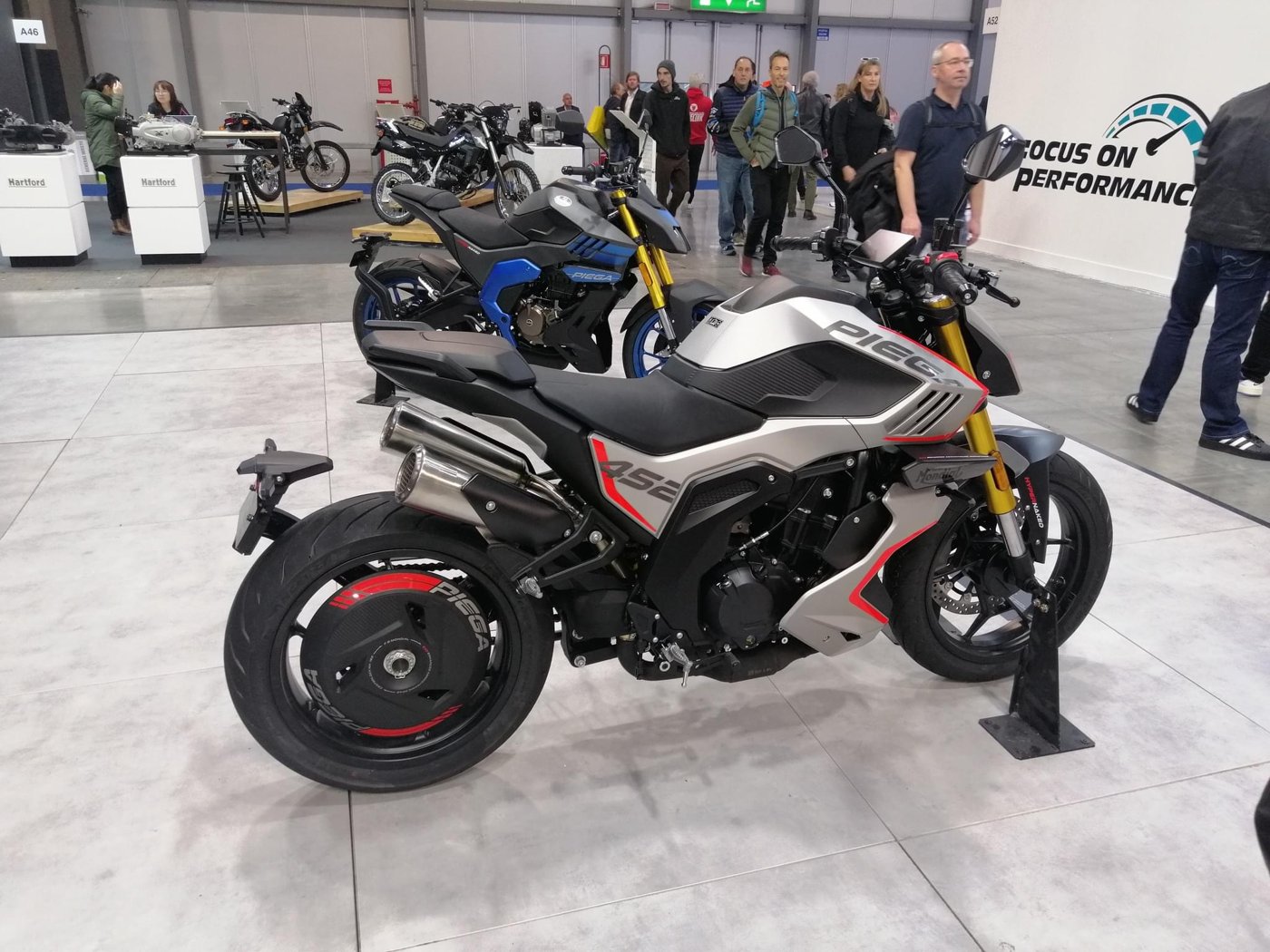
- 2023: Piega 452 and Flex, unveiled at EICMA.
- 2024: MUD 452.
- 2025: Spartan 600, the first Mondial of more than 500cc, shown at EICMA for 2026.
The modern bikes are designed and engineered in Italy and manufactured in China. The engines come from different partners, not all from Piaggio as is often said. The Piega 452, a Frascoli-designed A2-compliant naked bike, uses a 449.5cc parallel twin made by CFMOTO, and sold in Italy at launch for €5,990. As Dueruote put it, it has an "Italian father and a Chinese mother". In 2020 Mondial's Chinese production partner registered the Flat Track's design as its own; after Pelpi protested, the supplier admitted the error and transferred the design back.
Pelpi's own business has grown alongside Mondial. It revived the KL scooter brand in 2021 and distributes Kove, Hero and, from 2026, BSA in Italy. And the heritage side has been formalised: in 2017 Pierluigi Boselli and Cesare Galli founded the Registro Internazionale FB Mondial, a non-profit register that certifies historic Mondials and advises restorers.
Mondial's Competition Record at a Glance
- World championships: five riders' titles (125cc: Nello Pagani 1949, Bruno Ruffo 1950, Carlo Ubbiali 1951, Tarquinio Provini 1957; 250cc: Cecil Sandford 1957) and five constructors' titles (125cc 1949, 1950, 1951, 1957; 250cc 1957).
- Grand Prix wins: 18, fourteen in the 125cc class and four in the 250cc.
- Unbeaten: every counted 125cc championship race from 1949 to 1951.
- Production-bike Grand Prix win: Provini, Spain 1954, on a 125 Monoalbero.
- Road racing: Milano–Taranto outright 1954 (Remo Venturi, 175); Motogiro d'Italia 1954 (Provini).
- Motocross: Italian champion, Emilio Ostorero (250cc 1956; 250 and 500cc 1957).
- National racing: Italian 125 senior champion, Francesco Villa (1961–63).
Collecting FB Mondial
Mondials are rare, and the market is split in two.
The works racers are among the most valuable small-capacity motorcycles in the world. A 1957 250 Bialbero Grand Prix bike, attributed to Sandford and Provini, sold for $143,000 at RM Sotheby's in New York in 2013. John Goldman's unrestored ex-Ubbiali 1951 125 won Best of Show at The Quail in 2015, and his ex-Provini 1957 250 did the same in 2017. Provenance is everything. The genuine works bikes stayed at the factory until 1977, and as Goldman has said, "there are far more 1957 Mondial 250 Grand Prix Bialbero bikes in the world now than were ever produced."
The road bikes are affordable by comparison. A 1957 175 Sport from the Guy Webster collection sold for $10,000 at Gooding & Company, and Piega 1000s sold for around $20,000–$24,000 at Iconic Motorbike Auctions in 2021. The 125 Champion, 175s and 200s are the most commonly seen road Mondials; the Monoalbero production racers and the 175 Serie Oro Super Sprint (only 40 built) are the rarest.
For originality, the Registro Internazionale FB Mondial issues certificates and holds the factory knowledge, and it sells reproduction tank transfers made from original sheets. Our logo history has a guide to dating a Mondial by its transfers. Current auction results by model are on our FB Mondial valuations page.
Models by Type
The current FB Mondial range runs from 50cc scooters to a 554cc bobber. The main lines:

Piega 452
The Piega 452 is Mondial's flagship naked bike, launched at EICMA 2023 and designed by Rodolfo Frascoli. Its 449.5cc parallel twin, built by CFMOTO to Mondial's specification, makes 35 kW, the limit for the European A2 licence. It has a single-sided swingarm, Brembo brakes and a TFT display, and sold in Italy at launch for €5,990. The name comes from the Honda-engined Piega 1000 superbike of 2002.

Piega 125
The Piega 125, introduced in 2021 and designed by Rodolfo Frascoli, is the learner-legal version of the Piega: a sporty naked bike with a 124cc twin-cam single, a six-speed gearbox and a customisable TFT display.

FLEX 300
The Flex, unveiled at EICMA 2023 alongside the Piega 452, is a practical urban motorcycle built for rider and passenger comfort, with a 292cc engine, six-speed gearbox and 17-litre fuel tank.

HPS 125
The HPS, short for "Hipster", is the model that relaunched the brand at EICMA 2015: a café-racer-styled roadster with a 124cc liquid-cooled four-valve single, originally from the Piaggio group. A 300cc version followed in 2016, and the HPS remains in the range.

SPARTAN 250
The Spartan, launched in 2022, is Mondial's retro cruiser, aimed at new and younger riders with a low seat, LED lighting and a colour display. The larger Spartan 600, a 554cc parallel twin bobber shown at EICMA 2025, became the first Mondial of more than 500cc.

SPARTAN 125
The Spartan 125 brings the same retro-cruiser styling to the learner-licence class, with a low 800 mm seat and a 15-litre tank.

SMX MOTARD
The SMX 125 range arrived in 2017. The Motard version combines road tyres and a large-diameter front brake with dual-channel ABS and a tall, off-road-derived chassis, powered by a 124cc twin-cam single.

SMX ENDURO
The SMX Enduro is the off-road version of the SMX 125, with long-travel suspension and 21/18-inch wheels on off-road tyres.

FLAT TRACK
The Flat Track, launched in 2019, is a 125cc street tracker with 19-inch wheels and flat-track tyres. In 2020 its design briefly became the subject of a dispute with Mondial's Chinese production partner, which had registered it as its own before transferring it back.

IMOLA 125
The Imola, introduced in 2020, took Mondial into scooters. It is a compact urban scooter with keyless ignition, based on a Chinese Taro design, and comes in 125cc and 50cc versions.

IMOLA 50
The Imola 50 is the moped-licence version of the Imola scooter, with the same keyless system and low 770 mm seat.
Key Milestones
The Boselli siblings open a motorcycle shop and workshop in Milan under the name FB, for Fratelli Boselli.
FB builds motocarri (three-wheeled goods vehicles) at Oreste Drusiani's works in Bologna.
The Bologna works are destroyed in an Allied air raid on 24 July.
Alfonso Drusiani's 125 twin-cam debuts at Faenza on 12 September as the F.B. Mondial, and wins at Monza on 24 October.
Nello Pagani wins the first 125cc world championship; Mondial takes the constructors' title.
Bruno Ruffo is 125cc world champion.
Carlo Ubbiali is 125cc world champion; Mondials take the first four places at the first 125cc Isle of Man TT.
Mondial stops official racing; the 125 Monoalbero production racer goes on sale.
Provini wins the Spanish Grand Prix on a production Monoalbero and the Motogiro; Remo Venturi wins the Milano–Taranto on a 175.
Provini (125cc) and Sandford (250cc) win world titles; at season's end Mondial, Gilera and Moto Guzzi withdraw from Grand Prix racing.
Honda acquires a 1956 Mondial 125 in September to prepare for the Isle of Man TT; Tonti and Pattoni found Paton.
Giuseppe Boselli steps back; his nephew Massimo takes over.
Production ends.
The Honda-engined Mondial Piega 1000 reaches customers.
Mondial Moto S.p.A. is declared bankrupt on 24 September.
The brand is licensed to Pelpi International; the HPS 125 is shown at EICMA in November 2015.
The Registro Internazionale FB Mondial is founded.
The CFMOTO-engined Piega 452 and the Flex are unveiled at EICMA.
The Spartan 600, the first Mondial of more than 500cc, is shown at EICMA.
Noteworthy Statistics
- 10 world titles: five riders' and five constructors', won in just five seasons (1949, 1950, 1951 and 1957).
- 10 out of 10: Mondial's record in counted 125cc world championship races from 1949 to 1951.
- 18 Grand Prix wins: 14 in the 125cc class, 4 in the 250cc.
- 1 podium sweep: Sandford, Provini and Miller, first to third in the 1957 250cc championship.
- 16.5 PS: the output Honda measured from its 1956 Mondial 125, more than its own first TT racer.
- About 2,000: the Registro's estimate of pushrod 125 road bikes built from 1949 to 1953.
- $143,000: the price paid for a 1957 250 Bialbero works racer at RM Sotheby's in 2013.
Myths and Common Errors
| Claim | The evidence |
|---|---|
| "Mondial built the first four-stroke 125." | Ducati's Cucciolo and Gilera's 125 were already four-strokes. Mondial's achievement was proving the four-stroke superior in 125cc racing. |
| "Mondial pioneered the disc brake." | Douglas raced disc brakes in the early 1920s. Mondial's disc was a mechanical front disc on the 1965 Record 50. |
| "Mondial was first with desmodromic valves." | Its desmo 175 prototype of 1955–57 never raced; Azzariti and Ducati came first. |
| "Giuseppe Boselli was the founders' father." | He was one of the siblings. |
| "Honda was given the 1957 championship bike." | Honda acquired a 1956-model 125 in September 1958, most likely by purchase. |
| "Mondial won every race from 1949 to 1957." | It won every counted 125 race from 1949 to 1951; from 1952 to 1956 its only Grand Prix win was Spain 1954. |
| "Ruffo was Mondial's 250 champion." | Ruffo's 250 titles were won on Moto Guzzis; Mondial's 250 champion was Sandford. |
| "The Piega used an Aprilia engine." | It used Honda's VTR1000 SP-1 V-twin. |
| "Modern Mondials all use Piaggio engines." | Only the early 125s and 300s; the Piega 452 and MUD use CFMOTO twins, and the Imola is based on a Taro scooter. |
| "Pelpi owns FB Mondial." | The Boselli family's Mondial Moto Srl owns the trade mark; Pelpi is the licensee. |
| "Mondial closed in 1979." | Production ended in 1978, according to the Boselli family. |
FB Mondial FAQ
What does FB stand for in FB Mondial?
Fratelli Boselli, meaning "the Boselli brothers". The Boselli siblings, Carlo, Luigi, Ettore, Giuseppe and their sister Ada, opened the business in Milan in 1929 and built three-wheeled goods vehicles before their first Mondial motorcycles in 1948.
How many world championships did FB Mondial win?
Ten: five riders' titles and five constructors' titles. Nello Pagani (1949), Bruno Ruffo (1950), Carlo Ubbiali (1951) and Tarquinio Provini (1957) won the 125cc championship, and Cecil Sandford won the 250cc championship in 1957.
Why did FB Mondial stop racing?
At the end of 1957 Mondial, Gilera and Moto Guzzi jointly withdrew from Grand Prix racing, citing a lack of foreign opposition, pressure from the authorities and public opinion, rising risk to riders, and the need to concentrate on production. Giuseppe Boselli later said that having achieved so much, Mondial could only lose it by continuing.
Did Honda copy the FB Mondial?
Honda studied one. In September 1958 it acquired a 1956 Mondial 125 racer, and its engineers credit it with helping them build their first Isle of Man TT racer. But Honda chose a twin-cylinder design, not a copy of the Mondial single.
Who owns FB Mondial today?
The trade mark is owned by Mondial Moto Srl, the company of Count Pierluigi Boselli, son of Giuseppe Boselli. Since 2014 it has been licensed exclusively to Pelpi International, which designs and sells the current FB Mondial range.
Where are FB Mondial motorcycles made?
The current models are designed and engineered in Italy and manufactured in China, with engines from partners including the Piaggio–Zongshen joint venture and CFMOTO.
Are FB Mondial motorcycles good for beginners?
Much of the range is aimed at them. The Imola 50 and the 125cc HPS, Piega, SMX, Flat Track and Spartan models suit moped and learner licences, and the Piega 452 is built to the European A2 licence limit.
Sources
- Federazione Motociclistica Italiana, Mondial, un marchio straordinario and Da Motitalia, le 125 diventano 4 tempi
- Biblioteca Salaborsa, Bologna chronology: La moto Mondial debutta a Faenza and La società BDB Brevetti Drusiani
- Italian Wikipedia: Mondial Moto, Mondial 125 Monoalbero, Patto di astensione, Tarquinio Provini
- Wikipedia season results: 1949, 1950, 1951, 1952, 1957; and racingmemo
- Honda, The 1958 Isle of Man TT race
- Registro Internazionale FB Mondial, model and racing histories
- Alan Cathcart, 1957 Mondial 250 Bialbero racer test
- Motorcycle Classics, 1957 Mondial 250GP
- Dueruote, Tributo Mondial and Il futuro della Mondial (2005)
- Moto.it, Il desmo non è soltanto Ducati, Fabio Taglioni and Zongshen Flat: il brevetto è di FB Mondial
- Il Giorno, Mondial Moto bankruptcy trial (2012)
- OddBike, Mondial Piega: honouring a favour
- inSella, Mondial Moto, chiarezza sul marchio (2018)
- FB Mondial, History; Dueruote, Mondial Piega 452 test
- RM Sotheby's, 1957 FB Mondial 250 Bialbero Grand Prix; Gooding & Company, 1957 FB Mondial 175 Sport
Explore the FB Mondial logo history, browse FB Mondial models and values, or read about Mondial's great rivals in our histories of Moto Guzzi, MV Agusta and Ducati.