
Few motorcycle logos are older than the motorcycle, and Husqvarna's is one of them. The crowned H on a modern enduro began as a mark on gun barrels at a Swedish arms works, more than two hundred years before anyone there built an engine.
The core of the design is simple: a rounded shape, an H inside it, and three prongs on top. People read the top in two ways. Some see a crown, the sign of an arms factory founded by royal command. Others see a gun sight, the view straight down a rifle barrel. Both readings have a history, and this page follows it from the drill mill of 1689 to the bikes Husqvarna sells today under licence.
We built it from primary material where we could find it, including the Husqvarna Museum's own history, the company's press releases, US trade mark records, factory parts lists, and dated photographs of surviving bikes. Where the sources disagree we say so. Where the popular story is wrong, including on earlier versions of this page, we correct it. For the full company story, see our history of Husqvarna.
The Short Version
- 1689: The Crown's arms factory at Jönköping builds a drill mill at the Huskvarna falls. This is the start of the works that became Husqvarna.
- Before 1900: Barrels are marked with a ring and an H, with three strokes above it. Its date of origin is unknown. The Husqvarna Museum still uses a version of it as its symbol.
- c.1912–1972: The company logo is a royal crown over a Gothic H, beside a heavy serif "Husqvarna" wordmark.
- 1903 onward: The first motorcycles carry HUSQVARNA in serif capitals on the tank. From about the 1930s some tanks also carry the crowned Gothic H.
- 1950s–early 1970s: On the bikes, the name moves to a flowing script: on the Silverpilen's arrow flash, and on the candy-red tanks of the motocross years.
- 1973: The company becomes Husqvarna AB and introduces the blue crown-H, a rounded square with an H inside and three prongs on top. It is on the tanks by 1974.
- 1986–87: The motorcycle business is sold to Cagiva in Italy. Husqvarna AB keeps the trade mark and licenses it, then later to BMW (2007) and Pierer/KTM (2013).
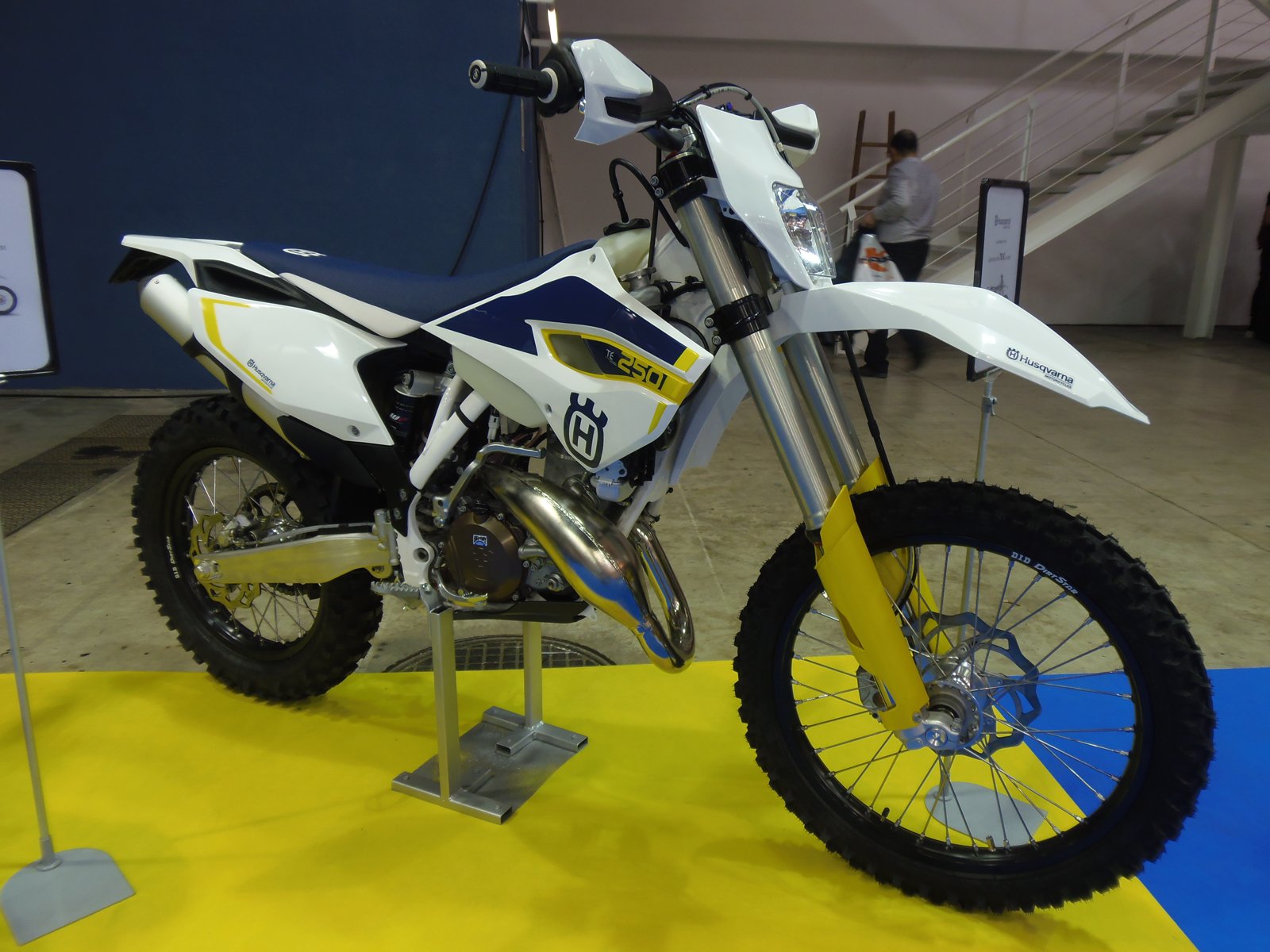
- 2014 on: KTM relaunches the brand in white, blue and yellow, with the crown-H on the shrouds.
- 2025–26: The motorcycle brand becomes Husqvarna Mobility, and Bajaj takes control of its parent company. The mark is still owned by Husqvarna AB in Sweden.

1689–1900s: The Arms Factory and the Barrel Mark
Husqvarna did not begin in Huskvarna. Its roots are in the Jönköping arms factory (Jönköpings gevärsfaktori), set up in 1620 by royal ordinance to make muskets for the Swedish crown. In 1689, according to the Husqvarna Museum, "the factory established a drill mill in Huskvarna" to use the power of the falls there. Production then moved there step by step. The king at the time was Charles XI. Husqvarna's own motorcycle site puts it more simply: "On the Swedish king's command, a weapons factory was founded in the town of Huskvarna."
The works stayed in state hands until 1757, when they were privatised and, in the museum's words, "soon changed [their] name to Husqvarna Rifle Factory." In 1867 new weapon orders led to a joint-stock company, Husqvarna Vapenfabriks Aktiebolag. Sewing machines followed in 1872, bicycles in the 1890s and motorcycles in 1903.
The spelling. The company kept the old spelling of the town's name. Swedish sources note that the town's name was written Husqvarna, with a q, until 1906, when it became Huskvarna. The company kept the qv. That is why the brand and the town are spelled differently today.
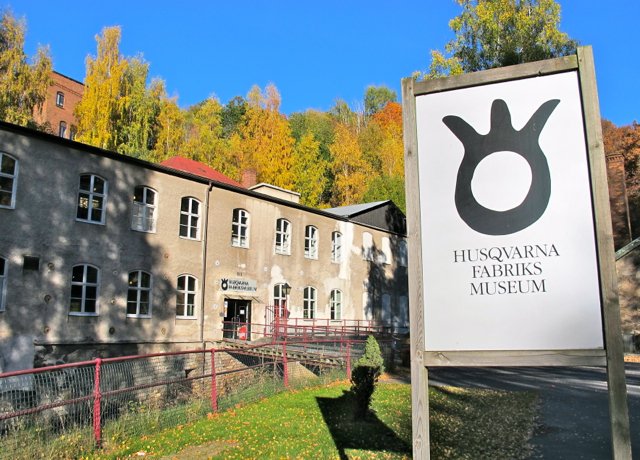
The mark on the barrels. The oldest Husqvarna symbol is not a crown. It is a ring. Sune Envall, a Swedish designer who says he worked on the company's graphics, gives the fullest account we have found. "The factory stamped a round ring on the gun barrels," he writes, and later cut an H into the ring with a chisel, adding "3 chisel stabs above the ring to symbolize gun sight." The Husqvarna Museum in Huskvarna uses a drawing of that ring, with three prongs rising from it, as its own symbol.
Two cautions. First, Envall's account is a first-person recollection, not a factory document, and we have not found a dated example of the stamp. Nobody we have read can say which century it first appeared in. Second, the date 1869, which has been attached to this mark on logo websites and on earlier versions of this page, has no source that we can find. It may be a confusion with 1867, when the company was incorporated. Sweden's first trade mark law dates from 1884, so no Swedish trade mark registration can be older than that.

c.1903–1972: The Crowned Gothic H
In the early twentieth century the ring gave way to something grander. Swedish sources date the symbol to about 1912–1972. It was a royal crown (kungakrona) over a Gothic H, which marked the company's long link to the Crown. Envall describes it as "a crown and a stylized fractal golden H placed on a blue weapon crest." Beside it sat a heavy serif Husqvarna wordmark.
The first motorcycles. Husqvarna's first powered two-wheeler was a bicycle frame with a Belgian FN engine, built from 1903. The company's own heritage page says it was completed "after the Husqvarna logo was painted on the tank." A Swedish club history put it plainly: "Men det stod Husqvarna på tanken" ("but it said Husqvarna on the tank"). Neither source says whether there was a crown as well.
The surviving bikes help:
- 1905: a 300 cc machine has HUSQVARNA in gold serif capitals, lined in gold, on a red tank panel. There is no emblem.
- 1917: a Model 145 carries the name in capitals and a small round emblem that looks like a crowned monogram. The only free photograph is too small to be sure.
- 1930s: the road bikes and JAP-engined machines usually have a chrome tank with a coloured panel, often red, lettered HUSQVARNA in serif capitals.
- c.1938: a lightweight at the Tekniska museet in Stockholm carries the full corporate emblem on its tank: a gold crown over a Gothic H on a ribbed gold shield, with HUSQVARNA on a scroll below it, on a cream panel with maroon wing stripes.
The 1930s are when Husqvarna first became famous for motorcycles, through its 500 cc racing V-twins. The company's marketing of the time, as reproduced on its heritage pages, is about the riders and the wins, not the badge.
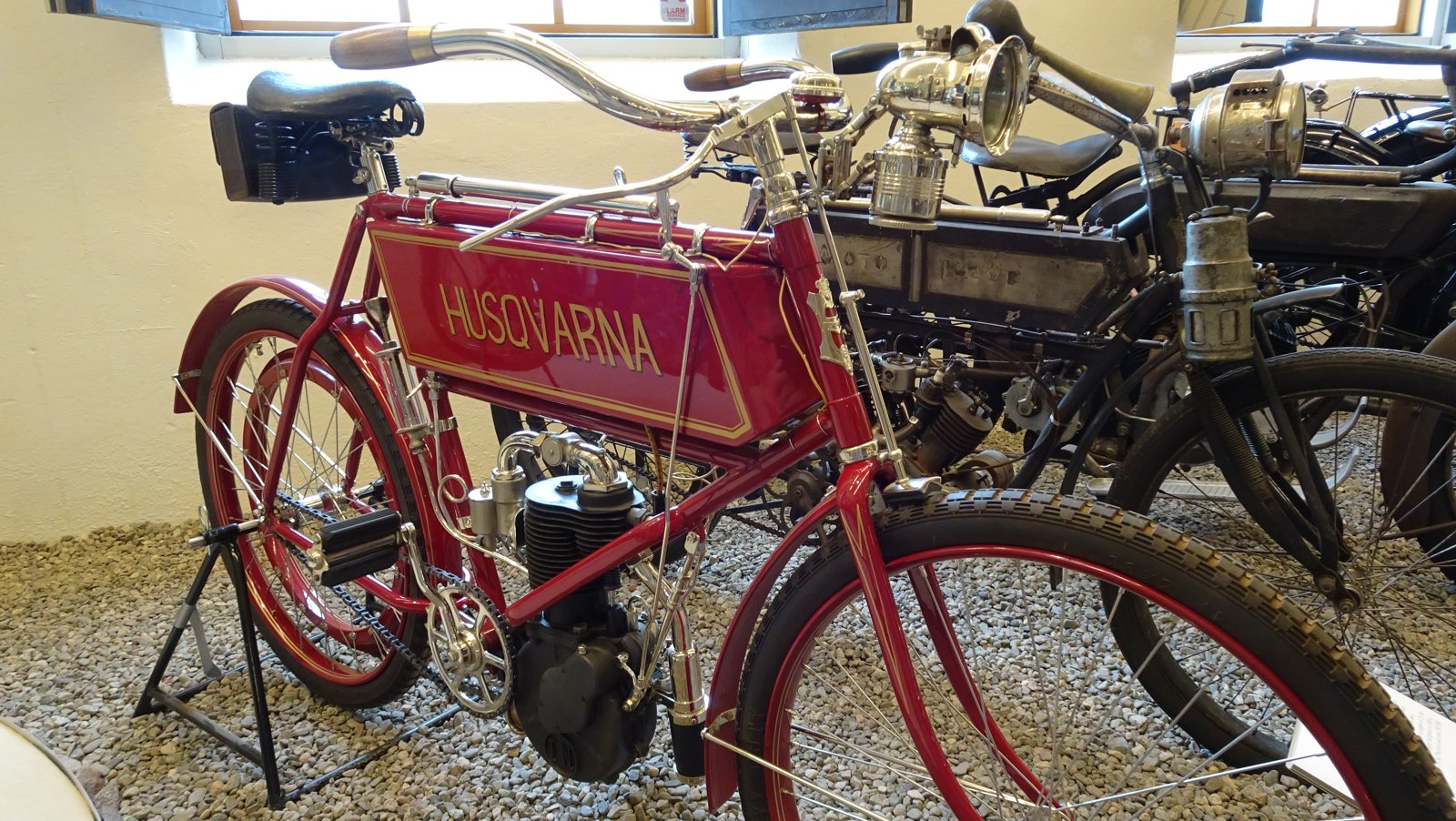
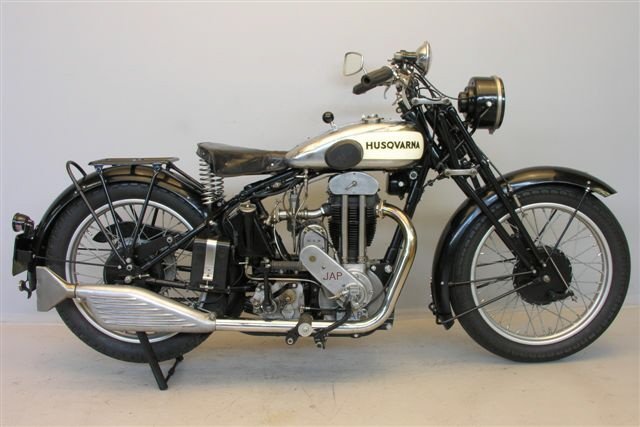
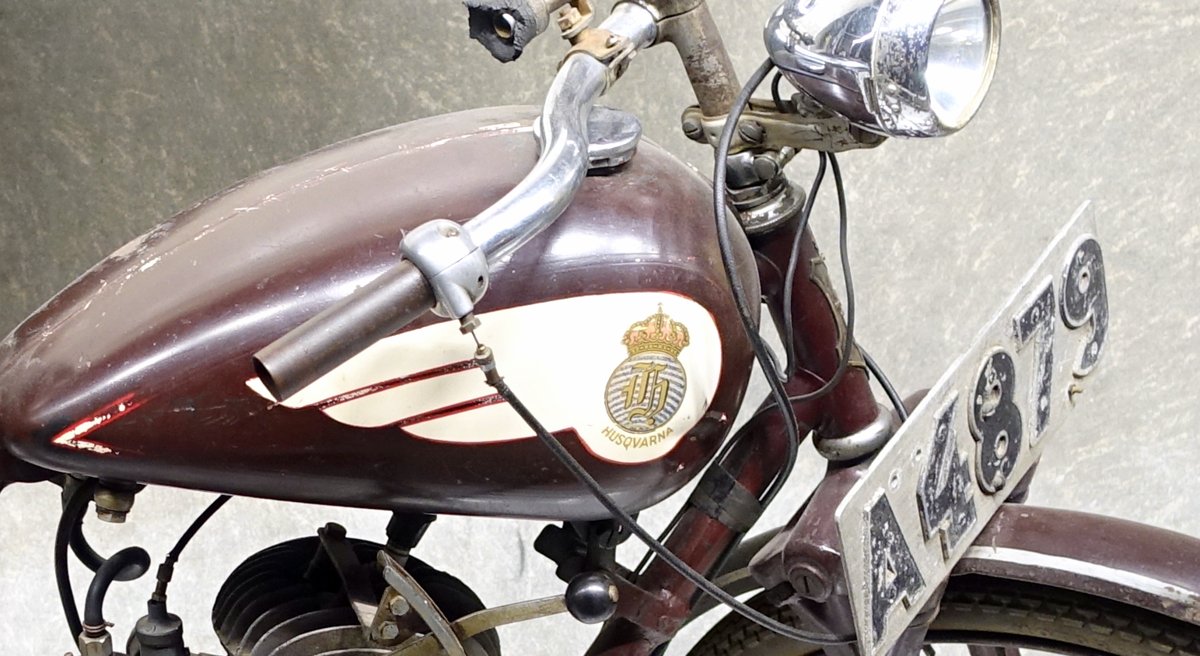
A second c.1938 lightweight, at the Malmö museum of science and technology, has only the name in script and no crown. That could be a factory difference or a restorer's choice. It is a useful warning: one surviving bike does not settle what the factory fitted.
1955–1973: The Script Years
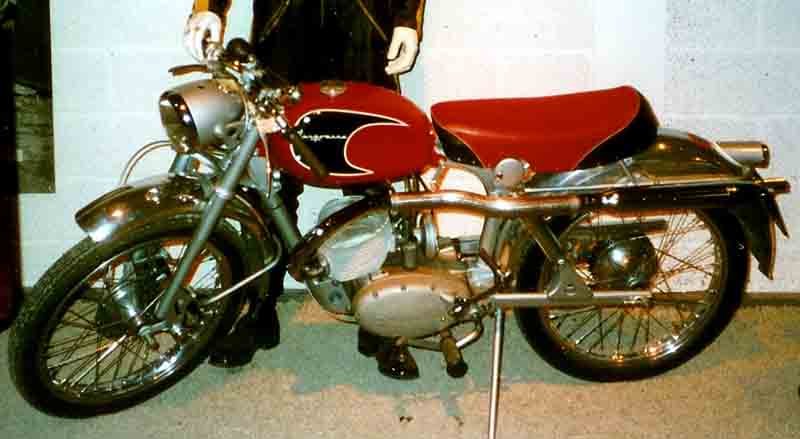
After the war the crown stayed on company paperwork, but on the motorcycles the name started to do the work on its own, in a flowing Husqvarna script.
The Silverpilen. In January 1955 Husqvarna launched the 175 cc Silverpilen ("Silver Arrow"), Model 282. According to Husqvarna's heritage pages, the sales director Harald Carlström named it after Mercedes-Benz's Silver Arrow racing cars, and about 11,300 were built up to 1965. The name did not describe the paint. The 1957 factory parts list gives the tank in black lacquer (part M-28197) or red lacquer (M-28168, 1957 only), and the 1958 supplement lists only the black one. The graphic was a pointed arrow flash along the tank side, edged in white, with the Husqvarna script inside it.
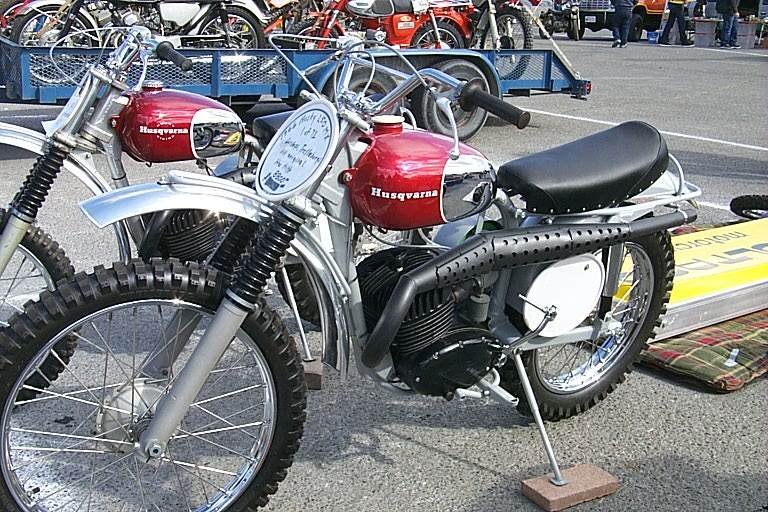
The motocross years. In the 1960s Husqvarna's lightweight two-stroke crossers changed off-road racing. Torsten Hallman won the 250 cc motocross world championship in 1962, 1963, 1966 and 1967, and the American importer Edison Dye made "Husky" a byword in the United States. The look of those bikes is the one most people picture: a candy-apple red tank with chrome knee panels and Husqvarna in white script. The Husky Club's model history says 1967 was the last year for the candy-apple red. The dated photographs we examined show the script and no separate crown badge on the tank.
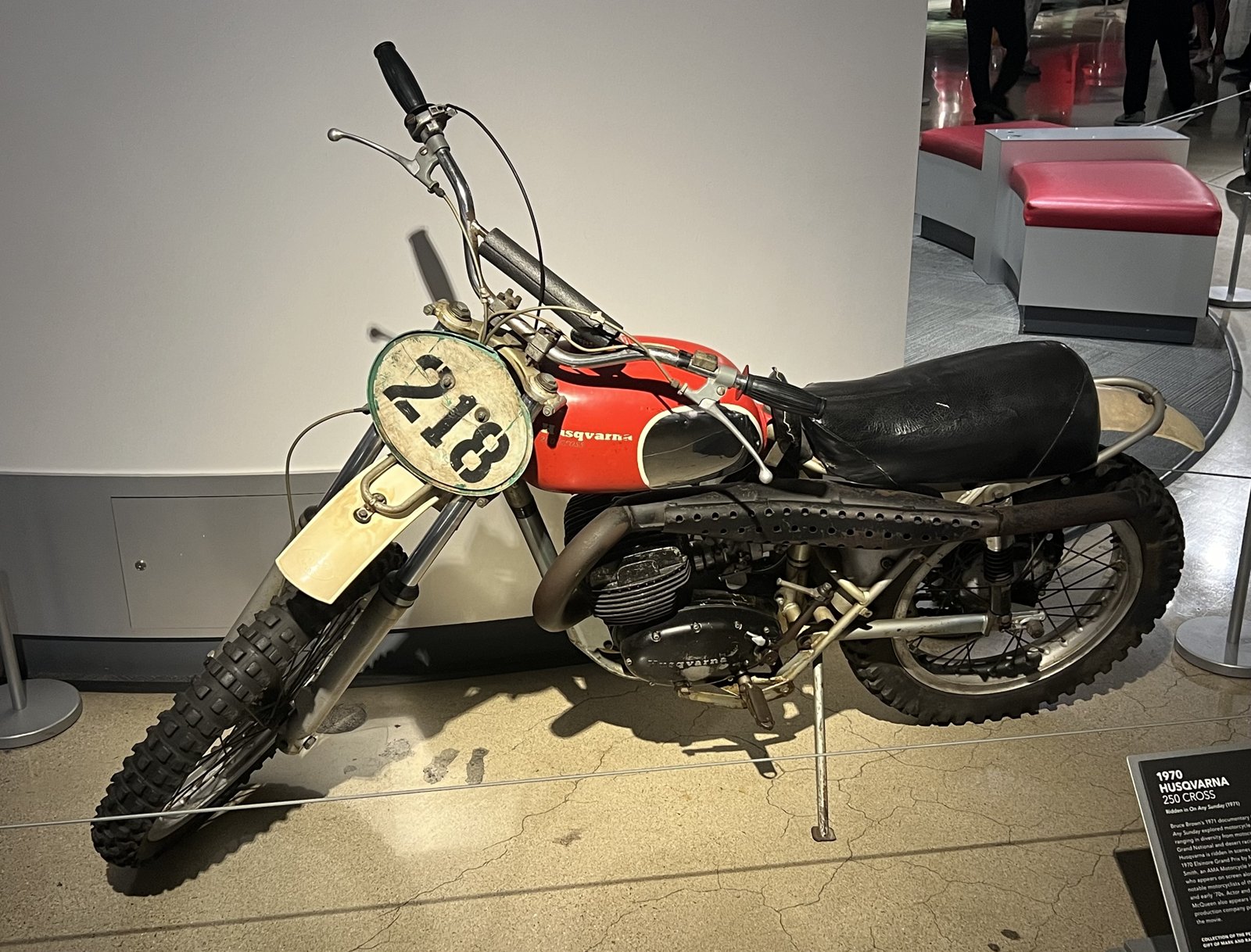
The 1970 250 Cross in the Petersen Automotive Museum, one of the bikes from Bruce Brown's 1971 film On Any Sunday, shows the late form: a red tank with a chrome panel and a small script logo.
1972. The same club history records that on the 1972 "MJ" series the tank colour depended on the model: orange for the 400 and 450, "Lion Yellow" for the 125, red for the 250. The model number moved off the tank onto a chrome sticker on the left engine case.

1973–1986: Husqvarna AB and the Blue Crown-H
The logo still in use today arrived with a new company name. The Husqvarna Museum is direct: "The company changes its name to Husqvarna AB and a new logo is introduced in 1973."
The new mark kept the idea and dropped the ornament. The Gothic H became a plain, heavy H. The ring and crest became a rounded square, which Envall compares to the "super-ellipse" of the Danish designer Piet Hein. The crown became three short prongs on top, which could be read either as a crown or as the old gun sight. The colour was blue, and the wordmark was a clean sans serif usually identified as Helvetica.
Who designed it is disputed. Two accounts exist, and we could not reconcile them:
- The logo wiki Logopedia credits Hormaz Kapadia of the Jönköping agency Gumaelius Annonsbyrå. It quotes him as saying that the old Gothic logo "did not work in dealers' small ads," that it "looked Japanese to the Americans," and that the new one was "created with sewing machines in mind… orange was the color on fashion, and the new reflex blue had just been created." We could not trace these quotes to their original source.
- Sune Envall, writing in 2017, says he drew the symbol as assistant to the artist Pierre Olofsson, from a brief given in the late 1950s, and that the usual 1973 date is wrong. He adds that the brief insisted "the new symbol absolutely must keep the crown because the American importer … felt that the crown was a very strong symbol."
What is well sourced is the introduction date, 1973, from the museum. On the motorcycles, the Husky club's history says that 1974 "was also the year of displaying the new Husqvarna company logo and it was prominently displayed on both tank sides of every size Husky." Reproduction-decal suppliers list separate tank decal sets for 1975–77 and 1978–82, and headstock decals for 1978–82 and 1983–88. So the details changed from year to year, but the crown-H stayed.
A new owner. In 1977–78 Husqvarna was bought by Electrolux. The museum says 1977; most other sources say 1978, which may be the completion date. The crown-H survived the takeover and went on chainsaws, lawn mowers, sewing machines and motorcycles alike.
1987–2013: A Swedish Name, Licensed Abroad
In the mid-1980s Electrolux sold the motorcycle business to Cagiva of Italy. Husqvarna Group's own 2007 press release says: "Husqvarna manufactured motorcycles from 1903 until 1987. The operation was then sold to Cagiva of Italy." Other sources give 1986. The engineers who stayed in Sweden started Husaberg in 1988.
What was sold was the business, not the name. Husqvarna AB kept the trade mark and licensed it for motorcycles. This is the most misunderstood fact in the whole story, and it explains why the crowned H has stayed so consistent through four owners. The owners could change the colours, but not the mark.
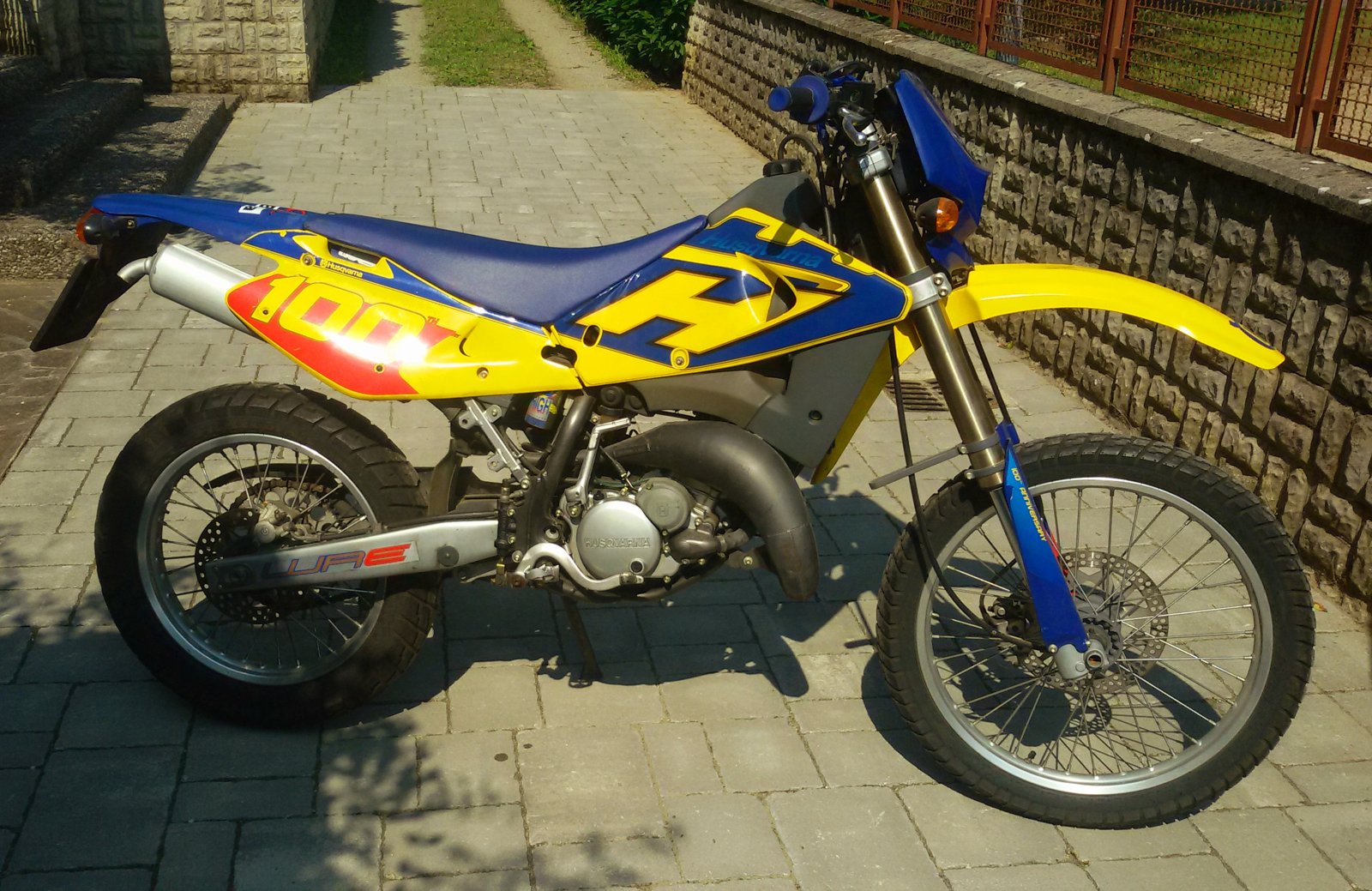
Cagiva years. Production moved to Italy, and the graphics changed with the fashions of the time. Bikes from around 2000 are yellow and blue, and the 2004 WRE 125 built for the brand's hundredth year has an oversized H on its shroud. We have not found a dated source for a Cagiva-era change to the logo itself.
BMW years. In 2007 BMW bought the motorcycle operation from MV Agusta, Cagiva's parent. Husqvarna Group announced a licence under which "BMW has the right to use the Husqvarna brand for motorcycles as well as related products and services." The 2011 range got new colours and graphics, and the BMW-era bikes are mostly red, white and black, with the crown-H on the front plate. We found no evidence of a formal logo redesign under BMW.

2013–Present: Back to Swedish Colours
In January 2013 BMW sold Husqvarna to Pierer Industrie, the owner of KTM, and it became Husqvarna Motorcycles GmbH in Austria. The first full KTM-era range, for 2014, was a deliberate return to Sweden.
- Colours: Cycle News reported that Sweden's blue, yellow and white were chosen to recall a time when "Swedish-bred bikes ruled the off-road world." The brand's own site still speaks of its "iconic Swedish blue, yellow and white colour scheme."
- Logo: Transmoto described white plastics, yellow fork guards and a "retro-look Husky logo on the shrouds." That logo was the 1973 crown-H, applied large.
- Design: The Austrian studio KISKA led the repositioning, under the line "Pioneering since 1903".
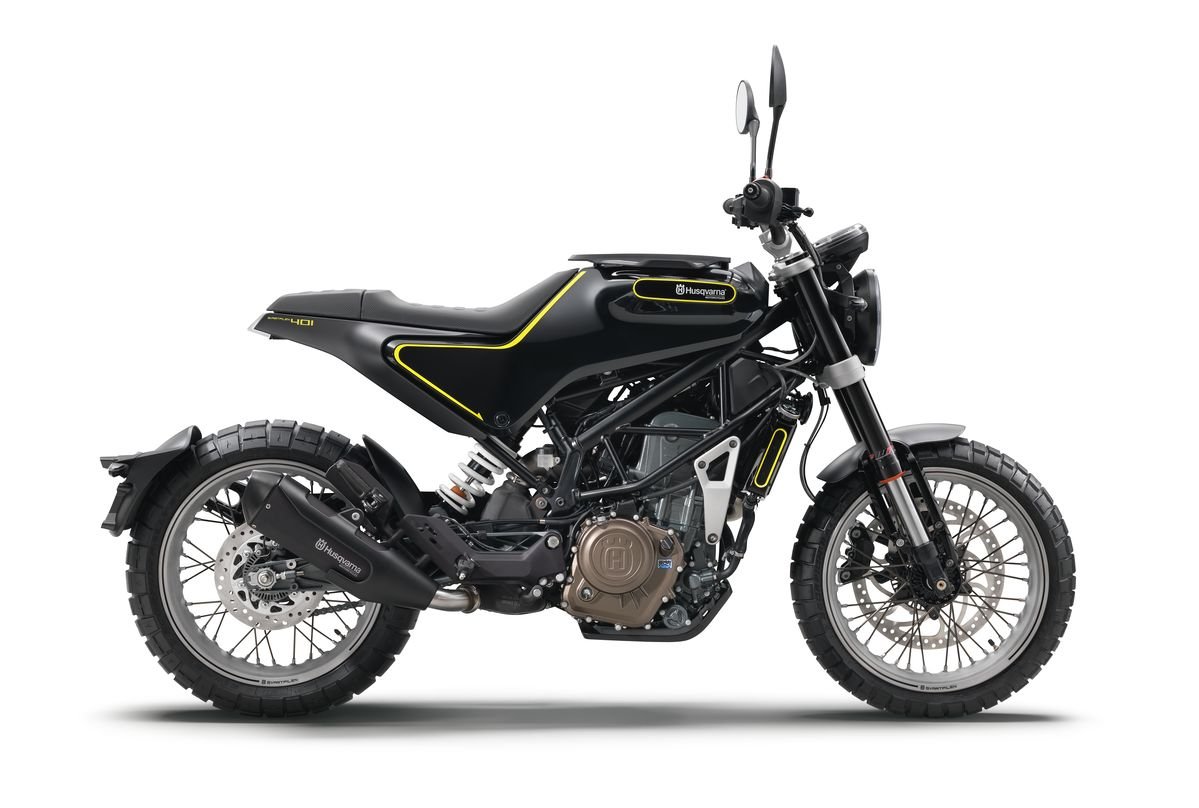
The road bikes went further. The Vitpilen ("white arrow") and Svartpilen ("black arrow") concepts, shown at EICMA in Milan in 2014 and in production from 2018, borrowed their names from the Silverpilen. They carry the crown-H small on the tank beside the wordmark.
Today's mark. Husqvarna AB filed the current symbol-and-wordmark combination internationally in 2017. The US registration (2020) describes "a stylized uppercase letter 'H' inside a three-pronged crown design" next to the word Husqvarna, covering goods including motorcycles. A 2023 EU application, followed by a US application in 2024, covers the crown-H over HUSQVARNA in white inside a navy square, with the colour claimed as Pantone 534. We found no announcement of a public logo change to go with it.
Husqvarna Mobility and Bajaj. With the 2025 models the motorcycle brand began calling itself Husqvarna Mobility. In November 2025 India's Bajaj completed its takeover of the Pierer group, and in January 2026 Pierer Mobility AG was renamed Bajaj Mobility AG. None of this changed who owns the logo. The motorcycle site's legal notice still says the marks are "used under license from Husqvarna AB, Sweden."
Crown or Gun Sight?
This is the question people most often ask about the Husqvarna logo. The honest answer is that the symbol has carried both meanings at different times.
- The gun sight. The oldest mark, the ring with three strokes above it, is described as the view down a barrel: the ring is the muzzle and the strokes are the sights. English and German Wikipedia both describe the modern logo this way, and Swedish Wikipedia says the 1973 symbol "recalls the mark first used to mark the weapons" (our translation).
- The crown. From about 1912 to 1972 the logo had an unmistakable royal crown, which marked the factory's origins as a Crown arms works. By Envall's account, the 1973 redesign was required to keep the crown.
The modern three prongs are drawn so that they can be read either way. We have not found any current official Husqvarna wording that settles the question. The page on the company's old website that Wikipedia cites for the gun-sight explanation no longer exists.
Lettering and Colour
The wordmark. There have been three main forms. The first was serif capitals on the early tanks, with a heavy serif wordmark beside the crowned emblem. The second was the flowing script of the 1950s and 1960s bikes. The third is the sans serif wordmark introduced with the 1973 logo, usually identified as Helvetica and later redrawn. Some logo websites say the current wordmark resembles recent typefaces such as Sequel Sans, but we have found no source connecting them.
The colour. Blue has been the corporate colour since at least 1973: "reflex blue", if the Kapadia quotes are right, and Pantone 534 in the 2024 trade mark filing. On the motorcycles, though, colour has always followed fashion and racing: red, black, chrome, orange, yellow, BMW's red and white, and KTM's white, blue and yellow. Claims that Husqvarna blue "symbolises protection, reliability and high quality", which appeared on an earlier version of this page, have no source.
How to Date a Husqvarna by Its Tank
This table comes from dated museum bikes, factory parts lists, the Husky club's model history and reproduction-decal catalogues. Treat it as a first check, not a verdict. Many old Husqvarnas have been restored with whatever decals were available.
| Period | Tank logo and graphics | Notes |
|---|---|---|
| 1903–1920s | HUSQVARNA in serif capitals, painted on a tank panel | The 1905 300 cc has gold capitals on red |
| 1910s–1930s | Name in capitals; a small crowned emblem on some models | 1917 Model 145 |
| 1930s | Chrome tank, coloured panel, HUSQVARNA in serif capitals | Road bikes and JAP-engined models |
| c.1938 | Crowned Gothic H shield above HUSQVARNA, with wing stripes | Some lightweights |
| 1955–65 | Silverpilen arrow flash with Husqvarna script | Tank black (1957–58) or red (1957 only) |
| 1960s–1973 | Candy-red tank (to 1967), chrome knee panels, white script | Motocross models |
| 1972 | Colour by model: orange, Lion Yellow or red | Model number on a chrome engine-case sticker |
| 1974–c.1986 | 1973 blue crown-H and sans serif wordmark on both tank sides | Decal sets change in 1975–77 and 1978–82 |
| 1987–2007 | Cagiva era; yellow and blue by around 2000; large H graphics | Built in Italy |
| 2007–2013 | BMW era; red, white and black; crown-H | 2011 range restyled |
| 2014 on | White, blue and yellow; large crown-H on the shrouds | KTM era; "Husqvarna Mobility" from MY2025 |
Red flags:
- A 1973-style blue crown-H on a bike claimed to be original from before 1974.
- A candy-red tank with the script on a model from after 1967, unless the history explains it.
- A silver-painted tank on a Silverpilen sold as original.
- The two-line "Husqvarna Group" lockup. That is a corporate logo from the 2010s and never went on a motorcycle.
- Husaberg parts or decals. Husaberg was a separate brand, founded in 1988 by former Husqvarna engineers.
For current prices by model, see our Husqvarna models and values.
What the Logo Stories Get Wrong
| Claim | The evidence |
|---|---|
| "The Husqvarna logo has been used since 1689." | The factory dates from 1689, but its earliest mark cannot be dated, and the crowned Gothic H belongs to the 20th century. |
| "The logo was created in 1869." | We found no source for this date. The company became a joint-stock company in 1867. |
| "The first motorcycle logo was designed in 1912." | The name was painted on the tank of the first motorcycle, built from 1903. 1912 is the usual start date for the crowned Gothic H company logo, not a motorcycle logo. |
| "The blue crown-H was introduced in 1983." | The museum dates the new logo to 1973, and it appeared on the tanks in 1974. |
| "In 2012 the motorcycle logo became 'Husqvarna Group'." | Husqvarna Group is the name of the Swedish parent company, which makes outdoor power products. Its lockup never appeared on a motorcycle. |
| "The Husqvarna trade mark was sold to Cagiva, BMW and KTM." | The motorcycle business was sold. The trade mark stayed with Husqvarna AB, which licenses it. |
| "The motorcycle division was sold to Cagiva in 1976." | It was 1986 or 1987. |
| "The Silverpilen was named for its silver tank." | It was named after Mercedes-Benz's Silver Arrow racers, and its tanks were black or red. |
| "A royal charter from King Karl X Gustav in 1689." | Karl X Gustav died in 1660. The king in 1689 was Charles XI. |
| "The three prongs represent saw teeth." | The prongs are older than the chainsaws. They go back to the crown and the gun sight. |
Husqvarna Logo Timeline
The Crown's arms factory is founded at Jönköping.
The factory builds a drill mill at the Huskvarna falls, the start of the Husqvarna works.
The works are privatised and become the Husqvarna Rifle Factory.
Husqvarna Vapenfabriks Aktiebolag is formed.
The first Husqvarna motorcycle is built, with the name painted on its tank.
The crowned Gothic H becomes the company logo.
The Silverpilen launches, with its arrow flash and Husqvarna script.
Torsten Hallman wins four 250 cc motocross world titles on script-tanked Husqvarnas.
The company becomes Husqvarna AB and introduces the blue crown-H.
The new logo goes on both sides of every Husqvarna motorcycle tank.
Electrolux acquires Husqvarna.
The motorcycle business is sold to Cagiva; Husqvarna AB licenses the name.
BMW acquires the motorcycle business and signs a licence for the Husqvarna brand.
Pierer/KTM takes over; the 2014 range returns to Swedish blue, yellow and white.
Husqvarna AB files the current crown-H and wordmark internationally.
The brand becomes Husqvarna Mobility, and Bajaj takes control of its parent company.
Husqvarna Logo FAQ
What does the Husqvarna logo represent?
It is an H with three prongs on top. The prongs are read either as a crown, recalling the factory's origin as a royal arms works, or as a gun sight seen from the muzzle, recalling the ring-and-sight mark once stamped on its barrels. The pre-1973 logo had an explicit royal crown; the 1973 redesign was drawn so that it can be read either way.
Is the Husqvarna logo a crown?
Partly. From about 1912 to 1972 the logo was a royal crown over a Gothic H. The simplified 1973 logo kept three prongs where the crown had been. According to one of the designers involved, the brief insisted on keeping the crown.
When was the current Husqvarna logo introduced?
In 1973, when the company changed its name to Husqvarna AB. It appeared on the motorcycles' tanks from 1974. The symbol has been redrawn since, and the current symbol-and-wordmark combination was filed as a trade mark in 2017, but the design is essentially the 1973 one.
Why is it spelled Husqvarna but the town is Huskvarna?
The town's name was written with a q until 1906. The company kept the old spelling when the town changed to Huskvarna.
Do Husqvarna chainsaws and motorcycles belong to the same company?
No. The chainsaws and outdoor power products are made by Husqvarna Group (Husqvarna AB) in Sweden, which owns the name and the crown-H. The motorcycles are made in Austria by Husqvarna Motorcycles, now Husqvarna Mobility. It is part of Bajaj Mobility AG, formerly Pierer Mobility, and uses the name and logo under licence from Husqvarna AB.
Why are Husqvarna motorcycles called Huskys?
"Husky" is a nickname that became popular in the United States in the 1960s and 1970s, when Husqvarna dominated off-road racing. Owners' clubs, the press and dealers used it, and period "Husky" decals exist, but the factory logo has always used the full Husqvarna name.
Sources
- Husqvarna Museum (Husqvarna Fabriksmuseum), History
- Husqvarna Group, License agreement with BMW for the Husqvarna brand (2007), Husqvarna Group firar 325 år and Our history
- Husqvarna Motorcycles, The brand, Legal notices, and the "Good old times" heritage series: The first motorised bike, The Silver Arrow, episode 1
- Sune Envall, Logotype Husqvarna (2017)
- Logopedia, Husqvarna (Kapadia attribution and quotes, unsourced)
- Swedish Wikipedia, Husqvarna and Huskvarna; English Wikipedia, Husqvarna Motorcycles and Husqvarna Vapenfabrik; German Wikipedia, Husqvarna AB
- Husqvarna motorcycle club (Sweden), Husqvarna MC-historia
- Husky Club, Vintage Husqvarna model history
- Classic Motor, Husqvarna Silverpil: rätt bensintank? (1957–58 parts lists)
- USPTO records via Justia: HUSQVARNA, reg. 1067453; H HUSQVARNA, reg. 6060901; HUSQVARNA with H, serial 98575696
- Dirt Bike, Husky: the forgotten years
- Cycle News, First ride: 2014 Husqvarna off-roaders; Transmoto, 2014 Husqvarna insights; KISKA, Husqvarna Motorcycles
- BMW Group, Strategic realignment at BMW Motorrad (2013)
- Enduro21, Husqvarna Motorcycles becomes Husqvarna Mobility; Bajaj Mobility, Change of company name
- Husqvarna Vintage, reproduction decals (decal families by year)
Read the full history of Husqvarna, browse Husqvarna models and values, or compare with the badge stories of KTM, which now builds Husqvarnas alongside its own bikes, and BSA, another motorcycle maker that began as an arms works.