Three Airmen and the Genoa Pact of 1919
In 1919, three men who had served together in the Corpo Aeronautico Militare, Italy's wartime air corps, made a pact in Genoa. Carlo Guzzi was the mechanic of the group, a Milan-born engineer who had already spent time in the testing department at Isotta Fraschini. Giorgio Parodi was a pilot and the son of a shipowner, Emanuele Vittorio Parodi, whose money would actually get a motorcycle company off the ground. The third man, Giovanni Ravelli, was an aviator and a motorcycle racer, and the plan was simple: build motorcycles together once the war ended.
The three had flown and served in the Miraglia Squadron, and the friendship forged there was the real foundation of what became Moto Guzzi. Carlo Guzzi brought the engineering vision. Giorgio Parodi brought the family capital and the business sense. Ravelli, had he lived, would have brought the racing credibility the young firm badly needed in its first seasons.
Ravelli's Death and the Eagle Badge
Giovanni Ravelli never got to ride for the company he helped found. He died in 1919 during a test flight, before Moto Guzzi had built a single production bike. It was a loss that could have ended the pact before it started.
Instead, Parodi and Guzzi carried the plan forward and set up the company formally in 1921, built around Carlo Guzzi's engineering and based at Mandello del Lario on the shore of Lake Como. They honored Ravelli with the eagle that still appears on the Moto Guzzi badge today, a quiet memorial from an aviation squadron to a motorcycle marque. Every Moto Guzzi since has carried a dead airman's wings on its tank.
The 500 Normale and the Logic of the Flat Single
Carlo Guzzi had sketched his idea during the war: a horizontal, unit-construction single-cylinder four-stroke engine, with an overhead camshaft driven by bevel gears, four valves, and dual ignition. He built the first prototype around 1920. It looked nothing like the vertical singles and V-twins other European builders favored, and that was the point.
The production version, the 500 Normale, appeared in 1921. It displaced 498.4cc (88mm bore, 82mm stroke), made about 8bhp through a pushrod valvetrain, and mounted its cylinder flat and forward rather than upright. It was also the first motorcycle in the world fitted with a center stand, a small detail that says a lot about how Guzzi thought: not chasing speed figures, chasing usability.
The engine had an exposed flywheel that riders nicknamed the "bacon slicer," a visible, spinning reminder that this was a machine built to be understood and serviced, not hidden under bodywork. Guzzi's priority was never outright performance. It was function and reliability first, in an era when most manufacturers were racing each other toward bigger numbers. That philosophy carried through the company's racing program and its road bikes alike, something covered in more depth on Moto Guzzi's marque history page.
Mandello del Lario and the Wind Tunnel
Mandello del Lario gave the company more than scenery. Guzzi used the site to build out real engineering infrastructure years before it was common practice, including what's credited as the industry's first motorcycle wind tunnel. For a firm obsessed with aerodynamics and mechanical efficiency rather than flash, a wind tunnel wasn't an indulgence. It was a tool for refining the thing Carlo Guzzi actually cared about: making the bike work better, not just look faster.
Until 1934, every engine built at Mandello carried the signature of the mechanic who assembled it, a practice that tells you how small and personally overseen the operation still was more than a decade into production. That changed as the factory scaled up, but the underlying habit of treating the engine as a precision instrument rather than a commodity never really left the company.
Racing Dominance and the Otto Cilindri
Through the 1930s, 40s, and 50s, Moto Guzzi turned Carlo Guzzi's horizontal single into a genuine world-beater. Engineer Giulio Cesare Carcano refined the layout to win nine 350cc riders' and constructors' world titles during the 1950s. Before the factory withdrew from racing in 1957, the marque had collected 11 world speed records, 14 world championships, 55 foreign championships, and 50 national speed championships, a competition record that few European manufacturers of the era could match.
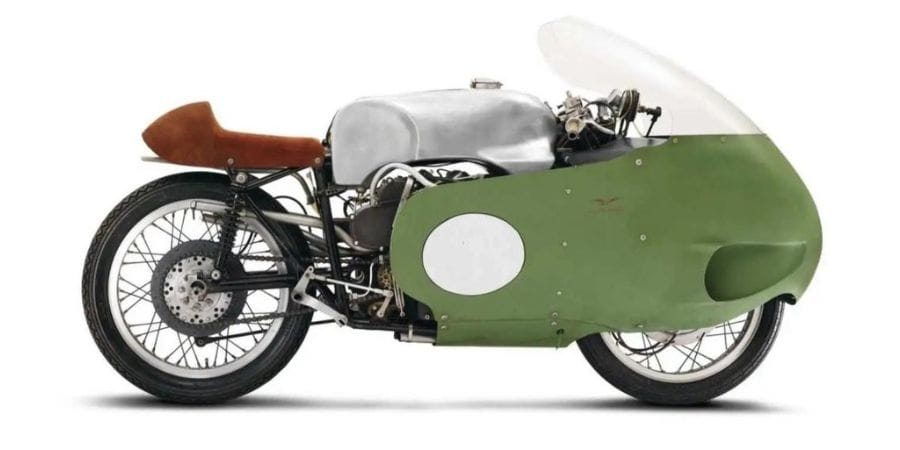
The most famous expression of that era's engineering ambition was the Otto Cilindri, a 500cc V8 grand prix engine that pushed well past anything the horizontal single could offer in outright speed. It never replaced the single in production bikes, but it proved the factory could build whatever it wanted when racing demanded it. The single remained the road bike's heart because Carlo Guzzi, and the engineers who followed his lead, still believed reliability sold more motorcycles than raw horsepower did.
What Carlo Left Behind, and How the V-Twin Arrived After Him
Carlo Guzzi died on 3 November 1964 in Mandello, the town where he'd built his engine and his company. The horizontal single he'd first sketched during the war had by then powered the marque for 43 years under his own direction, and it would keep rolling off the line a little while longer. The Falcone, the last of the classic horizontal singles, had entered production in 1950 and stayed in the lineup until 1967, bringing the single's production run close to 45 years from the original 500 Normale.
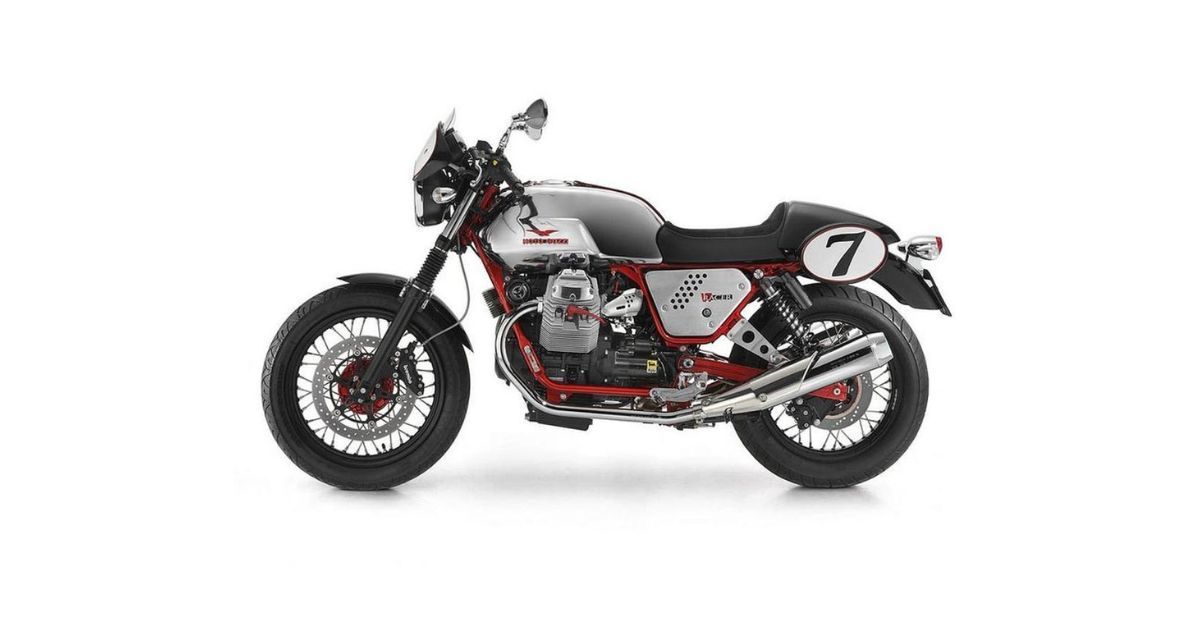
The engine that finally replaced it wasn't Carlo's design, and it wasn't even originally meant for a motorcycle. The transverse V-twin, designed by Giulio Cesare Carcano and later refined by Lino Tonti, began life as a project for a sporty Fiat 500 and as a contender for an Italian police motorcycle contract. When it arrived in the V7 in 1967, three years after Carlo's death, it replaced four and a half decades of horizontal-single orthodoxy with an air-cooled 90-degree V-twin, one-piece crankcase, pushrod valves, and shaft final drive, an architecture Moto Guzzi still builds today.
Carlo Guzzi never saw the V7. But the engineering instinct behind it, rational, essential, built for durability over spectacle, was his instinct first. Readers curious about how that philosophy shows up across the model range can dig into 25 interesting facts about Moto Guzzi, or browse current values and histories on RunMotoRun's Moto Guzzi history page and gear page.
Image credits: photobeppus, CC BY-SA 2.0, via Wikimedia Commons