
A museum turned down a motorcycle, and it wasn't Ducati's fault
In 1998, the Guggenheim Museum in New York hung a Ducati 916 on its wall as art. MoMA had been offered a 916 for its own collection and passed. The Guggenheim didn't hesitate, and the bike went on to sit alongside the San Francisco Museum of Modern Art's holdings too. That's an unusual amount of institutional respect for a motorcycle built to win races.
Motorcycle News called it, in 2014, the most beautiful bike of the last fifty years. Strip away the sentiment and you're left with a simple fact: no other superbike before it had managed to look inevitable, like it couldn't have been shaped any other way. That was Massimo Tamburini's doing, and it's why the 916 still commands attention, and rising money, three decades on.
The superbike landscape before the 916
By the late 1980s, Ducati's V-twins had a following but not a coherent visual identity. Bikes like the 750 SS and the 860 carried Fabio Taglioni's desmodromic engineering forward, but styling had been functional rather than deliberate. Meanwhile Japanese four-cylinder superbikes were getting faster every season, and Ducati needed something that could win on Sunday and be recognized instantly on Monday.
Massimo Tamburini began sketching what would become the 916 in 1988, working out of the Cagiva Research Center in San Marino. He'd already shaped bikes for MV Agusta and co-founded Bimota, so he came to the project with a rare combination: he understood chassis engineering as well as surfacing. Working alongside Sergio Robbiano at CRC, Tamburini spent five years refining the shape before Ducati presented it publicly at the Milan Motorcycle Show in October 1993. Production proper didn't start until 1994; the 1993 show bike was a debut, not a delivery.
Tamburini's design language
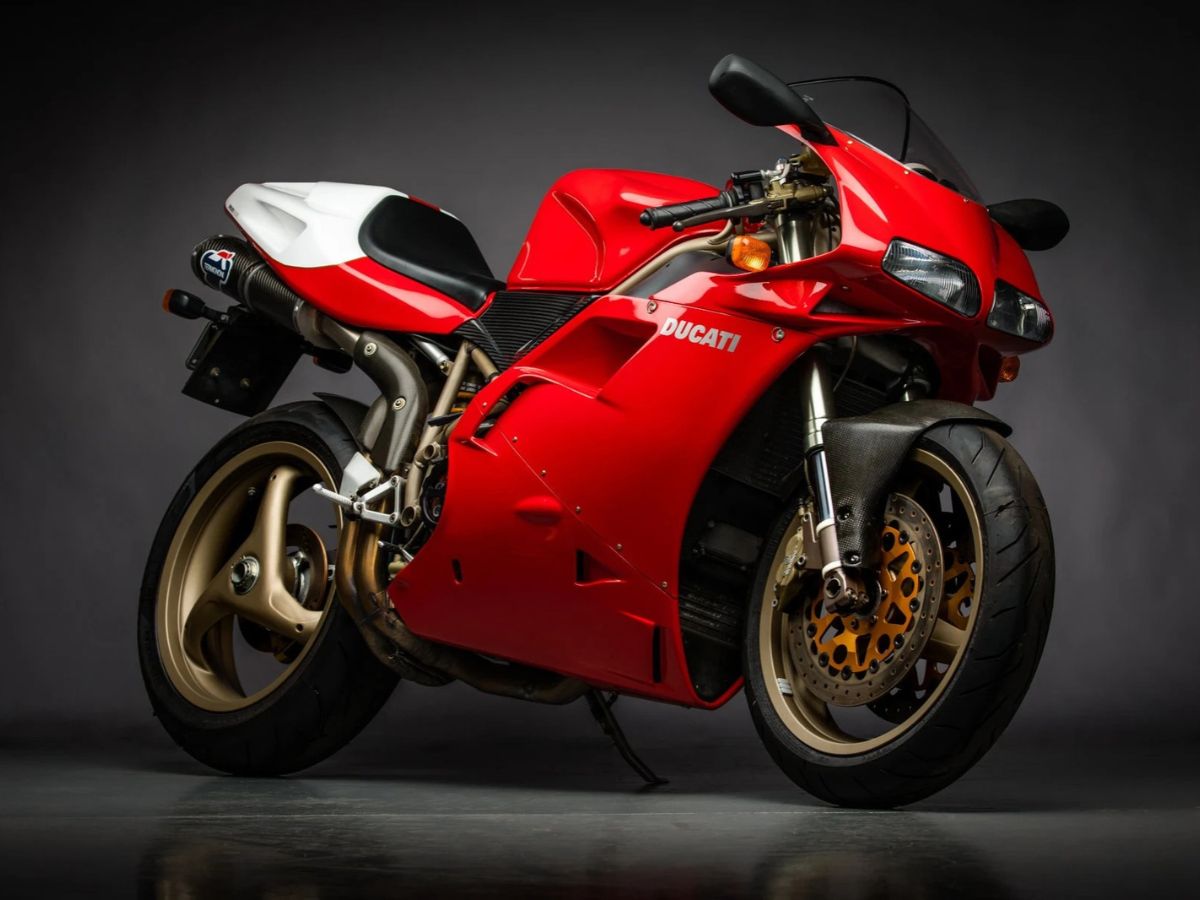
The 916's silhouette wasn't decoration bolted onto an existing platform. Tamburini reportedly drew inspiration from the female form for the twin headlights, the narrow hips at the tank, and the underseat exhaust that cleaned up the tail section like nothing before it. Every line served the next line.
The engineering backed up the styling. Positioning the battery beside the front cylinder helped Ducati achieve close to 50/50 weight distribution, a detail invisible to onlookers but felt instantly by anyone who rode one hard into a corner. The single-sided swingarm wasn't just a styling flourish either; it let race mechanics swap a rear wheel in seconds during a pit stop, a genuine functional answer disguised as a design statement.
Underneath the bodywork sat a 916cc, 90-degree V-twin with four-valve desmodromic heads and fuel injection, wrapped in a tubular steel trellis frame, a Ducati signature that Tamburini kept and refined rather than reinvented. The road bike made 109 hp at 9,000 rpm and 89 Nm of torque at 7,000 rpm, reached a top speed in the 257 to 260 km/h range, and weighed 194.5 kg dry. Suspension came from 43mm Showa upside-down forks up front and a Showa monoshock with progressive linkage at the rear, with dual 320mm front discs on four-piston calipers doing the stopping.
Foggy, the 916, and total World Superbike dominance
A design this considered still had to prove itself on track, and it did so almost immediately. Carl Fogarty officially rode the 916 starting in 1994 and won World Superbike titles that year and the next, 1994 and 1995, riding the bike that made his name and vice versa. Troy Corser took the 1996 title on the same basic machine, and Fogarty came back for a third championship in 1998, again on a 916.
Fogarty's fourth title in 1999 came on a 996-derived bike, but the racing lineage was unbroken. Across his career on 916s and their derivatives, Fogarty racked up more than 55 race wins. Steve Hislop added a British Superbike Championship on a 916 in 1995. For a five-year stretch, Ducati's V-twin was simply the bike to beat, and it did it on a chassis architecture that had started as a design sketch, not a race department blueprint.
The family: 916, 748, 955, 996, 998
Ducati didn't stop at one displacement. The platform spawned a 748cc version from 1995 for a lighter-revving, more accessible alternative, and eventually grew into the 996 and 998 as Ducati chased more power within World Superbike's rules. A 955 designation also appeared briefly in the racing lineage as displacement classes shifted.
Ducati built roughly 310 units of the 916 in its first year, 1994, and most of those went straight to race teams rather than dealers. Regular production ran from 1994 through 1998, when the model line gave way to the 996. A Carl Fogarty replica model followed in 2000, with 202 units produced, a tribute edition built for collectors rather than racers. If you want the fuller family tree of Ducati's V-twin sportbikes, the 748 is worth reading about on its own, and the Ducati history page fills in where the 916 sits in the wider timeline.
Why collectors are paying up now
Values have been climbing steadily, and the 916 has settled into blue-chip territory the way certain Ferraris and Porsches did years before their motorcycle equivalents caught on. First-year 1994 models are widely considered the pinnacle for investment purposes: they're the rarest, most were built for racing rather than road use, and they carry the direct connection to Fogarty's first title.
The 1994 and 1995 SP variants are generally rated the most collectible across the whole range, prized for their closer-to-race specification. Recent sale data backs up the trend: a low-mileage Varese-built 916 sold for around $65,000, a figure that would have seemed absurd for a Ducati sportbike a decade ago. Museum status helps too. A motorcycle that's hung in the Guggenheim carries a different kind of provenance than one that just won races, and buyers are willing to pay for both halves of that story.
A few things worth checking before you commit to buying one:
-
Frame and paint originality: many 916s have been crashed and repainted; original Ducati Rosso paint and a straight trellis frame matter enormously to value.
-
Year and model matters: a 1994 or 1995 SP will command a real premium over a later, more common 996 or 998; know exactly which variant you're looking at.
-
Service history on the belts and valves: desmodromic valve service isn't cheap to neglect or to catch up on; get documentation.
-
Race-derived parts versus stock: some bikes have been modified toward race spec, which can help or hurt value depending on the buyer.
-
Single-sided swingarm condition: check for wear and correct bearing service, since it's a structural component, not just a styling detail.
The bottom line
Massimo Tamburini died in April 2014, but the 916 has outlived the question of whether a motorcycle can be both a racing weapon and a museum object. It settled that argument decisively, and the market has been catching up to that fact ever since. For anyone tracking values or hunting for the right example, it pays to see live 916 auction results and valuation trends on RunMotoRun before making an offer.
Image credits: Public domain, via Wikimedia Commons; ScuderiaAssindia, CC BY-SA 3.0, via Wikimedia Commons