A Featherbed Frame Runs Out of Road
By the mid-1960s Norton had a problem it could not engineer its way around with more capacity alone. The Atlas, a 750cc stretch of the same basic parallel-twin that had powered Nortons since the 1940s, shook itself and its rider half to pieces at speed. The featherbed frame that had once been the envy of the racing world was never designed to carry an engine this big, and vibration was becoming a dealbreaker in a market where Honda's CB750 was about to arrive with an electric start and none of the shaking.
Norton's parent group, Associated Motor Cycles, collapsed in 1966. What emerged was Norton-Villiers, under chairman Dennis Poore, and Poore knew the Atlas could not simply be pensioned along. He wanted a genuine replacement, not another reskin, and he wanted it fast. Development started in 1966, with the new machine shown to the public at the Earls Court Show in 1967 under a name that suited the urgency: Commando.
The company that built it was, by any honest reading, in crisis. Britain's motorcycle industry as a whole was losing ground to Japanese manufacturers on price, reliability, and refinement. The Commando was Norton-Villiers' answer, and for a while it worked far better than anyone had a right to expect. For the fuller picture of how the wider industry got here, see our rundown of British motorcycle industry history.
The Isolastic Idea
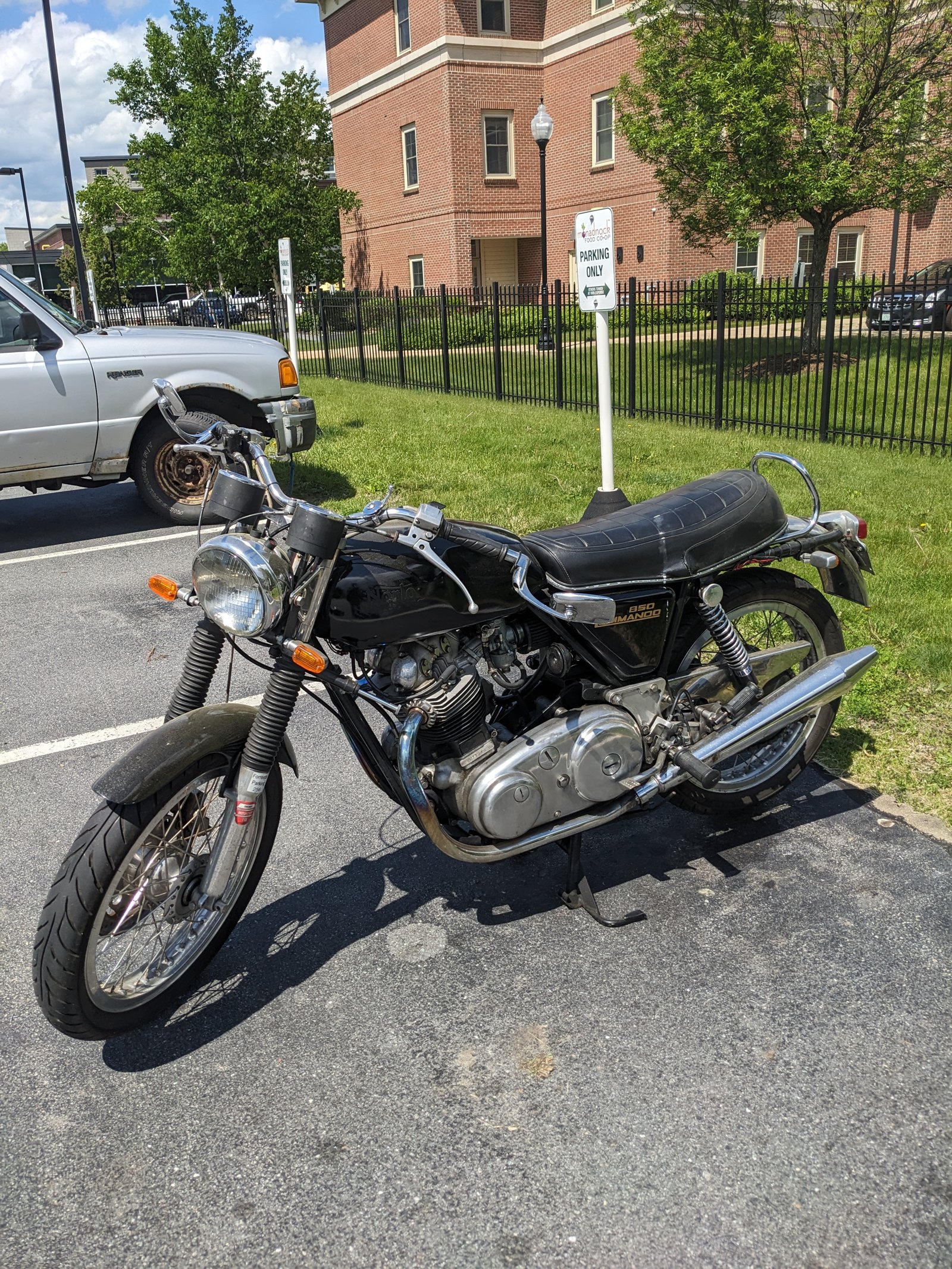
The engineering answer came from an unlikely source. Dr. Stephan Bauer, a former Rolls-Royce engineer, conceived the idea of isolating the vibrating powertrain from the frame with rubber, rather than trying to eliminate the vibration at its source. Norton-Villiers' chief engineer Bernard Hooper, with assistant Bob Trigg doing much of the development legwork, turned that concept into a patented system Norton called Isolastic, and it went on the production drawing under the internal name GlideRide.
The featherbed frame was dropped entirely. In its place came a new main frame built around a 2 1/4 inch top tube supporting a conventional duplex cradle that carried the engine, gearbox, and swinging rear fork as a single unit. That whole assembly floated inside the frame on rubber bushes, so the rider's hands, feet, and seat were largely spared the buzz that had defined big British twins for two decades.
It wasn't trouble-free from day one. The first production machines, completed in April 1968, developed a reputation for bending frames under hard use. Norton fixed it with a revised Isolastic frame introduced in January 1969, which resolved the structural issues that had marred the launch. There was a cost-cutting wrinkle too: the adjustable Mark III-type isolastic mounts used on prototypes were dropped for production in favor of shimmed washers, simply because they were cheaper to make. Owners today still spend time getting that shimming right, a small tax on riding one of the smoothest big twins Britain ever built.
750 or 850: Which Commando to Want
The Commando's decade-long run split neatly into two engine eras, and collectors still argue about which one they'd rather own. The original 745cc unit, in various tunes, powered every Commando from the 1967 launch through the Mark V in 1973. In standard road trim it produced around 58 bhp at 6,800 rpm, enough for a genuine 115 mph and a reputation as one of the fastest production roadsters of its era.
In 1973 Norton enlarged the engine to 828cc, marketed as the 850, with a bore and stroke of 77mm by 89mm. The bigger engine ran lower compression, around 8.5:1, and traded a little top-end urgency for smoother, more usable torque and, not coincidentally, a bit less strain on an engine that had already been pushed hard in its high-compression 750 forms. The John Player Special of 1974, a limited-edition 828cc model finished in racing colours honoring Norton's sponsor, is among the most sought-after Commandos on the market today.
Between those two engines sat the Combat, a short-lived 1972 high-compression 750 variant built for performance. It ran into reliability trouble quickly enough that Norton didn't keep it around, a reminder that squeezing more out of this engine had real limits. For sheer speed in period, nothing beat the Production Racer, nicknamed the Yellow Peril, hand-assembled with gasflowed heads and a racing camshaft to produce 66 to 68 bhp and a genuine 130 mph.
Winning on Track and in the Showroom
The Commando didn't just solve Norton's vibration problem, it won races and awards at the same time. The Production Racer, developed under engineer Peter Inchley at Thruxton, gave privateers a genuinely competitive machine straight from the factory, hand-built between 1970 and 1972 with blueprinted engines and high-compression pistons.
The clearest sign of how well the Commando landed with the people who mattered came from the trade press. It won Motor Cycle News' Machine of the Year award for five consecutive years, from 1968 to 1972, a run no other British bike matched during the period. For a company fighting for survival, that kind of sustained recognition was as valuable as any single race result.
It wasn't enough to reverse the industry's fortunes. When the wider Norton-Villiers-Triumph group needed rescuing later in the decade, government subsidy under Industry Secretary Tony Benn went to the Small Heath and Meriden operations, not to Commando production. The bike that had done so much to keep Norton's name alive ended up on the outside of the deal that kept British motorcycling limping forward a little longer.
Buying and Valuing a Commando Today
The Commando's cult status has only grown with distance. Lower survival rates than Japanese contemporaries, combined with a genuinely devoted following, keep Nortons priced above equivalent bikes from less-loved marques. Values have climbed noticeably in the last few years: one Commando sold for $20,000 on Bring a Trailer, a figure that made collectors sit up and take notice of how far the model has moved from its old reputation as an affordable classic.
The broader market still runs a wide range, roughly $5,000 to $20,000 or more, depending on condition, model year, and how original the bike remains. Certain variants command real premiums. The S Type, with its scrambler-style high-left exhaust and 2.5 gallon tank aimed at the American market, remains one of the most collectible of the early bikes, and the John Player Special's limited run has made it a genuine grail for Commando specialists.
Before buying, a few checks matter more than most:
Parts availability is genuinely good for a bike this old, which helps keep ownership realistic rather than aspirational. Track current Norton Commando auction values on RunMotoRun to see where the market sits before you commit to a purchase, and compare notes with our broader piece on 25 interesting facts about Norton motorcycles if you're still deciding whether the marque is for you.
- Isolastic shimming: check for correct clearance; sloppy or over-tight mounts cause handling quirks that get blamed on the frame instead of the maintenance
- Frame originality: early 1968 frames had known weaknesses before the January 1969 revision, so verify which frame type is fitted
- Engine number and matching: confirm the engine and frame numbers correspond to the claimed model year, especially on desirable variants like the S Type or John Player Special
- Electrics and charging: period Lucas systems are a known weak point across British twins of this era, not unique to Norton but worth budgeting for
- Documentation: ownership history and prior restoration invoices matter more on a Commando than on most classics, given how actively the market now scrutinizes originality
Image credits: Daniel Hartwig from San Mateo, CA, USA, CC BY 2.0, via Wikimedia Commons; Artaxerxes, CC BY 4.0, via Wikimedia Commons