A Sicilian count, a factory near Milan, and a motorcycle nobody planned
MV Agusta exists because a helicopter company needed something to build while Italy figured out what to do with its aircraft industry after the war. That's not a marketing story. It's the literal origin of one of the most decorated names in motorcycle racing.
The Agusta family's connection to flight goes back to 1907, when Count Giovanni Agusta, a Sicilian aristocrat obsessed with flying machines, founded the Agusta aeronautics company. His son Domenico took over the business after Giovanni's death in 1927 and kept it running through the war years, building aircraft for a regime that no longer existed by 1945.
With Italy's aviation industry banned from producing aircraft under the postwar armistice terms, Domenico Agusta pivoted the Cascina Costa factory near Milan toward something the country desperately needed: cheap transport. He founded Meccanica Verghera, MV, on 19 January 1945 as a branch of the family firm. By that autumn the company had its first product, the MV 98, a simple 98cc runabout built to get Italy moving again.
Building the racing empire
Domenico Agusta didn't just want to sell motorcycles. He wanted to win with them, and he had the aviation profits to make that happen. Franco Bertoni took MV Agusta's first race win on an MV 98 Sport in 1947, and within a few years the small Cascina Costa outfit was fielding serious Grand Prix machinery.
The results, once they started, didn't stop. Cecil Sandford delivered MV's first world rider's and constructor's championships in 1952 in the 125cc class. John Surtees gave the marque its first premier-class title in the 500cc category in 1956, and Carlo Ubbiali added five 125cc titles and two 250cc crowns to the tally through the 1950s. By 1953, annual production at the factory had climbed past 20,000 units, proof that the racing program wasn't just prestige spending, it was building a brand people wanted to own.
Then came Giacomo Agostini. Riding for MV Agusta, Agostini won seven consecutive 500cc World Championships between 1966 and 1972, added an eighth in 1975, and stacked seven straight 350cc titles on top of that between 1968 and 1974. He also won at the Isle of Man TT ten times. Across his career, Agostini took 122 Grand Prix victories and 15 world titles, more than any rider in the history of Grand Prix racing, and the great majority of it came in MV Agusta colors.
Add in names like Mike Hailwood, Phil Read, Les Graham, Tarquinio Provini, and Luigi Taveri, and you get a roll call that reads like a history of Grand Prix racing itself. Between 1952 and 1974, MV Agusta won 37 World Championship titles across the 125cc, 250cc, 350cc, and 500cc classes, including that run of 17 consecutive 500cc titles, plus 34 victories at the Isle of Man TT. Other tallies, counting both riders' and constructors' championships together, put the total closer to 75. However you count it, no other marque has come close.
The road bikes: what the racing paid for
Domenico Agusta treated the road bikes almost as an afterthought, a way of funding the race team rather than the point of the company. Even so, the production machines carried real engineering DNA from the track, and none more than the 750S.
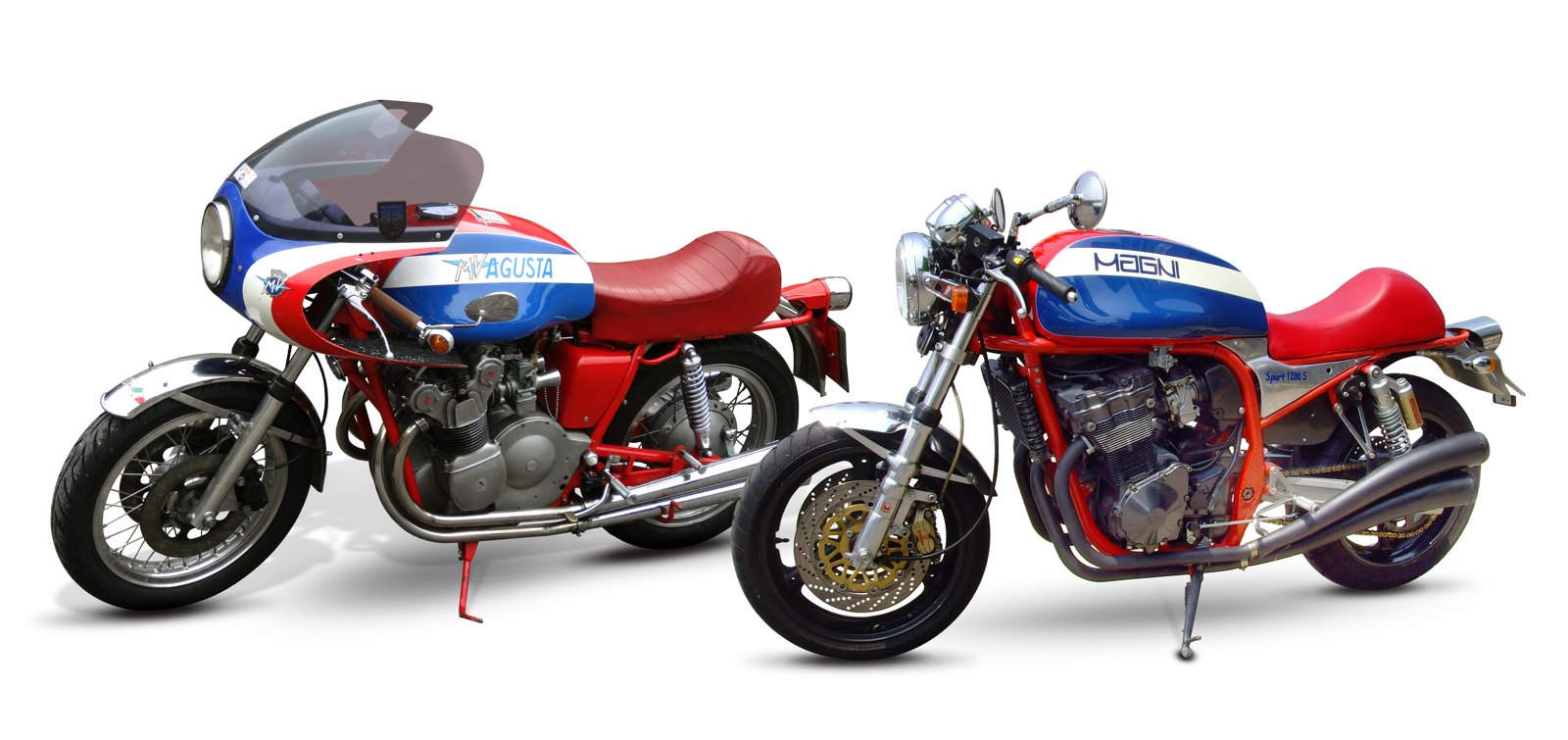
The MV Agusta 750 Sport, later the 750S, debuted in 1970 and ran through 1975. Its 743cc DOHC inline-four made 72 bhp at 9,200 rpm and pushed the bike to a genuine 120 mph, numbers that put it in rare company for a road-legal motorcycle of that era. Only 583 were built, which is a big part of why surviving examples now command serious money at auction.
The road bikes never sold in volume the way the smaller-capacity machines did, but they didn't need to. They existed to prove that a company capable of winning 17 straight world titles could also build something you could ride to dinner. For collectors comparing exotic Italian fours from the period, it's worth reading up on Ducati's history and the Ducati 750 SS as a useful point of comparison, since both marques were chasing the same idea from different directions.
Bankruptcy, silence, and a false start
Domenico Agusta died in 1971, and the company that had run largely on his personal will and his family's aviation money lost its center of gravity almost immediately. In 1973 the Agusta family sold 51 percent of MV Agusta to EFIM, a state-backed financing group, and the racing program that had defined the brand began to wind down.
Agostini delivered MV Agusta's last world championship, to date, in 1976. Without the count's direct involvement and without the appetite for continued racing losses, the motorcycle division became a smaller and smaller part of a business whose real money was in helicopters. Production dwindled through the late 1970s and into the 1980s, and by the middle of that decade the MV Agusta name had effectively gone dark.
It's easy to forget, looking at today's exotic superbikes, that there was a real stretch of years when MV Agusta simply wasn't making motorcycles at all. The name sat dormant, a piece of racing history rather than an active manufacturer.
Rebirth: Cagiva, Tamburini, and the F4
The revival came from an unexpected direction. In 1997, Cagiva, the Varese manufacturer that had already saved Ducati once, bought the dormant MV Agusta name and set about giving it a motorcycle worthy of the badge.
That motorcycle was the F4, designed by Massimo Tamburini at the Cagiva Research Center. Tamburini was already responsible for some of the most admired Italian sportbike designs of the era, and the F4 750 Serie Oro, first shown at the 1997 Milan EICMA show before reaching customers around 1998 to 1999, was built to announce that MV Agusta was back at the top of the sportbike world, not just trading on old glory.
The F4 line stayed in production from 1999 to 2018, and it produced some genuinely extreme variants along the way. The 2002 F4 750 Senna, a tribute edition, carried a 749cc liquid-cooled four making 146 hp at 12,900 rpm, numbers that would have been unthinkable on the 1970s 750S. MV Agusta's ownership kept shifting after that, with Mercedes-AMG acquiring a 25 percent stake in 2014, but the F4 had already done its job: it proved the brand could still build something worth wanting.
Why collectors care now
MV Agusta's value to collectors rests on two separate but connected legacies. There's the pure racing history, 37 world titles by one count, 75 by another, built on the backs of Agostini, Surtees, Ubbiali, and Hailwood, a record no other manufacturer has matched. And there's the road bikes that trickled down from that program in tiny numbers, the 750S chief among them at just 583 units built.
That scarcity is exactly why the market treats MV Agusta the way it does. A 750S in good original condition is a different tier of collectible from most 1970s Italian fours, precisely because so few were made and because the bike's connection to the racing dynasty is direct rather than implied.
The modern F4 generation adds another collecting lane entirely, with Tamburini's design work and limited-run variants like the Senna drawing their own following among people who want the racing pedigree in a bike they can actually register and ride. Whether your interest is a 1950s Grand Prix machine, a 750S, or a Tamburini-era F4, the throughline is the same 37-title story. If you're weighing where MV Agusta fits against other Italian exotica, our history of Ducati and Moto Guzzi pieces are worth a look for context.
See MV Agusta models and auction valuations on RunMotoRun if you're ready to start comparing specific machines.
Image credits: Auge=mit, CC BY-SA 4.0, via Openverse; beide Quellen: Klaus Nahr (Flickr) / Freisteller, Bildbearbeitung & Retusche, CC BY-SA 4.0, via Wikimedia Commons