For a few years either side of 1960, the Birmingham Small Arms Company was the largest motorcycle manufacturer on earth. It had grown out of a cartel of Victorian gunsmiths, survived two world wars and the Birmingham Blitz, owned Triumph, Ariel, Sunbeam, Daimler and Lanchester, won two motocross world championships and the Daytona 200, and put more than a hundred thousand machines under the British Army. Thirteen years later it did not exist.
This is the full story of the marque from Small Heath, researched from primary and specialist sources and written to correct the errors that circulate in almost every short account of BSA — including in earlier versions of this page. Where sources genuinely disagree, we say so rather than picking the tidiest version.
The Gun Trade Origins: Birmingham, 1861
Two things called BSA are routinely confused, and the confusion starts at the beginning.
The Birmingham Small Arms Trade Association was a body of master gunsmiths, generally dated to around 1854 and formalised by an Act of Parliament in 1855, which allowed any gunmaker within ten miles of Birmingham to join. The Birmingham Small Arms Company Limited was something different and, at first, something its own trade resented: a joint-stock company formed on 7 June 1861 by a group of gunsmiths — usually given as fourteen, though sources also say sixteen or twenty-four — specifically "to manufacture guns by machinery."
The Crimean War is often given as the reason. Strictly, the war had ended in 1856, five years before the company existed. What drove incorporation was the lesson of that war: Birmingham's hand-craft trade could not supply arms at scale, and in 1855 the government's own Royal Small Arms Factory at Enfield had begun mechanised production with American machinery and interchangeable parts. The Birmingham masters incorporated to compete on Enfield's terms. The War Office helped, granting access to its drawings and to the Enfield factory itself, and BSA bought its machinery from Greenwood and Batley of Leeds.
In 1862 the company took a 25-acre site on Golden Hillock Lane in Small Heath, cut a road across it and named that road Armoury Road — an address that would appear on motorcycle frames for over sixty years. The factory, "a square fortress building with towers to each corner," opened in 1863. The land cost £300 an acre, the buildings £17,050, against an initial capitalisation of £24,500. Chairman John Dent Goodman bridged both organisations, having chaired the Trade before the Company existed.
The order that secured BSA's future came in 1863: 20,000 Enfield rifles for Turkey, BSA's share of a 50,000-gun order placed with the Birmingham trade as a whole. In 1866 came the first British contract — converting 100,000 muzzle-loaders to the Snider breech-loading principle for £98,750, delivered seven weeks early in February 1868. Martini-Henry production followed in the 1870s, and Lee-Metford rifles at 1,200 a week during the Army's re-equipment of the 1880s.
Bicycles, Fittings and False Starts (1878–1909)
Arms contracts came in lumps, and between them there was nothing. On 19 August 1878 the factory closed altogether and stayed shut for about a year. It is worth pausing on that date, because the claim that BSA was "the largest arms manufacturer in Europe by 1880" — repeated on countless websites — describes a company that had just been idle for twelve months for want of work. There is no support for it.
What saved BSA was diversification, and specifically two wheels. In 1880 the company contracted to build 210 Otto Patent Safety Dicycles at £8 15s each — E. C. F. Otto having reportedly demonstrated his machine to the directors by riding it across the boardroom table and down the staircase. In 1881 BSA resolved to manufacture bicycles and tricycles and registered the trademark that would define it: three stacked rifles, the "piled arms", a mark already used informally as the company's sign. (For the full evolution of the badge, see our BSA logo history.)
Then BSA made its first great strategic error. In 1887 it stopped making cycles to free capacity for the Lee-Metford rifle — and so sat out the pneumatic-tyred safety-bicycle boom that made fortunes elsewhere. It returned to the trade in 1893, but only as a component maker, selling "BSA fittings": hubs, brackets, cranks, forks. Complete BSA bicycles did not reappear until 1908, twenty-one years after they stopped, and then largely because BSA's fittings were being counterfeited.
That fittings business is the hinge of the whole story, and it explains a claim that needs correcting. BSA's modern corporate site states that "the brand's motorcycle division was set up in 1903." No historical source supports a motorcycle division in 1903. What BSA actually did was introduce motorcycle fittings from about 1901–02 — reinforced frames, strengthened forks and heavy-duty hubs — so that other firms could build motor bicycles, typically around Belgian Minerva engines. BSA built its own experimental machine around 1905 using a bought-in engine, and in July 1906 The Motor Cycle reported that BSA had "decided to take up the manufacture of a light motor bicycle."
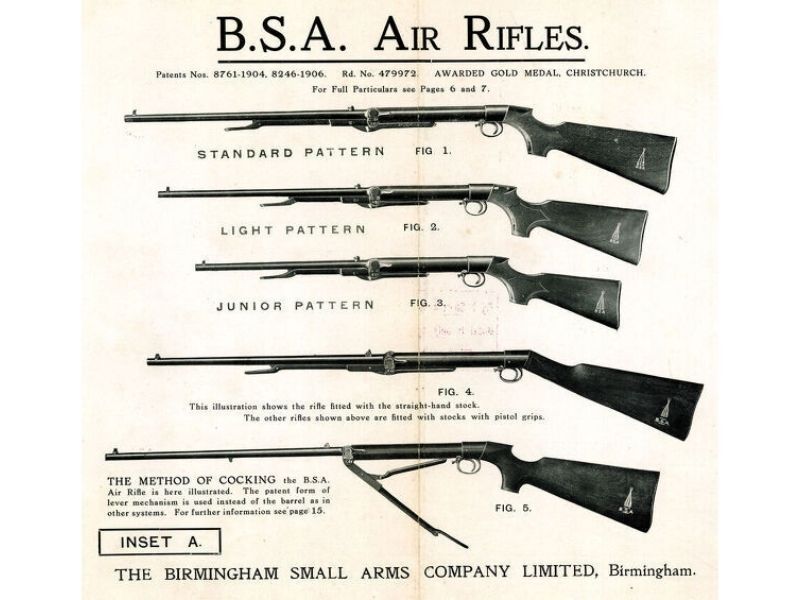
Two acquisitions made the leap possible: the Royal Small Arms Factory at Sparkbrook in 1906, and the Eadie Manufacturing Company of Redditch in 1907. Air rifles, still made in Birmingham today, began around 1904.
The First BSA Motorcycle (1910–1914)
You will see BSA's first motorcycle dated to both 1909 and 1910. Both camps are describing something real, and the reconciliation is straightforward: the machine was built in 1910 and shown publicly that November, at Olympia on 21 November 1910 (stand 66), as a 1911-season model. Customers took delivery in 1911. Sources saying "1909" are dating the internal decision and design work, not a machine anyone could buy.
It had no model letter — it was simply "the 3½ h.p." Beneath that rating sat a vertical 499cc single, 85 × 88mm, with mechanically operated inlet and exhaust valves, which was notable in 1910 when automatic inlet valves were still common. Ignition was by chain-driven magneto in an aluminium case, final drive by adjustable-pulley belt with the pedalling gear retained, and braking by a pedal-operated dummy belt rim. Heavy flywheels let it pull down to 3 mph. It cost £50, or £56 10s with the "free engine" cone clutch, and it wore the green-and-yellow tank that identified early BSAs.
You will also see a top speed of 30 mph quoted for this machine, including in the previous version of this page. No period or authoritative source gives a figure, and we are not going to invent one.
It sold, though. BSA's entire output was taken up in 1911, 1912 and 1913. Model letters A to D arrived for 1912 with interchangeable components — the Model D a 4¼ hp, 550cc, three-speed TT variant — followed in 1914 by the 557cc Model H with all-chain drive for sidecar work. (Do not confuse it with Triumph's far more famous WWI Model H; careless sources do.)
The Great War: Rifles, Not Motorcycles
Something else needs correcting here, because two respected classic-bike outlets have published it. BSA's Great War contribution was not 126,334 motorcycles or a fleet of M20s — the M20 did not exist until 1937. That is a Second World War figure imported into a First World War paragraph.
What BSA actually did between 1914 and 1918 was arm the Empire. Rifle output rose from 650 a week before the war to a peak of 10,000 SMLE Mk III .303 rifles a week, totalling around 1.6 million (the precise figure of 1,601,608 appears in American Rifleman; BSA's own literature rounds it to 1.5 million). Each rifle had 131 components and required 149 machining operations on the body alone. BSA also bought the Lewis gun licence in 1914 and became its sole European manufacturer, building roughly 145,400 of them; over 30,000 reached the BEF in France alone. Add shells, fuses, gun locks, machine tools and one of the first mass-produced folding military bicycles, and — through its Daimler subsidiary — aero engines, aircraft, ambulances and staff cars, including the engine and transmission of the world's first tank.
Motorcycles were a casualty of all this. Civilian vehicle production was largely suspended after November 1916, and BSA is essentially absent from surveys of British WWI military motorcycles, a field dominated by Douglas, Triumph and Royal Enfield. The workforce grew from somewhere between five and six and a half thousand to nearly 20,000 at the peak, much of the increase being women.
The 1920s: Round Tanks, Slopers and "One in Four"
Peace brought BSA Cycles Ltd (incorporated 1919, building both bicycles and motorcycles) and, that November, BSA's first V-twin: the Model E, a 50-degree 770cc side-valve of 6–7 hp at £130, good for about 55 mph and usually sold with a matching green-and-cream sidecar. A 986cc Model F followed in 1922 and evolved into the Model G, which lasted until the Second World War. Between 1920 and 1925 BSA even built about a hundred three-wheeled taxi cabs on Model E engines.
The machine that made BSA a household name was smaller and cheaper. The Model B "Round Tank" of January 1924 was a 249cc side-valve single with two speeds, all-chain drive and a rear brake only, at £39 10s. Over 35,000 Round Tanks and their later wedge-tank derivatives were sold, and the General Post Office adopted them for telegram delivery. For hundreds of thousands of people this was the first motor vehicle they could afford.
Then came the machine that changed how motorcycles looked. The Sloper, designed by Harold Briggs (recruited from Daimler) and announced in August 1926 as a 1927-season model, put a 493cc overhead-valve single in the frame at an angle, under a saddle tank, with a low seat. It ran until 1935 in capacities up to 595cc, and Ariel and Triumph spent the next decade following its styling lead.
This is where the most-repeated BSA statistic comes from, and it needs handling carefully. "One in four is a BSA" was an advertising slogan, best dated to roughly 1927–1930 — the BSA Owners Club, which is the claim's own custodian, presents it as exactly that, an inter-war slogan that "could be adopted without fear of contradiction." It is not an audited market-share figure, and it is a different claim from the "one in four motorcycles sold worldwide" line that BSA's modern owners attach to the 1950s.
What is documented is scale. The Times recorded in 1932 that BSA "remained the largest manufacturer of motorcycles" even as the market shrank to less than half its late-1920s size, and BSA's own 1937 sales came to 56,077 machines — a figure that must include exports, since total UK new registrations that year were 46,500.
Cars, Three-Wheelers and the Conglomerate Habit
Along the way BSA acquired the habit that would eventually kill it: buying companies it could not integrate.
BSA built its own cars from 1907, and by 1909 the venture was failing. The response, in October 1910, was to buy the Daimler Motor Company of Coventry with BSA shares — a rescue of BSA's car ambitions rather than the start of them. It was, on Wikipedia's summary of the corporate record, a combine "never adequately balanced or co-ordinated": there was no integration of facilities, and a provision obliged Daimler to pay BSA an annual dividend of £100,000, roughly 40% of the cash BSA had actually invested, starving Daimler of development capital for decades. By 1913 Daimler employed 5,000 people to build 1,000 vehicles.
Worse followed. In February 1920 BSA bought Airco, then the world's largest aircraft manufacturer, discovered within days that it was insolvent, and liquidated the acquisition. BSA paid no dividend for four years.
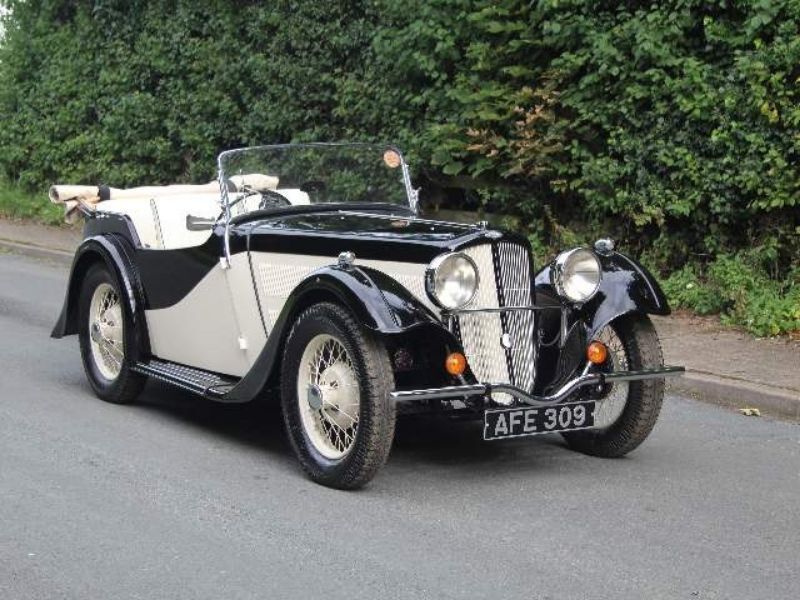
The car side produced some genuinely interesting engineering. BSA's 1929 three-wheeler — 1,021cc air-cooled V-twin, 9 hp — was front-wheel drive, with independent front suspension, a reverse gear, electric start and full weather protection, all of which Morgan lacked. About 6,650 were built to 1935. The front-wheel-drive BSA Scout followed from April 1935 at £149 10s, with eight quarter-elliptic springs at the front, running through six series until 3 September 1939; roughly 3,000 were made. Lanchester was bought at the turn of 1930–31 and folded into Daimler's Coventry works. BSA, Daimler and Lanchester all passed to Jaguar in 1960.
Blue Star to Empire Star: The Sporting Singles (1932–1936)
BSA's reputation in the 1920s was for solid, cheap transport. The 1930s gave it a sporting one.
The Blue Star, announced late 1931 and catalogued from 1932 to 1936, came in 249, 349 and 499cc overhead-valve form with high-compression pistons, special cams, twin exhaust ports, a positive-stop foot gearchange and an enamelled star on the timing case. The 499 was the best seller and the direct ancestor of everything that followed. Bert Perrigo, who had joined the competition department in 1926, was so closely involved that he was paid a half-penny royalty on every Blue Star sold.
The Empire Star was announced in 1935 to mark the Silver Jubilee of King George V and sold from 1936 to 1939, advertised as "The Masterpiece of the Industry." It added an alloy primary chaincase, a hardened bore, dry-sump lubrication and a relocated Magdyno. To prove it, BSA ran a 500 for 500 miles at Brooklands at over 70 mph, then a further 1,000 miles round Britain without needing a spare part.
The designer usually credited with all this is Val Page, who arrived at BSA in 1936 from Triumph, having previously created the engines behind the Brough Superior SS80 and SS100 and Ariel's Red Hunter line. The credit needs a small correction: Page arrived after the Empire Star was announced (some sources credit the 496cc head to David Munro). Page's genuinely new engine appeared for 1937, and it is that engine — and its distinctive shape, which lasted twenty-five years — on which the Gold Star was built.
30 June 1937: How the Gold Star Got Its Name
BSA's most famous model name was won in about eight minutes of racing, and the details are worth getting right because they are constantly garbled.
On 30 June 1937, at a Brooklands meeting, Wal Handley — a four-time Isle of Man TT winner, then in retirement — was persuaded back to ride a 496cc Empire Star prepared at Small Heath by Jack Amott, Len Crisp and others. It was outwardly near-standard, with a racing riding position and a big fishtail on the silencer, but it ran a racing carburettor, a new-design magneto, close-ratio gears and alcohol fuel. It was BSA's return to road racing after sixteen years.
Handley won the three-lap 500cc race by several hundred yards from R. C. Appleby's Excelsior. Two speeds came out of it, and secondary accounts constantly swap them: the race average was 102.27 mph, and the fastest lap 107.57 mph. Because he had exceeded 100 mph on a lap during a race — a materially harder feat than a record attempt — he was awarded a Brooklands Gold Star badge. The machine itself was destroyed in its second outing when Handley collided with another rider; a replica built for the 75th anniversary in 2012 now lives at Brooklands Museum.
Bert Perrigo then persuaded BSA's management to turn the badge into a model, and the M24 Gold Star was announced late in 1937 as a 1938 machine: 496cc, 82 × 94mm, with an all-alloy deeply finned cylinder and head, an Elektron magnesium-alloy gearbox, a Reynolds 531 frame deliberately built without sidecar lugs, and dual compression ratings of 7.75:1 on petrol or 12.5:1 on dope. Around 30 bhp gave 90–95 mph in road trim. Only two pre-war variants were built — the 1938 JM24 and 1939 KM24 — totalling 564 machines before the war stopped everything.
Rearmament, the M20, and 19 November 1940
BSA had never scrapped its Great War gun-making plant; it had stored it at company expense for twenty years "in the belief that BSA might again be called upon." In the late 1930s that decision paid off. By March 1939 BSA was building 600 .303 Browning aircraft machine guns a week for the Air Ministry — the guns in the wings of Spitfires and Hurricanes. It signed a licence with Československá zbrojovka Brno for what became the Besa machine gun (BESA: BSA plus Brno), took on the Boys anti-tank rifle from 1937, and Daimler brought an aero-engine shadow factory into production during 1938.
Its motorcycle contribution was the M20: a 496cc side-valve single by Val Page, 13 bhp at 4,200 rpm, heavy, slow, low on ground clearance — and almost unbreakable. It failed its first War Office submission in 1936 for unacceptable engine wear, needing a new piston and barrel after about 6,000 miles. Three more were submitted in 1937, of which two "just passed" the 10,000-mile trials at Chertsey. On the outbreak of war the government requisitioned the 690 machines BSA had in stock and ordered 8,000 more.
By 1945 BSA had supplied 126,334 military motorcycles, the overwhelming majority of them M20s — roughly thirty per cent of the entire British industry's wartime motorcycle output. (The commonly published "126,334 M20s" over-attributes slightly: BSA also built the 600cc M21 and other War Department variants.) Alongside them came 1,250,000 Lee-Enfields, 404,383 Stens, 468,098 Brownings, 68,882 Boys rifles, 42,532 Hispano and 32,971 Oerlikon cannon, 62,540 Besa guns and 128,000 military bicycles, across 67 factories at peak.
A warning for anyone researching this period: several websites publish BSA's First World War figures — 1.5 million rifles, 10,000 a week, 145,000 Lewis guns, 20,000 peak employees — as Second World War figures, because a widely-copied source says only "the war."
And then there is the day almost every short history of BSA leaves out. Small Heath had already been hit on 26 August 1940, losing 750 machine tools without fatalities. On the evening of Tuesday 19 November 1940, with around a thousand workers on the night shift, two bombs collapsed the "New Building" that housed the Browning machine-gun plant along with machinery for the Bren, Besa, Boys and Lee-Enfield and for motorcycle components. Fifty-three employees were killed and 89 injured, aged between 18 and 68, ten of them women. It took six weeks to recover all the bodies. Around 1,600 machine tools were destroyed across the raids and rifle production stopped for three months. Sixteen gallantry awards followed, eight of them to BSA employees. It was the most devastating single attack on Birmingham of the entire war.
Empire Building: Sunbeam, Ariel, New Hudson — and Triumph
BSA emerged from the war with cash, contracts and an appetite. Sunbeam came from AMC in 1943–44 (sources split between the two years), Ariel in 1944 from Jack Sangster, and New Hudson at some point between about 1946 and 1950 — genuinely contested, so we will not pretend to a date.
The big one was Triumph. Sangster had bought Triumph in 1936 for around £50,000, installed Edward Turner and produced the Speed Twin, the machine that forced every British maker into parallel twins. In 1951 he sold Triumph Engineering to BSA for a reported £2.5 million and joined the BSA board; in 1956 he took the chair from Sir Bernard Docker after a boardroom fight and made Turner chief executive of the automotive division.
That purchase is the moment BSA became the largest producer of motorcycles in the world. Note what that claim is and isn't: it is volume leadership, well attested from 1951 onward and by some accounts already true between the wars. The specific figure of a 25% global market share in the 1950s has no primary sourcing behind it whatsoever — it appears in BSA's own modern marketing copy and in secondary articles that cite nothing — and it is implausible against contemporaneous output from NSU, Harley-Davidson, Moto Guzzi and the rising Japanese makers. In 1953 motorcycles were carved out of BSA Cycles Ltd into a separate BSA Motorcycles Ltd; the bicycle business went to Raleigh in 1957.
The Bantam: Britain's Motorcycle (1948–1971)
The most numerous BSA ever built was German. The DKW RT125 came to the Allies as war reparations, and BSA's engineers redrew it as a mirror image so the gearchange fell on the right in British fashion, converting the measurements from metric to inches as they went. The same drawings produced the Harley-Davidson S-125 and Hummer in America, the SHL and Sokół in Poland, and the Minsk in the USSR.
The D1 Bantam appeared in 1948 — export markets first, Britain in 1949 — with 123cc, 4 bhp, 45 mph and a price of £60 plus about £16 purchase tax. It ran through the 148cc D3 Major (1954), the 173cc D5, D7, D10 and D14/4, and finally the B175, which lasted until 1971: twenty-three years, longer than any other BSA. Exact production was never recorded; sourced estimates run from 350,000 to 500,000, with 400,000 the figure most often quoted. (The "250,000" you may see is unsupported, as is the claim that the D1 was 148cc — that was the 1954 D3.)
It taught a generation to ride, delivered telegrams, won ISDT gold medals, and remains the cheapest way into classic British motorcycling.
The Twins: A7, Golden Flash, and the Gold Star Perfected
BSA's answer to the Speed Twin was the A7, launched in September 1946 at 495cc and 26 bhp, from a design team led by Val Page with David Munro and a colleague whose surname the sources cannot agree on (Perkins or Parker). A 495cc prototype had actually been ready for the 1940 catalogue before the war intervened.
Its bigger brother mattered more. Bert Hopwood designed the 646cc A10 Golden Flash, unveiled at the Motor Cycle Show in the autumn of 1949 for the 1950 season. It was named for its beige-gold finish — a marketing masterstroke that outsold Triumph's Speed Twin and Thunderbird, and which British buyers initially could not have at all, because 80% of production went to the United States and home-market bikes came in black only.
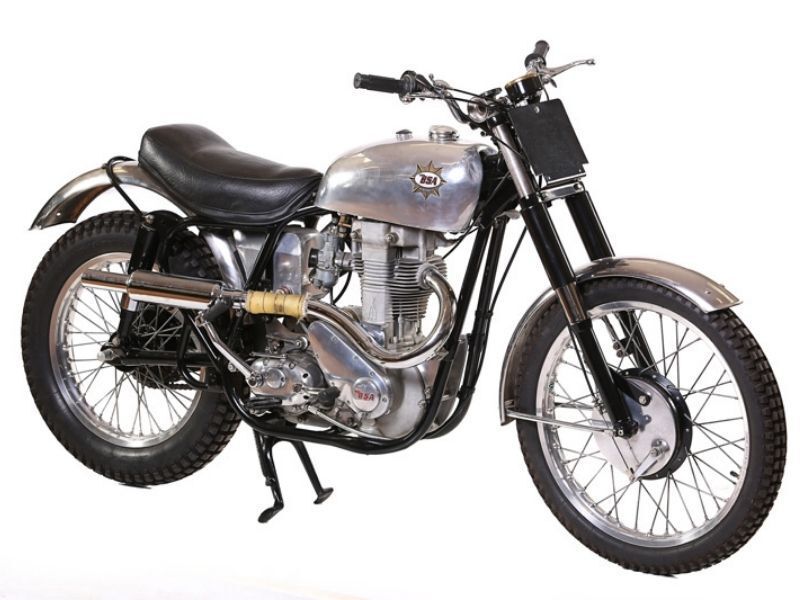
Meanwhile the Gold Star became the most admired sporting single in Britain, through a famous alphabet of prefixes: ZB (from the 1948 Earls Court show, all-alloy engine), BB (1953, swinging-arm duplex frame), CB (1954, the deep-finned "Big Fin"), DB (1955, improved oil feed and finned brakes) and finally the DBD34 of 1956 — 500cc, a 38mm bell-mouth Amal, around 40 bhp at 7,000 rpm and 110 mph, at £277 in Clubmans or Scrambles trim.
Its dominance of the Clubmans TT is the stuff of legend and is usually mis-cited. The correct figures: in 1949, 21 of 74 starters in the Junior Clubmans were Gold Stars, and Harold Clark won. By the 1955 Junior, 33 of the 37 entries were 350 Gold Stars. In the 1956 Senior, every entrant bar one of a field of 55 was Gold Star mounted, and Bernard Codd won both Senior and Junior. The organisers concluded that races made up of a single model were not a sound idea and abolished the Clubmans TT for 1957. BSA had won the class to death.
Gold Star production itself ended in 1963 — not because of Japanese competition, but because Lucas stopped making the magneto.
The Maudes Trophy, and Daytona 1954
The Maudes Trophy was established in 1923 by George Pettyt of Maudes Motor Mart and awarded by the Auto-Cycle Union for the most meritorious independently observed endurance demonstration, usually on machines the observers themselves picked at random. Attempts were rare; many years had no winner.
BSA's record is 1926 (sixty climbs of Bwlch y Groes), 1938 (an M21 combination and an M23 Empire Star: twenty climbs of Bwlch y Groes, Brooklands acceleration, speed and braking tests, twenty more climbs, then crossing London north–south and east–west entirely in top gear) and 1952.
The 1952 ride is the great one. Three 500cc A7 Star Twins were taken at random off the production line and ridden by Norman Vanhouse, Fred Rist and Brian Martin, managed by Bert Perrigo, for 4,958 ACU-observed miles through Austria, Germany, Denmark and Norway — including the ISDT in Austria, where all three won gold medals, and flying quarter-mile runs at over 80 mph at Oslo. It was the first post-war award of the trophy.
Two corrections. The previous version of this page dated a BSA Maudes win to 1931: that year's trophy went to Ariel, for a seven-machine demonstration that also used Bwlch y Groes, which is almost certainly the source of the confusion. And there was no 1953 BSA win — the 1952 achievement was simply publicised heavily through 1953.
Two years later BSA did something in America that nobody has quite repeated. At the 1954 Daytona 200, run on the beach-and-road course with 111 starters, BSA shipped five factory-prepared machines from Birmingham — two Shooting Star twins and three Gold Star singles — under Roland Pike with Cyril Halliburn tuning. Bobby Hill won on a 500cc A7 twin in 2h 07m 22.7s at 94.24 mph, from Dick Klamfoth twenty seconds back on another twin and Tommy McDermott third on a Gold Star single. By the best-documented account BSA took the first five places; some sources record only the top three. Either way, clip-on bars and a four-speed gearbox had comprehensively beaten Harley-Davidson and Indian on their own sand.
Unit Construction and the Small Singles (1958–1971)
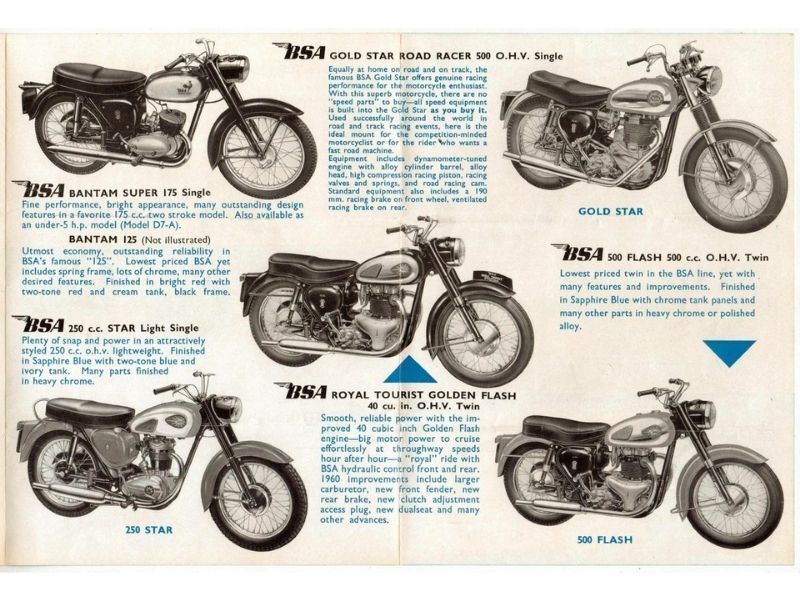
In September 1958 BSA launched the C15, its first four-stroke unit-construction machine: a 250cc overhead-valve single of 15 bhp. Its engine was a scaled-up Triumph Tiger Cub, which had itself grown from the 150cc Terrier — Edward Turner's design, wearing BSA badges, a direct consequence of the 1951 takeover. Variants multiplied: the C15 Star, the tuned Sportsman and SS80, trials and scrambles versions, the Starfire Roadster and the police C15P.
Boring the C15 from 67 to 79mm produced the 343cc B40 in 1961 at 21 bhp, and the SS90 of June 1962 at 24 bhp; around 14,000 were built, including some 3,000 military B40WDs and 108 "Roughriders" aimed at Australian sheep farmers. In 1967 the C15 gave way to the higher-compression 247cc C25 Barracuda in Britain and B25 Starfire in America — 26 bhp at 7,250 rpm, and an early reputation for big-end failures.
The one that mattered was the B44 Victor, and here the previous version of this page was wrong on three counts at once. The Victor was not derived from "the unit-construction Rocket Gold Star introduced in 1963." There was never a unit-construction Rocket Gold Star; the real Rocket Gold Star was a pre-unit twin of 1962–63. The Victor's actual ancestry runs C15 → B40 → Jeff Smith's works motocrosser: competition chief Brian Martin took the B40 engine to 421cc, "considered the maximum reliable size," then to 441cc by stretching the stroke from 70 to 90mm and swapping the iron barrel for alloy. That engine won two world championships, and BSA sold it as the Victor GP (34 bhp, about 500 built, 1966–67), the Victor Enduro and Special, and the road-going Victor Roadster, renamed B44SS Shooting Star for the US in 1968 — by which point it was BSA's top export model. It became the 499cc B50 in 1971, of which around 5,700 were built, and which turned out to be BSA's last new engine.
The Rocket Gold Star: Last of the Pre-Unit Twins (1962–63)
The most valuable pushrod BSA is a two-year model built from parts BSA already had. Launched in February 1962, the Rocket Gold Star put a tuned A10 Super Rocket engine — 646cc, overhead-valve pushrod, not overhead camshaft as the previous version of this page stated — with a 357 Spitfire camshaft into the double-downtube Gold Star frame, with a 190mm racing front brake and the optional RRT2 close-ratio gearbox. It made 46 bhp standard and around 50–51 with a racing exhaust. A 1963 magazine test recorded 123 mph and 90 mph in second gear, the fastest bike the testers had ever ridden.
Only 1,584 were built, of which 272 were off-road scramblers, leaving roughly 1,312 road machines. Because the recipe can be assembled from a Super Rocket and a Gold Star frame, the RGS is also the most-faked BSA in existence — frame prefix GA10 and engine prefix DA10R must agree, and the owners' club holds the factory records that settle it.
The Unit Twins: Thunderbolt, Lightning, Spitfire (1962–1972)
BSA replaced the A7 and A10 in 1962 with unit-construction twins: the A50 at 499cc and the A65 at 654cc. The naming that followed was driven almost entirely by the American market — by 1969, 80% of BSA's factory output went to the United States — and it is routinely muddled. For the record:
- A65 Thunderbolt (1966–72) — the single-carburettor tourer. Over 100 mph, comfortable at 70.
- A65 Lightning (1964/65–72) — the twin-carburettor sports model, about 51 bhp and 108 mph, the all-round British sportster of the decade.
- A65 Spitfire Mk II–IV (1966–69) — the flagship, twin Amal GP carburettors on velocity stacks, 10.5:1 compression, alloy rims, and a best recorded run of 123 mph against a 119.2 mph average. The fastest standard BSA ever made, and notoriously difficult to start when hot. There was no Mk I on sale; BSA counted the earlier Spitfire Hornet as that.
- A65 Lightning Clubman (Sept 1964 – Oct 1965) — this is the stripped-out, single-seat, rearset, siamese-piped production racer built to beat the Bonneville, and only 200 were made. The previous version of this page attached that description to the Spitfire.
- A50 Cyclone, Wasp and Royal Star — all 500s, not 650s.
- A65 Hornet and Firebird Scrambler — the US off-road and street-scrambler models.
- A70 Lightning 750 (1971) — 751cc, about 52 bhp, built purely to homologate BSA's 750 for AMA Class C flat track, which required 200 production units. Exactly 202 were built, all exported to America.
The final 1972 range was the Thunderbolt, Lightning and Firebird Scrambler. In 1973 a last few hundred T65 Thunderbolts were shipped to fill Spanish and Australian orders — and they were rebadged Triumph TR6 Trophys.
Jeff Smith and Two World Championships
BSA's greatest sporting achievement is missing from almost every popular history of the marque, including the previous version of this page.
Jeff Smith MBE (1934–2026) joined Small Heath as a general engineering apprentice in 1952 and stayed until January 1972. On Brian Martin's 441cc works Victor he won the 500cc Motocross World Championship in 1964 and 1965 — BSA remains the only British marque to take back-to-back 500cc motocross titles, and Smith's 1965 win was the last 500cc motocross world championship taken by a four-stroke for decades.
The 1964 title went to the last round: Smith won the final three Grands Prix to finish on 56 points against Rolf Tibblin's 54. In 1965 he won six GPs and clinched it early, with team-mate Vic Eastwood fourth. Around it he collected nine British 500cc motocross championships (1955, 1956, 1960–65, 1967), two British trials championships, a place in seven winning Motocross des Nations teams, and eight ISDT gold medals riding for England.
BSA's attempt at a third title is a parable for the whole company. For 1966 — not 1965, as some accounts have it — Small Heath built a titanium-framed 500 with a magnesium crankcase, titanium bars, hub and spokes, and discs front and rear, at just 194 lb. In-season it lost a carburettor in practice, stretched its titanium swingarm, cracked its frame, fractured a saddle tube in Russia through bad welding and suffered ignition and clutch failures. Smith's verdict is the epitaph BSA's management earned: "we were developing a bike during the World Championship, when in fact by the time the season starts your bike should be all sorted out."
John Banks carried on, finishing runner-up in the 500cc world championship in 1968 and 1969 — in 1968 he actually scored more gross points than champion Paul Friedrichs, but the FIM counted only the best seven of thirteen results — and taking British titles in 1968, 1969 and 1970. He was left unemployed when BSA's competition effort stopped in 1971.
In trials, BSA won the Scottish Six Days Trial four times: John Draper (1951), Jeff Smith (1955), Arthur Lampkin (1963) and Alan "Sid" Lampkin (1966), the last four-stroke SSDT win until 2007.
The Rocket 3, and Daytona 1971
The A75 Rocket 3 should have been BSA's salvation. Bert Hopwood and Doug Hele had a 740cc three-cylinder prototype running by 1965 and a refined version in 1966. Management sat on it, then insisted the BSA version be visibly different from Triumph's Trident — cylinders canted forward in an A65-derived duplex cradle, altered timing cases, and styling by the Ogle Design consultancy, complete with the notorious "ray gun" silencers. The redesign added around 40 lb and cost somewhere between eighteen months and two years.
The Rocket 3 finally launched in the summer of 1968: 740cc, 58 bhp, four speeds, kickstart, drum brakes. About four weeks later Honda showed the CB750 — five speeds, overhead cam, electric start, a disc brake, an oil-tight engine, and a lower price. Roughly 27,480 Rocket 3s and Tridents were built across seven years; only about 205 BSA-badged five-speed machines were ever made.
Then, absurdly, the triples started winning. At the 1970 Daytona 200 the works team put six bikes on the grid — Triumphs for Gene Romero, Don Castro and Gary Nixon, BSAs for Dave Aldana, Jim Rice and Mike Hailwood — Romero took pole at a record 157.34 mph, Hailwood's BSA broke a valve stem at quarter distance, Nixon's Triumph blew while leading, and Dick Mann won on a Honda. Romero took the 1970 AMA Grand National title with BSA/Triumph riders filling the top five places in the championship.
In 1971 Mann came back and did it on a BSA. On a Rob North-framed "Lowboy" Rocket 3, he won the Daytona 200 ahead of Romero's Triumph and Don Emde's BSA — Hailwood again led on a BSA before his engine failed — and went on to take the 1971 AMA Grand National Championship, adding the Houston TT and road races at Kent and Pocono. At Easter the same year, British and American riders on BSA/Triumph triples contested the first Transatlantic Match Races, Britain winning 183–137 with Ray Pickrell and Paul Smart on 48 points each and Mann the best American on 46.
BSA had a world-beating racing motorcycle and no company left to sell it.
For completeness: BSA never won a solo road-racing world championship, and its two genuine outright TT victories were both sidecar wins — Chris Vincent and Eric Bliss in the 1962 500cc Sidecar TT, the first international TT win of any kind for BSA, and Terry Vinicombe and John Flaxman on the Kirby-sponsored A65-based outfit in the 1968 750cc Sidecar TT. BSA also never held the motorcycle land speed record, unlike Triumph and NSU.
The Collapse (1967–1973)
The received version — Japanese bikes were better, BSA died — is too simple to be useful. What actually happened is a management failure, and the numbers show it.
The motorcycle division was BSA's profit engine, not a burden. Through the 1960s it supplied between 50% and 70% of total group profit. Yet of £10.1m of group capital expenditure between 1945 and 1960, only £2.2m went to motorcycles, and in 1957 motorcycle R&D was halved from £200,000 to £100,000. Daimler alone lost about £6.75m between 1945 and 1960. The conglomerate was the parasite; the bikes were the host.
The results tell the story: pre-tax profit of £3.33m in 1967–68, then £846,000 in 1968–69, then a £3m trading loss in 1970–71 and a further £485,000 loss in 1971–72 — about £8.2m of cumulative losses once the machine-tool write-offs are included. (The frequently quoted "£8.5m loss for 1971" conflates the trading loss with a £6.9m write-off on the sale of the machine-tool business — and, confusingly, £8.5m is also what BSA had paid for Churchill Machine Tool in 1960.)
Underneath sat operational chaos. A failed computerised production-control system at Small Heath broke the 1968 model year. At Wolverhampton, 60% of machine tools were more than twenty years old. Investment per worker was £1,300 against Honda's £5,000. Lionel Jofeh, who ran the motorcycle division from 1967, had come from Sperry Gyroscope with no motorcycle experience, and by 1969 had driven out Bert Hopwood, the best engineer in the building. The Umberslade Hall research establishment, leased from 1967 and nicknamed "Slumberglade" on the factory floor, absorbed money and produced the oil-in-frame chassis.
That chassis is the emblem of the whole debacle. For 1971 BSA replaced the oil tank with a three-inch frame backbone carrying the engine oil, across the B25/B50 singles and the A65 twins, and rolled it out alongside thirteen new or revised BSA and Triumph models announced in November 1970 — a near-total range replacement by a company that could not build its existing bikes properly. The seat came out at roughly 33 inches unladen, with contemporary reports saying a 34-inch inseam was needed to touch the ground, against a norm nearer 30. The frames were first painted dove grey, which showed every oil leak, so BSA switched to black mid-season while also lowering the frame, widening the engine case flanges and fitting a bigger oil pump. The bikes reached dealers in late summer, months into the selling season. At the same time BSA had tooled up for 2,000 a week of the Ariel 3, a tilting three-wheeled 50cc moped advertised with the slogan "Here it is — whatever it is!" It sold a few hundred, at a loss of about £2 million.
The market punished exactly the failure that occurred: BSA's US share fell from 23% in 1968/69 to 10% in 1971/72, and the cited cause was delivery delay, not specification. As Tony Benn later put it in the Commons, all three British plants together could produce the equivalent of only fifteen days' output by Honda.
The endgame: Barclays put up £10m in 1971, motorcycle assembly was concentrated at Triumph's Meriden with engines and components at Small Heath, Lord Shawcross replaced Eric Turner as chairman and Brian Eustace became chief executive of a company already past saving. The Department of Trade and Industry brokered what has fairly been called a shotgun wedding, and in 1973 BSA's motorcycle interests were merged with Norton-Villiers under Dennis Poore's Manganese Bronze Holdings to form Norton Villiers Triumph, with an initial £4.87m of public money. Manganese Bronze took BSA's non-motorcycle assets, notably Carbodies, maker of the London black cab. BSA plc went into receivership in July 1973.
BSA-badged production ended in the summer of 1973, after sixty-three years. The final range was the B50 Gold Star single, the A65 Thunderbolt and Lightning, and the A75 Rocket 3. No source names the literal last machine off the line, and we are not going to guess at one.
There is a coda that most accounts miss entirely. Poore's plan had been to close Meriden and consolidate at Small Heath — but in September 1973 Meriden's workers occupied their factory and refused to let anything leave, bottling up the assembly line that Small Heath was now feeding. The occupation lasted about eighteen months and ended with a government-backed workers' co-operative. Small Heath died instead: closure was announced in September 1975 and completed in February 1976, after finishing a Saudi Arabian police motorcycle order, with about 1,000 jobs lost. What finished it was Industry Minister Eric Varley recalling a £4m loan and refusing to renew export credit in July 1975 — not Honda.
The Long Afterlife of a Trademark (1978–2016)
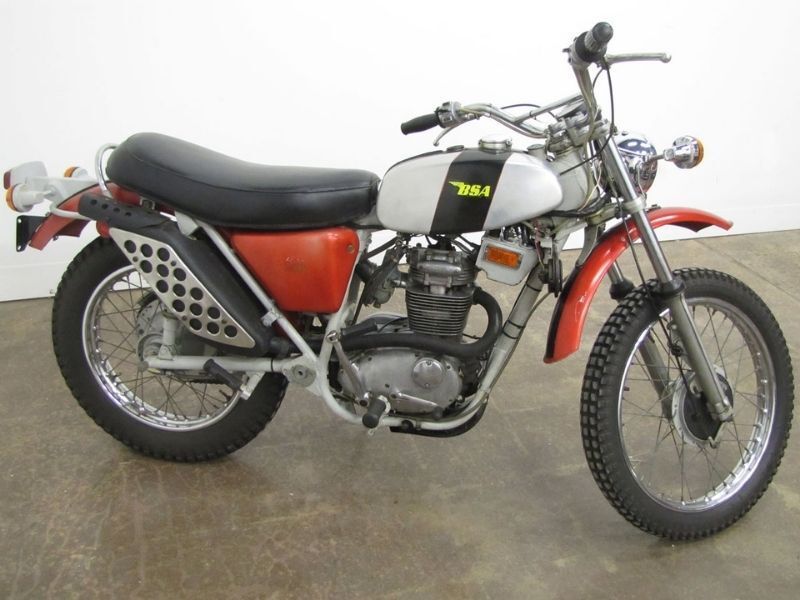
The name survived, thinly. When NVT was liquidated in 1978, NVT Motorcycles Ltd — which held the BSA marque rights — was bought out by its own management and renamed BSA Company Limited under former NVT man William Colquhoun, selling spares and building small numbers of military and off-road machines around Rotax and Yamaha engines. In 1991 it merged with Andover Norton International; from 1997 to 2003 BSA Regal in Southampton built the heritage-styled Gold SR, a 400/500cc roadster. By 2002 it was a parts operation, and in 2007 the components business was sold.
Meanwhile the last BSA engine design refused to die: Alan Clews bought the residual B50 parts stock and founded CCM, whose BSA-derived four-stroke motocrossers kept winning into the late 1970s. BSA Guns Ltd, for its part, still makes air rifles in Birmingham.
Classic Legends and the New BSA (2016–2026)
On 25 October 2016, India's Mahindra & Mahindra, through its subsidiary Classic Legends Private Limited, acquired BSA Company with all its global brand rights — reportedly for around £3.4 million, though the figure appears only in trade coverage and not in Mahindra's own announcement. Classic Legends now runs three heritage marques: Jawa (relaunched 2018), Yezdi (2022) and BSA.
The revived Gold Star 650 was unveiled in December 2021 and went on sale in Britain from mid-August 2022. Its engine is the detail most articles get wrong: a 652cc liquid-cooled DOHC four-valve twin-spark single licensed from Rotax and then extensively modernised by the Technical University of Graz for Euro 5 and fuel injection, deliberately styled to look nothing like the Rotax original. It makes 45 hp at 6,500 rpm and 55 Nm, weighs 213 kg, and carries Brembo brakes and dual-channel ABS. Reviews have been consistently warm-but-qualified: good value, handsome, characterful, with fit and finish behind Royal Enfield and Honda benchmarks. It is manufactured in India, with UK assembly long promised.
The range has since grown. The Scrambler 650 went on sale in Britain in July 2025 at £5,999, and the Bantam 350 — a 334cc single making 29 bhp — arrived in October 2025 at £3,499, aimed squarely at Royal Enfield's core market. The Gold Star 650 lists at around £6,399. In India the Gold Star launched on 15 August 2024 at Rs 2.99 lakh, deliberately undercutting the Royal Enfield Interceptor 650. A US launch through BSA Motorcycles NA and a 23-dealer network has been promised repeatedly since 2022 and, as of late 2025, had not happened.
The commercial news is better than it has been in fifty years. For the financial year to March 2026, Classic Legends reported its first profit after years of losses, on 45,409 retail units and about 40% growth, against 19% for the 350cc segment as a whole. Exports are 10% of sales and targeted to double. Management's FY27 projections vary by source — the managing director has spoken of potentially exceeding 70,000 units, while other reports cite a target above 100,000 — and four new models are promised across the three brands, including a BSA Thunderbolt adventure bike on the 334cc single. An IPO has been discussed but not scheduled.
Two headwinds are worth naming. Royal Enfield sold over 1.2 million units in FY26, and a proposed Indian GST increase to 40% on motorcycles above 350cc threatens the Gold Star's pricing advantage in its largest market. And the electric BSA — a genuine, publicly co-funded project with the University of Warwick, Dana TM4 and others, whose prototype was reportedly engineered to vibrate and emit an engine note — has been described by management in 2026 as unprofitable, with EV development consciously de-prioritised in favour of brand-building.
BSA's Competition Record at a Glance
- Motocross World Championship (500cc): Jeff Smith, 1964 and 1965 — the only back-to-back 500cc titles by a British marque. Runner-up: John Banks, 1968 and 1969.
- British 500cc Motocross Championship: nine titles for Jeff Smith (1955, 1956, 1960–65, 1967); three for John Banks (1968–70).
- Motocross des Nations: Smith a member of seven winning British teams.
- Scottish Six Days Trial: John Draper (1951), Jeff Smith (1955), Arthur Lampkin (1963), Alan Lampkin (1966).
- ISDT: Jeff Smith, eight golds for England; all three works A7 Star Twins took gold in Austria in 1952.
- Daytona 200: Bobby Hill, 1954 (A7 twin, with BSA filling the podium and by most accounts the top five) and Dick Mann, 1971 (Rocket 3).
- AMA Grand National Championship: Dick Mann, 1971.
- Isle of Man TT: 15 wins and 42 podiums in total, the great majority of them Clubmans class victories; two outright wins, both Sidecar — Chris Vincent (1962) and Terry Vinicombe (1968). No solo world championship, and no outright Senior or Junior TT win.
- Maudes Trophy: 1926, 1938, 1952.
- Brooklands: Wal Handley's Gold Star lap of 107.57 mph, 30 June 1937.
The Key BSAs, Era by Era
| Model | Years | Engine | Why it matters |
|---|---|---|---|
| 3½ h.p. | 1910–14 | 499cc SV single | The first BSA motorcycle; belt drive, £50 |
| Model E | 1919–24 | 770cc SV V-twin | BSA's first V-twin; the sidecar workhorse |
| Model B "Round Tank" | 1924–29 | 249cc SV single | 35,000+ sold at £39 10s; put Britain on wheels |
| Sloper | 1927–35 | 493–595cc OHV single | Inclined cylinder and saddle tank; set 1930s styling |
| Blue Star | 1932–36 | 249/349/499cc OHV | BSA's first true sports singles |
| Empire Star | 1936–39 | 249/348/496cc OHV | The Brooklands machine's basis |
| M24 Gold Star | 1938–39 | 496cc OHV single | All-alloy, Reynolds 531, 564 built |
| M20 | 1937–55 | 496cc SV single | 126,334 military machines; the Army's bike |
| Bantam D1–B175 | 1948–71 | 123–173cc two-stroke | DKW-derived; 350,000–500,000 built |
| A7 / A7 Shooting Star | 1946–62 | 495/497cc OHV twin | Won Daytona 1954 and the 1952 Maudes Trophy |
| A10 Golden Flash | 1950–63 | 646cc OHV twin | The gold-tanked export success |
| Gold Star ZB–DBD34 | 1949–63 | 348/499cc OHV single | Killed the Clubmans TT by winning it |
| Sunbeam scooter | 1959–65 | 175cc two-stroke / 250cc twin | Turner-designed, a year late, outsold by Italy |
| C15 / B40 | 1958–67 | 247/343cc OHV single | First unit-construction four-stroke; Tiger Cub roots |
| Rocket Gold Star | 1962–63 | 646cc OHV twin | 1,584 built; the most collectable pushrod BSA |
| A65 Thunderbolt | 1966–72 | 654cc OHV twin | The single-carb tourer; lasted to the end |
| A65 Lightning | 1964–72 | 654cc OHV twin | Twin-carb sportster, ~51 bhp, 108 mph |
| A65 Spitfire Mk II–IV | 1966–69 | 654cc OHV twin | Amal GP carbs, 123 mph; fastest standard BSA |
| A65 Lightning Clubman | 1964–65 | 654cc OHV twin | 200 built; the Bonneville-beater |
| B44 Victor / B50 | 1965–73 | 441/499cc OHV single | Two motocross world titles; BSA's last engine |
| A75 Rocket 3 | 1968–72 | 740cc OHV triple | Won Daytona 1971; four weeks behind the CB750 |
| A70 Lightning 750 | 1971 | 751cc OHV twin | 202 built for AMA flat-track homologation |
| Gold Star 650 | 2022– | 652cc DOHC single | The Rotax-based revival under Classic Legends |
Full specifications, year by year, are in our BSA model database.
Models by Type
Five model families carried BSA through its best years, and between them they account for most of what survives today.
Gold Star
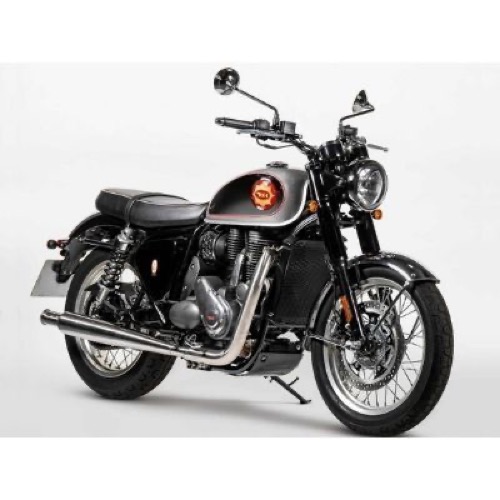
The Gold Star was always a single, and only ever a single — 348 or 499cc, overhead-valve, from the pre-war M24 of 1938 to the DBD34 of 1956. The name came from the Brooklands badge Wal Handley won on 30 June 1937 for a 107.57 mph lap during a race. Through the ZB, BB, CB, DB and DBD prefixes it became the most admired sporting single in Britain, dominated the Clubmans TT so completely that the class was abolished for 1957, and ended in 1963 when Lucas stopped making the magneto it needed.
Bantam
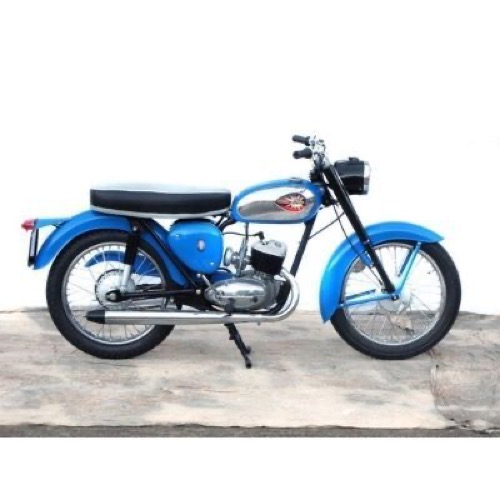
The most numerous BSA ever built was a German design: the DKW RT125, taken as war reparations and redrawn as a mirror image so the gearchange fell on the right. The 123cc D1 arrived in 1948 and the line ran through the D3, D5, D7, D10 and D14/4 to the 173cc B175 of 1971 — twenty-three years, longer than any other BSA. Production was never precisely recorded; sourced estimates run from 350,000 to 500,000.
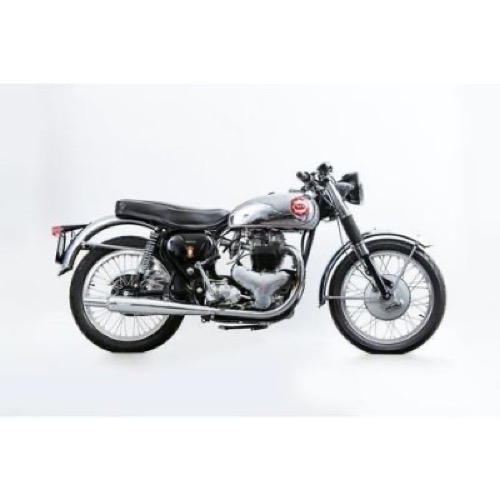
Rocket Gold Star
Not a Gold Star and not an overhead-cam engine: the Rocket Gold Star of February 1962 put a tuned 646cc pushrod overhead-valve A10 Super Rocket twin into the Gold Star's double-downtube frame, with a 190mm racing front brake and the optional RRT2 close-ratio box. It made 46 bhp standard and a 1963 test recorded 123 mph. Only 1,584 were built across two years, which makes it the most collectable — and the most faked — pushrod BSA. Frame prefix GA10 and engine prefix DA10R must agree.
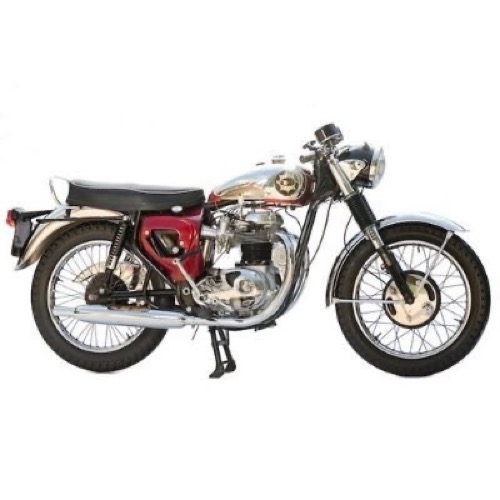
A65 Thunderbolt / Lightning / Spitfire
The unit-construction 654cc twins of 1962 onward, and the names are routinely muddled. The Thunderbolt is the single-carburettor tourer. The Lightning is the twin-carburettor sportster, about 51 bhp and 108 mph. The Spitfire Mk II–IV is the flagship — twin Amal GP carburettors, 10.5:1 compression, a best run of 123 mph and the fastest standard BSA ever made. The stripped-out single-seat production racer was none of these: that was the Lightning Clubman, of which 200 were built.
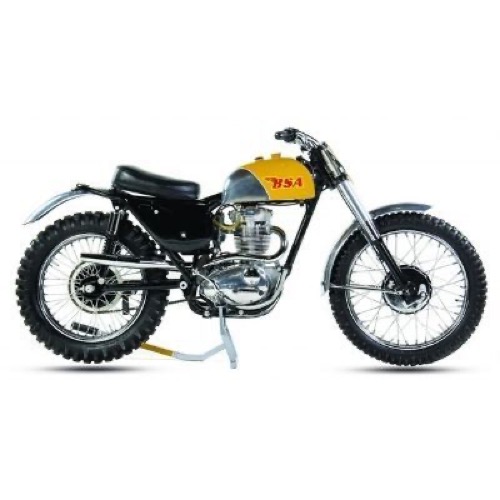
B44 Victor / B50
BSA's competition singles descend from the C15 by way of the B40, not from any "unit-construction Rocket Gold Star" — no such machine existed. Brian Martin took the B40 engine to 421cc and then to 441cc, and on that engine Jeff Smith won the 500cc Motocross World Championship in 1964 and 1965. It reached the public as the Victor GP, Enduro and Roadster, became the B44SS Shooting Star in America, and grew to 499cc as the B50 in 1971 — the last new engine BSA ever designed.
Collecting BSA Today
BSA is the value marque of the British big three, and that is both its charm and its problem. Recent auction data indexes over 1,400 BSA sales at an average of roughly $5,900 — a Norton Commando starts about where an A65 tops out, and Triumph enjoys far stronger brand liquidity because the name never died.
At the top. BSA's ceiling is set by rarity rather than fame: a 1936 Model Y13 V-twin made £33,350 at Bonhams in April 2025, and a documented 1963 Rocket Gold Star made $39,450 on Bring a Trailer in August 2023. There is currently a striking transatlantic gap on the RGS: three separate UK results in the spring of 2026 clustered between £9,775 and £10,580 including premium, while replicas trade around £4,255 — roughly 40% of a genuine bike. A Gold Star DBD34 works out at about £8,000–£13,000 or $11,000–$20,000, with true Clubmans-specification machines at the top. Competition provenance is the wild card: a 1974 B50 "Dick Mann" made $38,500 at Mecum Las Vegas in January 2026.
The volume models. A rideable Bantam is £1,200–£2,000 and a very good one £2,500–£3,500. An A10 Golden Flash runs £3,000–£3,800 for a rider and £4,300–£5,000 for a good one; a Super Rocket £4,000–£7,400. B31/B33 singles average around £3,500. An A65 Thunderbolt is £3,000–£3,700, a Lightning £2,700–£3,200 in Britain and rather more in America. A C15 starts around £1,000. Rocket 3s are the most predictable segment of all: $5,500–$6,600 in the United States against £9,200–£9,500 in Britain for the same machine.
The single most useful thing to know: on everything except the Rocket Gold Star and the DBD34, a finished bike costs less than a restoration. A concours BSA twin is £5,000–£8,000; a competent professional restoration is £12,000–£18,000. The market does not pay for the work.
What to check. The defining BSA twin weakness is the A65 bottom end, and it has a precise year break: pre-1966 cranks ran deep-groove ball main bearings, while 1966-on "wide" cranks used rollers with materially higher radial load capacity — BSA's own explanation being that the rollers were needed to keep up with rising engine outputs. A pre-1966 A65 with its original ball-bearing bottom end and no SRM conversion is a liability, and "has it had SRM work?" is the highest-value question in any BSA inspection. Bantams want electronic ignition. A Gold Star described as hard to start usually isn't broken — the DBD34 demands a memorised drill, and an RRT2-geared Clubmans is close to unrideable in traffic. Rocket 3s share the Trident's pressed-up crank, which makes a rebuild expensive.
Undervalued, on the current evidence: the 350 B32/CB32 Gold Star at £6,200–£7,300 against £8,800–£13,200 for the mechanically similar 500; the A65 Spitfire Mk II, BSA's fastest production twin, of which a matching-numbers restored example made only £4,370 in February 2025; and the A10 Super Rocket, which is essentially an RGS engine at 40–70% of the price.
The wider market in 2024–26 is best described as a correction rather than a crash, tilting toward buyers, with originality and matching numbers now non-negotiable at the top and weak or incomplete bikes increasingly failing to sell. BSA's real advantage is support: Draganfly, Burton Bike Bits, SRM Engineering, British Bike Bits, Feked and Classic British Spares between them mean you can build a complete A65 or Gold Star bottom end from catalogue parts, and the BSA Owners Club and BSA Gold Star Owners Club hold the records and the knowledge. Current auction results by model are tracked on our BSA valuations page.
One final irony. A two-year-old Gold Star 650 has shed roughly 35–45% of its list price — used 2024 examples advertise at £3,795–£4,895, and dealers discount new stock below the 2022 launch price. A used modern Gold Star now costs less than a scruffy C15 and about a third of the 1960 DBD34 whose name it borrows. For £4,000 and no spanner skills it is the rational buy; for value retention it is the worst BSA you can own.
Key Milestones
The Birmingham Small Arms Company is incorporated on 7 June by a group of Birmingham gunsmiths to make guns by machinery.
The Small Heath factory opens on Armoury Road; a 20,000-rifle Turkish order follows.
Bicycle and tricycle manufacture begins; the piled-arms trademark is registered.
BSA sells cycle and, from about 1901, motorcycle fittings; complete bicycles return in 1908.
BSA's first complete motorcycle, the 3½ h.p. 499cc single, is shown at Olympia; Daimler is acquired.
Around 1.6 million rifles and 145,000 Lewis guns; motorcycle production largely suspended.
The 249cc Round Tank arrives at £39 10s; four BSAs climb Snowdon.
First Maudes Trophy, for sixty climbs of Bwlch y Groes.
The Sloper is announced, setting the styling template for the 1930s.
Wal Handley laps Brooklands at 107.57 mph on an Empire Star, 30 June; the Gold Star name is born. The M20 enters the range.
Small Heath is bombed on 19 November; 53 employees are killed.
126,334 military motorcycles, 1.25 million rifles and much more, across 67 factories.
Ariel, Sunbeam, New Hudson and finally Triumph (1951, ~£2.5m) are acquired; BSA becomes the world's largest motorcycle manufacturer.
The Bantam is launched, and stays in production until 1971.
Three A7 Star Twins take ISDT golds and the Maudes Trophy over 4,958 observed miles.
Bobby Hill wins the Daytona 200 on a BSA, heading a BSA sweep.
Gold Stars so dominate the Clubmans TT that the class is abolished for 1957.
The unit-construction C15 arrives; the Sunbeam scooter follows.
The Rocket Gold Star and the unit-construction A50/A65 twins; Chris Vincent wins the Sidecar TT.
Jeff Smith wins the 500cc Motocross World Championship for BSA.
Umberslade Hall opens; profits collapse; the Queen's Award to Industry is won in both years.
The A75 Rocket 3 launches, weeks before the Honda CB750.
The oil-in-frame range arrives late and too tall; Dick Mann wins Daytona and the AMA Grand National on a BSA; a £3m trading loss is reported.
BSA's motorcycle interests merge into Norton Villiers Triumph; BSA-badged production ends after 63 years.
Small Heath closes in February.
NVT Motorcycles Ltd is bought out and renamed BSA Company Ltd.
Mahindra's Classic Legends acquires BSA Company and its global brand rights.
The 652cc Gold Star 650 is unveiled and goes on sale in Britain.
India launch of the Gold Star; the Scrambler 650 and Bantam 350 join the range.
Classic Legends reports its first profit, on 45,409 units and ~40% growth.
Noteworthy Statistics
- 126,334 military motorcycles built in the Second World War — roughly 30% of the entire British industry's wartime output.
- 67 factories at BSA's wartime peak; 1,600 machine tools destroyed by bombing.
- 1,584 Rocket Gold Stars, of which 272 were scramblers — and 202 A70 Lightning 750s, all exported.
- 564 pre-war M24 Gold Stars; 33 of 37 entries in the 1955 Junior Clubmans TT were Gold Stars, and 54 of 55 in the 1956 Senior.
- 350,000–500,000 Bantams over 23 years, the exact figure never recorded.
- 56,077 motorcycles sold in 1937, against total UK new registrations of 46,500 — the difference being exports.
- 50–70% of BSA Group profit came from motorcycles in the 1960s, while motorcycles received £2.2m of £10.1m of group capital spending from 1945 to 1960.
- £1,300 invested per worker at BSA against £5,000 at Honda in 1970.
- BSA's US market share fell from 23% in 1968/69 to 10% in 1971/72 — on delivery failure, not specification.
- 45,409 units retailed by Classic Legends in FY2026, its first profitable year.
BSA Motorcycles FAQ
What does BSA stand for?
The Birmingham Small Arms Company, incorporated on 7 June 1861 by a group of Birmingham gunsmiths to manufacture guns by machinery. It made bicycles from 1880, motorcycle fittings from about 1901, and its first complete motorcycle in 1910.
When did BSA stop making motorcycles?
BSA-badged production ended in the summer of 1973, after sixty-three continuous years, when BSA's motorcycle interests were merged into Norton Villiers Triumph and the BSA name was excluded from the new company's portfolio. The Small Heath factory itself carried on with NVT work until February 1976.
Why did BSA fail?
Not simply because Japanese motorcycles were better. BSA's motorcycle division generated most of the group's profit but received little of its investment; management with no motorcycle experience drove out its best engineer, spent heavily on Umberslade Hall and the Ariel 3 moped, and attempted a near-total range replacement for 1971 that arrived late and wrong. BSA's US market share collapsed from 23% to 10% on delivery failure rather than specification.
What was BSA's most successful model?
By volume, the Bantam — somewhere between 350,000 and 500,000 built between 1948 and 1971. By reputation, the Gold Star.
How did the Gold Star get its name?
From the Brooklands Gold Star badge awarded for lapping the outer circuit at over 100 mph during a race. Wal Handley did it on a 496cc BSA Empire Star on 30 June 1937, with a fastest lap of 107.57 mph, and BSA turned the award into a model name for 1938.
Did BSA ever win a world championship?
Yes — two, both in motocross. Jeff Smith won the 500cc Motocross World Championship in 1964 and 1965, making BSA the only British marque to take back-to-back titles in the class. BSA never won a solo road-racing world championship.
Are BSA and Triumph the same company?
No, though they were once under the same roof. BSA was founded in Birmingham in 1861; Triumph in Coventry. BSA bought Triumph Engineering from Jack Sangster in 1951 and the two were run as one automotive division, sharing engineering — the Rocket 3 and Trident triples are the same design — but they remained separate marques with separate dealer networks. Today they are entirely unrelated: Triumph is British-owned under John Bloor, BSA is owned by India's Mahindra through Classic Legends. See our history of Triumph.
Who owns BSA now?
Classic Legends Private Limited, a subsidiary of Mahindra & Mahindra, which acquired BSA Company and its global brand rights in October 2016.
Is the new BSA Gold Star a real BSA?
It carries the trademark legitimately and is developed in Britain, but there is no continuity of engineering with Small Heath. Its 652cc single is licensed from Rotax and developed with the Technical University of Graz, and the bikes are manufactured in India. It is a modern motorcycle wearing a historic badge — which, for £6,399 and with a three-year warranty, is a rather better proposition than most revivals.
What is the most valuable BSA motorcycle?
Model for model, the 1962–63 Rocket Gold Star, of which only 1,584 were built. In absolute terms, rarity beats fame: a 1936 Model Y13 V-twin made £33,350 at Bonhams in 2025, and a documented Rocket Gold Star made $39,450 on Bring a Trailer in 2023.