The History of KTM Motorcycles Logo
There's a version of the KTM logo story that gets told a lot — the orange appeared in 1996, KISKA stripped everything back, done. The reality is messier and more interesting. The logo that sits on every KTM motorcycle today took 70 years and nine distinct iterations to arrive at three plain black letters. Each version reflects something real about what the company was going through at the time. Some of the changes were deliberate brand decisions. Others were made by a former racer who'd just won a world championship and figured the logo deserved to celebrate too.
It's worth going through them properly.
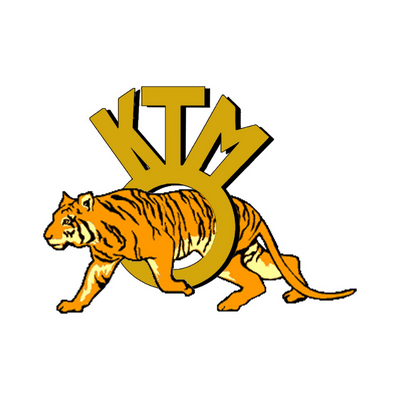
1953 — The Tiger That Never Was
Before KTM had an official logo, it had a tiger.
The first models of the R100 — the motorcycle that started it all — wore a badge featuring a tiger passing through a ring with "KTM" lettered alongside it. Nobody commissioned this as a brand identity exercise. It appeared on the early production bikes and was, by most accounts, more of a decorative choice than a strategic one.
The tiger wasn't arbitrary, though. The ring is a polysemantic image — it suggests a wheel, movement, speed, the idea of passing through something. The tiger communicates strength and aggression. As an instinctive statement of what a motorcycle manufacturer wants to project, it's actually not far off. What it wasn't was official.
The company never formally adopted it. It exists now as a footnote — the proto-identity of a brand that hadn't yet figured out what it was.
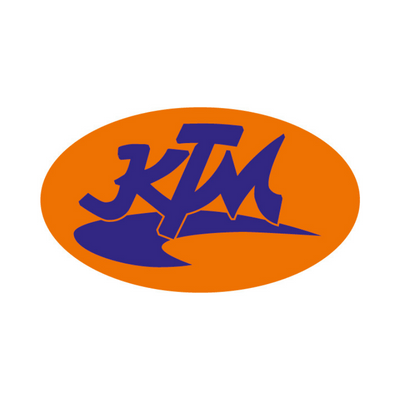
1954 — The First Official Logo: Orange Oval, Blue Letters
A year after the R100 launched, the first official KTM logo appeared: an orange oval with blue lettering. The timing wasn't accidental — 1954 was also the year Ernst Kronreif joined the company as a major shareholder, bringing with it the formal registration of the Kronreif & Trunkenpolz Mattighofen name. The logo arrived alongside a company that was, for the first time, properly constituted.
The 1954 logo was composed of a bright orange oval with a blue wordmark and a swoosh symbol as an underline. The color palette made it eye-catching, and the lettering had a playfulness to it that the later, more severe versions would move away from.
The orange and blue combination is worth noting. Orange would eventually become one of the most recognizable brand colors in all of motorsport, but that was 40 years away. In 1954, it was just a color choice — vivid, warm, attention-grabbing on a production line motorcycle in a postwar market where mobility was still a practical matter rather than a lifestyle one.
At this time, there was no consistent coloring across uses — the oval was printed partly in orange and blue depending on the application. This was a small company making its first attempts at visual identity. Consistency, in the branding sense, would come much later.
That same year, 1954, KTM won its first racing title at the Austrian 125cc national championship. The logo and the racing success arrived together. That pattern — visual identity and competitive performance intertwined — would define the brand for the next seven decades.
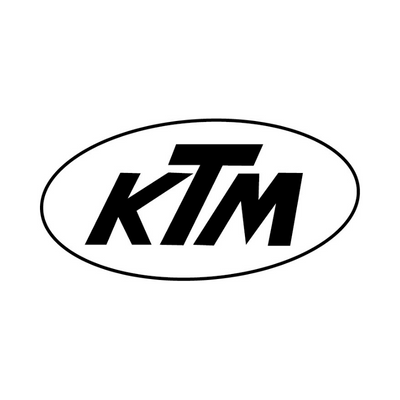
1958 — The Monochrome Alternative
By 1958, an alternative logo had appeared — a simple white oval with a black border and black lettering. This one was never formally adopted as the official emblem, which puts it in the same category as the 1953 tiger: a real thing that appeared on real products, but without official sanction.
The 1958 version was minimalist by comparison — a monochrome emblem with strict, slightly italicized lettering. The oval outline was black. In retrospect, it became a starting point for the brand's later visual direction.
What's interesting about 1958 is what it suggests about the company's internal uncertainty. KTM was growing — the Trophy 125cc sports motorcycle had launched in 1957, the Mecky moped was in production, and the product range was expanding. But the logo wasn't settled. Two versions existed simultaneously, which is less a sign of confusion than of a company that hadn't yet decided who it was trying to speak to. That question wouldn't get a definitive answer for another 35 years.
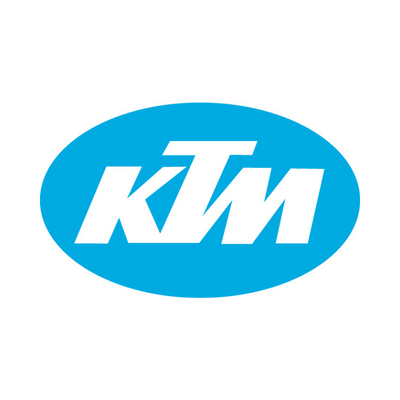
1962 — Erich Takes Over, the Logo Gets Updated
Ernst Kronreif died in 1960. Hans Trunkenpolz followed him two years later, in 1962, from a heart attack. His son Erich Trunkenpolz inherited management of the company, and one of his early decisions was to update the logo.
The official emblem of this period featured a new color scheme — a light blue background with white lettering. It was fresh and modern, balancing the new typeface where the letters became thicker and connected to each other. The oval shape remained.
The shift from orange-and-blue to light blue-and-white feels, in hindsight, like a change in temperature — warmer to cooler, more aggressive to more considered. Whether that reflects anything deliberate about Erich's direction for the company is harder to say. What the 1960s were, for KTM, was a period of steady expansion. By 1971, the company had 400 employees and 42 different models. The logo of this era had to work across a much broader range of products than the original R100 badge ever anticipated.
1974 — The Championship Stretch
This isn't a separate logo entry so much as a specific event driving a mid-period change: in 1974, KTM won their first motocross World Championship, with Gennady Moiseev riding the MC 250 in the 250cc class. It was a significant moment for a brand that had positioned itself around racing since the ISDT gold medal in 1956.
After winning the first World Championship title in 1974, Erwin Lechner — a former racer who was then KTM's sales manager — decided to change the logo. The oval was stretched, the blue color became more bold, and the lettering "Austria" was added.
The decision to add "Austria" is revealing. It's a moment of national pride — we just won a world championship, we're Austrian, we want people to know it. Lechner was a racer-turned-salesman, and this feels like a racer's decision: mark the achievement, make it visible. The stretched oval and bolder blue gave the logo more presence on competition machinery, which by the mid-1970s was increasingly where KTM's reputation lived.
1978 — Darker, Stronger, Two Versions
Four years after the "Austria" addition, it disappeared again. The blue coloring became darker. Two versions were produced: the original with an outline, and another without.
The 1978 logo was a more masculine, stronger version of its predecessor. The light blue turned into a deep blue, the lettering became more balanced and robust, and a white outline around the oval gave the emblem a harder edge.
The late 1970s were a complicated period for KTM. The company was still racing successfully and the product range was broad, but the moped market that had sustained much of the business through the 1960s and into the '70s was beginning to soften. The 1978 logo, with its darker tones and more severe treatment, reads a bit like a company trying to look serious. Whether that was intentional is difficult to say — logo design at this level, in this era, wasn't necessarily the strategic exercise it later became.
What's notable is that the "Austria" label added after the 1974 championship was quietly dropped. National pride has a shorter shelf life than you might think.
1989 — 'Fun in Motion': The TAUS-Gruppe Era
The moped market didn't just soften — it collapsed. KTM halted production in 1988 under the weight of accumulated debt. An Austrian investment trust, the TAUS-Gruppe, acquired a controlling stake in 1990 in an attempt to rescue the business. Their tenure produced one of the most visually distinctive — and, in retrospect, most obviously wrong — KTM logos in the brand's history.
The 1989 redesign was radical. The oval was removed entirely and the letters became open. The "T" was lengthened to cover neighboring "K" and "M" up to the middle. The slogan "Fun in Motion" appeared below the company name, written in red. To the left of the abbreviation sat an abstract graphic mark — a semicircle dissected by many thin lines, two-colored in blue and red.
"Fun in Motion."
It's hard to look at this in the context of KTM's history without some sympathy for whoever was tasked with designing it. The company was in genuine financial distress. The TAUS-Gruppe was trying to reposition it. "Fun in Motion" suggests a marketing consultant's attempt to broaden appeal, to move away from the hardcore off-road identity that had defined the brand and appeal to a more general audience. The semi-circle graphic element — striated, two-toned — reads as late-1980s corporate modernism. It could be any company. A radiator manufacturer. A financial services firm.
It was very much not KTM.
1992 — Stefan Pierer Pivots to 'Motorcycles'
The TAUS-Gruppe failed to turn KTM around. By 1991, creditor banks had taken control. In 1992, the company was split four ways and Stefan Pierer's Cross Industries acquired the motorcycle division.
Pierer maintained the 1989 logo's basic structure but changed one thing: the tagline "Fun in Motion" was replaced with the word "Motorcycles."
It's a small change that says everything. No more abstract brand positioning. No more semicircle graphic trying to suggest dynamism. Just: motorcycles. That's what this company makes. That's what it is.
This period saw KTM sharpen its visual identity and signal its refocus on motorcycle manufacturing specifically. Pierer was rebuilding the company around a clear product identity, and the 1992 logo update — modest as it was — reflected that clarity of purpose.
But Pierer had already met someone who would take the brand identity considerably further than a tagline swap.
1994–1996 — Gerald Kiska, Orange, and the Rebirth of Everything
This is the chapter most KTM histories get wrong, or at least incomplete.
Gerald Kiska founded his design studio in Salzburg in 1990. He met Stefan Pierer in 1991 — Pierer was still running a ski binding company at that point and hadn't yet acquired KTM. The relationship that formed between them led to Kiska playing a role in designing every KTM since. More specifically, Kiska created the KTM logo we now recognize in 1994. And it was also in 1994 that Kiska married that logo to orange — joking later that "all the other colors were already taken by the rest of the manufacturers."
The orange wasn't applied to the full production range immediately. It was the first Duke that first used orange for KTM, and that was an idea born in the workshop rather than from a strategic plan. The Duke launched in 1994, built on the LC4 engine, and it wore orange. Two years later, in 1996, KISKA simplified the logo further and orange became the official, brand-wide color.
In 1996, KISKA simplified the logo, removing all other elements and changing the "KTM" lettering to orange. No oval. No tagline. No abstract graphic marks. Just the three letters, in orange, on white.
The 1996 logo expressed strength, energy, and simplicity. No ovals or taglines.
KISKA's stated philosophy for KTM was — and remains — that the brand shouldn't try to be everybody's darling. It should be unmistakably intense. The logo, in their framing, symbolizes a champion on the winner's podium.
The following year, 1995, KTM adopted "Ready to Race" as its official slogan. The visual identity and the brand positioning clicked into place within a two-year window. Everything that KTM is today — the orange, the wordmark, the competitive identity — was assembled between 1994 and 1996 by a recovering company and a designer from Salzburg.
1999 — The Geometry Gets Precise
Three years after the orange wordmark, KISKA made a quiet but deliberate refinement.
In 1999, the logo changed not just in color but in geometry: the rear edge was adjusted and the T-line was extended to line up precisely with K and M.
This is the kind of detail that only a designer notices — until you put the 1996 and 1999 versions side by side, at which point the difference is obvious. The extended crossbar on the T creates a visual anchor that connects all three letters horizontally, giving the wordmark a stability and groundedness that the 1996 version lacked slightly. It's a small change with a meaningful effect on how the logo reads at speed, on a racing bike, at a distance, on a helmet.
Readability at small sizes and under race conditions was clearly part of the brief. The letterforms are open enough to remain legible on a moving motorcycle or helmet, which is a practical constraint that shaped the typographic decisions directly.
2003 — Black Letters, Final Form
Since 2003 to the present, the logo has remained unchanged. The 1999 geometry was retained, but the orange letters became black. Orange moved to context — backgrounds, liveries, bike plastics — rather than the letterforms themselves.
The current logo is minimalistic: a simple abbreviation. According to the designers, it expresses the manufacturer's energy and dynamism.
The black-on-orange combination that most people associate with KTM today — the logo as it appears on the orange bodywork of their off-road bikes, or reversed in orange on black on helmets and apparel — came directly from this 2003 standardization. The letters don't need to be orange when everything around them is. The contrast does the work.
Today's KTM logo is the anchor of a broader visual system that includes bike design, apparel, packaging, race team liveries, and retail environments. Every touchpoint uses the same orange-black contrast, the same aggressive typography, and the same no-excess approach to visual communication.
It has been over 20 years since the logo changed. That kind of stability, for a brand in a competitive consumer market, reflects confidence — the confidence of a company that knows exactly what it is and doesn't need to keep announcing it.
What the Logo Actually Means
KTM stands for Kronreif & Trunkenpolz Mattighofen — the formal company registration from 1953, when businessman Ernst Kronreif joined founder Hans Trunkenpolz as a major shareholder. The "M" is for Mattighofen, the Upper Austrian town where KTM has been headquartered since 1934. Before the official registration, the company had operated informally as Kraftfahrzeug Trunkenpolz Mattighofen, which produces the same initials.
There are no widely documented hidden images or embedded geometry in the KTM logo. It is an honest, direct wordmark without the kind of hidden figures you see in some other brand logos. The proportional relationships between the three letters are carefully controlled, and the spacing and weight balance create a visual stability that makes the logo feel planted and solid.
That plainness is the point. KTM didn't build its identity on symbolism or heritage imagery. It built it on orange and racing wins and a three-letter abbreviation that, by 2003, didn't need to explain itself to anyone in the motorcycle world.
| Year | Key Change | Context | | --- | --- | --- | | 1953 | Tiger badge (unofficial) | First R100 production models | | 1954 | Orange oval, blue letters (first official) | Kronreif joins; company formally registered | | 1958 | Monochrome oval alternative (unofficial) | Growing product range | | 1962 | Light blue background, white letters | Erich Trunkenpolz takes over | | 1974 | Stretched oval, bolder blue, "Austria" added | First World Championship win | | 1978 | Darker blue, white outline, "Austria" removed | Two versions produced | | 1989 | Oval removed, "Fun in Motion" tagline, abstract graphic mark | TAUS-Gruppe ownership | | 1992 | Fun in Motion replaced with "Motorcycles" | Stefan Pierer acquires motorcycle division | | 1994 | Current logo form created by KISKA; orange first appears on Duke | Brand rebuild under Pierer | | 1996 | Orange wordmark, all other elements stripped | KISKA formalizes orange brand-wide | | 1999 | T-crossbar extended for geometric precision | Typographic refinement | | 2003 | Letters become black; final form to present | Standardized orange-black visual system |