
Ducati / Ducati Models / 1991 Ducati 906 Paso
1991 Ducati 906 Paso
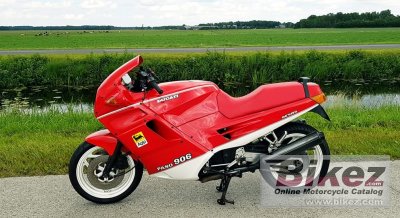
Category: Sport touring
Displacement: 904.0 ccm (55.16 cubic inches)
Power: 88.0 HP (64.2 kW)) @ 8000 RPM
Torque:
Top Speed: 214.0 km/h (133.0 mph)
Bike ID: 29670
29670
1991 Ducati 906 Paso Valuation
The 1991 Ducati 906 Paso represented Ducati's ambitious attempt at sport touring, sitting as a mid-range offering that bridged pure sportbikes and practical touring machines. This L-twin powered machine delivered genuine Italian character wrapped in polarizing Massimo Tamburini bodywork that either captivated or confused riders with its angular, fully-faired aesthetic.
The 906 Paso rewarded riders who appreciated Ducati's distinctive desmodromic valve actuation and the torquey delivery that made highway cruising engaging without being punishing. The riding position struck a reasonable compromise between aggressive and upright, though the bike's substantial bodywork and aerodynamics made it feel larger than its actual displacement suggested. Build quality was typical Ducati of the era — excellent mechanically but requiring more attention than Japanese alternatives.
However, there's a catch with 1991 examples: the 906 Paso actually ended production in 1989, replaced by the fuel-injected 907 I.E. Any bike labeled as a 1991 Ducati 906 Paso likely represents either a registration anomaly or misidentification, as Ducati had moved on to the updated 907 by this point.
These machines attract Ducati collectors seeking the brand's sport touring chapter and riders drawn to 1980s Italian design, though moderate collector interest keeps values reasonable compared to contemporary superbikes.
The 906 Paso rewarded riders who appreciated Ducati's distinctive desmodromic valve actuation and the torquey delivery that made highway cruising engaging without being punishing. The riding position struck a reasonable compromise between aggressive and upright, though the bike's substantial bodywork and aerodynamics made it feel larger than its actual displacement suggested. Build quality was typical Ducati of the era — excellent mechanically but requiring more attention than Japanese alternatives.
However, there's a catch with 1991 examples: the 906 Paso actually ended production in 1989, replaced by the fuel-injected 907 I.E. Any bike labeled as a 1991 Ducati 906 Paso likely represents either a registration anomaly or misidentification, as Ducati had moved on to the updated 907 by this point.
These machines attract Ducati collectors seeking the brand's sport touring chapter and riders drawn to 1980s Italian design, though moderate collector interest keeps values reasonable compared to contemporary superbikes.