
What your bike sounds like isn't an accident. It's a philosophy.
Ask any longtime motorcycle enthusiast what separates a Ducati from a BMW from a Triumph, and they'll probably start with the engine — not the specs, but how it feels. The lumpy, torquey punch of an L-twin at low revs. The silky buzzsaw howl of an inline-four being stretched past 10,000 rpm. The mechanical thump of a thumper single on a forest trail. These aren't just technical differences. They're different answers to the same question: what should riding a motorcycle feel like?
Europe has been arguing about that question for well over a century, and the continent's manufacturers have landed in wildly different places. This is that story.
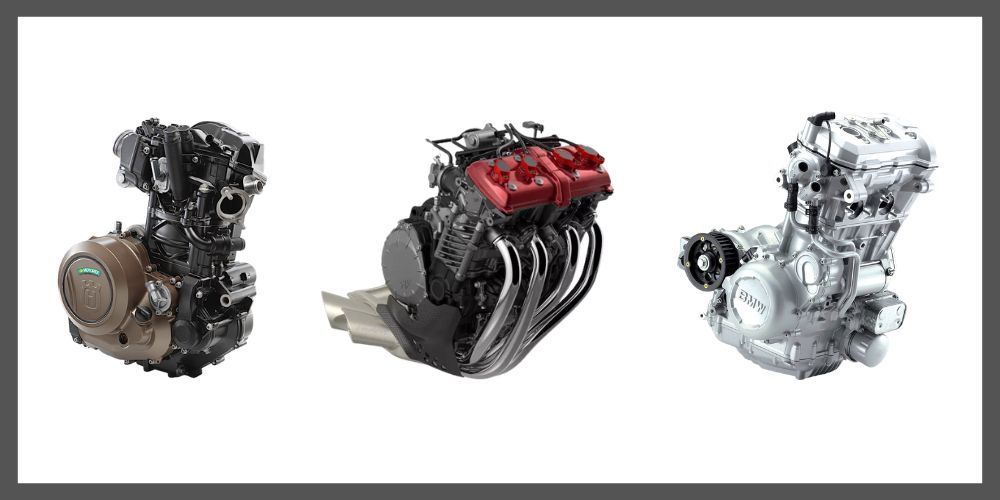
The single cylinder: where it all began
Before anything else, there was one cylinder. One piston going up and down in a tube.
The single-cylinder engine predates motorcycle culture as we know it — it essentially is the origin of motorcycle culture. Gottlieb Daimler bolted something approximating one to a wooden two-wheeled frame in 1885, and the rest is messy, disputed, gloriously complicated history.
What's interesting is how the humble single never went away. Japanese manufacturers largely abandoned it for street bikes decades ago, but European brands — particularly the off-road and adventure specialists — never stopped believing in it.
KTM and Husqvarna (both now under the Pierer Mobility umbrella, for better or worse) have built entire empires on refined single-cylinder engines. The KTM 690 Duke is probably the definitive modern street single: around 75 horsepower from one cylinder, which sounds modest until you realize the bike weighs next to nothing and the power delivery is so immediate it can genuinely unsettle experienced riders.
Husqvarna's Vitpilen and Svartpilen use the same mechanical heart but dress it differently — the Vitpilen leaning café racer, the Svartpilen going scrambler. Same engine, two completely different conversations.
Why do singles persist? A few reasons. They're mechanically simpler. They're lighter. And there's something about that big single-cylinder thump that forces you to ride differently — you're more connected to what the engine is doing, more attuned to the revs, more involved. Some riders find that annoying. Others find it addictive.
The vibration, by the way, is real. Counterbalancers help, but a big single is always going to buzz your hands on a long motorway cruise. That's just physics. Whether it's a flaw or a feature depends entirely on who you ask.
The parallel twin: Britain's gift to the world
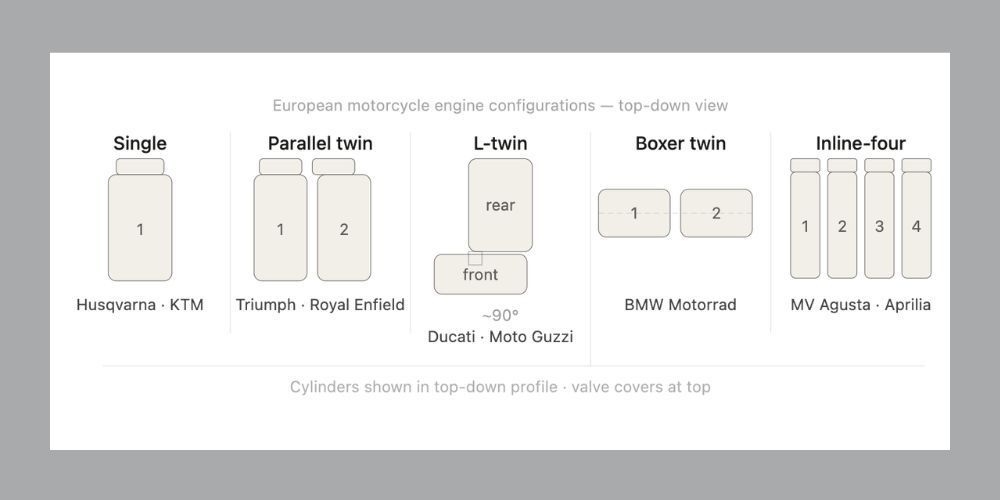
Triumph invented a lot of things, but the parallel twin — two cylinders sitting side by side, sharing a common crankcase — is probably their most consequential contribution to motorcycle engineering. Edward Turner's 1937 Speed Twin didn't just launch a new model; it launched an entire configuration that would dominate the next several decades.
The appeal was obvious. Two cylinders meant smoother power delivery than a thumpy single, more top-end performance, and a compact package that didn't require redesigning the whole frame.
Post-war Britain ran almost entirely on parallel twins. BSA, Norton, AJS, Matchless, Royal Enfield — they all had them. When the Japanese arrived in force during the 1970s with their own (often more refined) versions, most of those British brands collapsed. But the configuration itself survived because it's genuinely excellent.
The modern parallel twin has evolved considerably from Turner's original. Contemporary versions — like Triumph's 900cc unit in the Bonneville family, or BMW's water-cooled parallel twin used across the F-series adventure bikes — use 270-degree firing intervals rather than the old 360-degree arrangement. That subtle change in crank timing gives a more uneven, V-twin-ish feel to the power pulses, adding character without the complexity of an actual V-configuration.
Triumph remains the standard-bearer. Their 1200cc Bonneville engine, used in the Thruxton, the T120, the Scrambler 1200, is a masterpiece of parallel-twin development — enough displacement to pull strongly from low revs, enough top end to genuinely surprise you, and a sound that genuinely rewards a quiet road.
Royal Enfield deserves a mention here too. The Interceptor 650's parallel twin is made in India but designed by British engineers and is about as accessible as a twin gets. Honest, characterful, completely unpretentious.
The V-twin (and why Ducati calls theirs an L-twin)
Semantics matter here, and Ducati will tell you so.
A V-twin has two cylinders arranged in a V shape — the angle between them can vary considerably, and that angle matters a lot for packaging, character, and engineering complexity. Moto Guzzi's transversely-mounted 90-degree V-twin has the cylinders pointing out to the sides of the bike. Ducati's desmodromic L-twin has the cylinders at roughly 90 degrees too, but one points straight up and one points forward — making an L shape rather than a V.
Ducati insists on the distinction because the geometry really does create different engineering solutions and different riding characteristics.
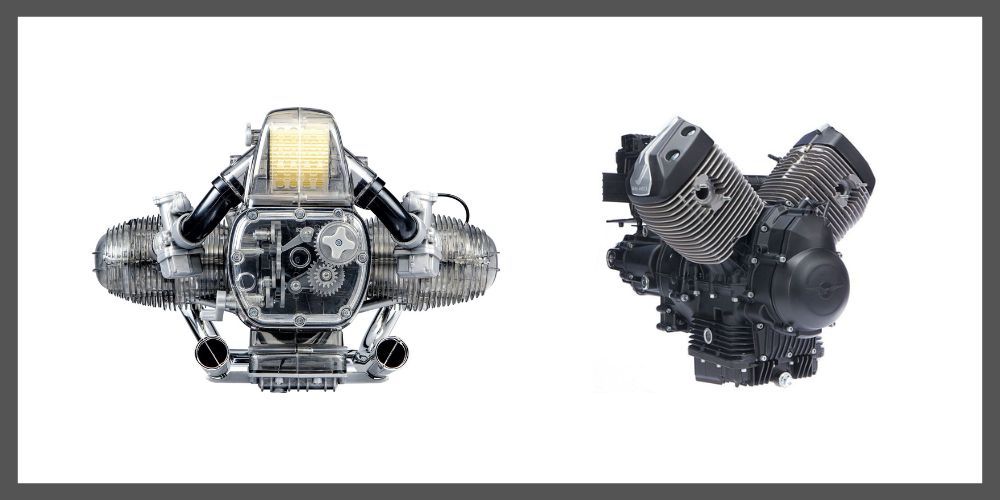
Moto Guzzi's transverse V-twin is one of the most distinctive engine layouts in motorcycling, full stop. The cylinders poke out sideways from the frame, which creates a wide motorcycle but also delivers excellent natural air cooling (lots of airflow hits both cylinders equally), a very low center of gravity, and a torque reaction that actually helps the bike lean into corners. It also looks absolutely unlike anything else on the road.
The Guzzi V-twin has been in continuous production since the early 1920s, which makes it almost certainly the longest-running engine configuration in motorcycle history. The displacement, the details, the fuel delivery have all changed — but the fundamental layout hasn't. You're essentially riding a direct descendant of the 1921 Normale.
Ducati's L-twin is a completely different beast. The Desmodromic valve system — which uses mechanical means to both open and close the valves, rather than relying on valve springs — is the headline feature, and it's been a Ducati constant since the late 1950s. Desmo requires more careful maintenance (the valves need periodic adjustment by someone who knows what they're doing), but it allows higher revs and more precise valve control at the top of the rev range.
The L-twin configuration also happens to make incredible sounds. The Monster, the Multistrada, the Supersport — they all produce that signature uneven, staccato bark that Ducati owners are absolutely insufferable about. And not without reason.
The boxer: BMW's 100-year argument
Ask a BMW Motorrad engineer why the boxer engine is the correct answer and clear your afternoon.
The horizontally-opposed twin — two cylinders pointing directly away from each other, with the pistons moving in opposite directions — is so physically balanced that it almost eliminates primary vibration entirely. The opposing pistons cancel each other's forces. You get smoothness that a parallel twin or V-twin genuinely can't match at low revs.
BMW put their first boxer into production in 1923. The R32, designed by Max Friz, became the template. Not just for BMW motorcycles but for what a boxer motorcycle should be: shaft drive instead of chain (because the transmission layout makes it sensible), the cylinders out in the airstream for cooling, the whole engine sitting low in the frame for handling stability.
A century later, the R 18 — BMW's retro-cruiser flagship — uses a 1,800cc boxer that's clearly a deliberate love letter to Friz's original philosophy. It's massive, overengineered in the best possible sense, and makes a sound unlike anything else on the road.
The modern liquid-cooled boxer — introduced on the R 1200 GS and now used across most of the GS range — added water cooling to the outer cylinder heads while keeping the overall layout. Purists complained. The GS kept selling in enormous numbers because it's probably the most practically useful motorcycle ever made. Both things can be true.
Zündapp and Victoria also used boxer layouts historically, though neither survived into the modern era. BMW stood alone, kept refining it, and built what is now genuinely one of the most distinctive engine identities in the industry.
The inline-four: Italian excess done right
Here's where Europe had to fight back against Japan.
The inline-four — four cylinders in a row, firing in sequence — was essentially perfected by Japanese manufacturers in the late 1960s and 1970s. Honda's CB750, then the Z1 from Kawasaki, set a standard of silky power delivery and top-end performance that European manufacturers struggled to match for years.
But Italy, being Italy, eventually decided that if you're going to do something, you should do it better than everyone else and make it considerably more dramatic.
MV Agusta is the benchmark. The Italian marque from Varese had been building four-cylinder racing motorcycles since the 1950s — Count Domenico Agusta's team dominated Grand Prix racing for years with multi-cylinder machines that were engineering tours de force. The road-going versions came later, were eye-wateringly expensive, and have become some of the most valuable collector motorcycles in existence.
The modern MV Agusta Brutale and F4 inline-fours carry that lineage. They're not the fastest inline-fours you can buy — the Japanese manufacturers would argue otherwise — but they're almost certainly the most musical. The exhaust note from an F4 at full chat is the kind of sound that makes grown adults stop whatever they're doing.
Aprilia's RSV4 uses an inline-four architecture that dominated World Superbike for years. Aprilia being Aprilia, they mounted it in a narrow-angle V4 configuration — which is actually closer to a V4 than a pure inline, but the distinction gets complicated fast.
The inline-four demands high revs to make its best power. That changes the riding experience fundamentally: you're more involved, more aware of where you are in the rev range, more likely to be working the gearbox. Some riders love this. Others prefer the broad torque of a twin and find inline-fours demanding in traffic.
The V4: when two V-twins aren't enough
If a V-twin is two cylinders in a V arrangement, a V4 is two pairs arranged the same way — front bank, rear bank, all firing in a carefully choreographed sequence designed to balance power delivery with packaging.
The V4 configuration allows a relatively narrow, compact engine (narrower than an inline-four in theory, shorter than a parallel-four) while delivering exceptional power and a very distinctive firing order. The sound is genuinely unlike anything else — a complex, multi-layered exhaust note that changes character as the revs build.
Aprilia's RSV4 established the configuration's credentials in competition. The V4 layout allowed Aprilia's engineers to keep the engine relatively compact and centralized in the frame, improving handling. It worked — the RSV4 became one of the most successful superbikes in World Superbike Championship history.
Ducati came to the V4 relatively recently with the Panigale V4 and the Multistrada V4. It was something of a theological moment for the brand, given how deeply the L-twin was embedded in Ducati's identity. The V4 is faster and more powerful. It's also, some Ducatisti would whisper, a bit less characterful. These arguments continue on forums.
KTM's RC8 used a V-twin (not a V4, despite what some assume), and their current Super Duke GT uses a parallel-twin. The Austrian brand has been more restrained in multi-cylinder experimentation than the Italians, focusing on delivering enormous performance from fewer, larger cylinders.
Two-strokes: the Europeans who couldn't be stopped
We'd be doing this badly if we ignored two-strokes, even though they've largely been legislated off public roads.
The two-stroke engine fires on every revolution of the crankshaft rather than every other one (as four-strokes do), producing power more frequently per unit of displacement. The result is enormous power-to-weight ratios and a brutally direct, spiky power delivery that four-strokes simply can't replicate.
Europe had two-stroke culture in its blood. Bultaco, Ossa, and Montesa — all Spanish — produced two-stroke machines that dominated trials and motocross competition from the 1950s through the 1980s. Bultaco's Sherpa T, developed with British trials champion Sammy Miller, essentially created the modern trials motorcycle.
Husqvarna built their racing reputation almost entirely on two-strokes. The Swedish brand's 250cc and 400cc motocross machines in the 1960s and 1970s were the bikes that other manufacturers measured themselves against. Steve McQueen raced one. That's really all you need to know.
CZ from Czechoslovakia and Jawa also produced formidable two-stroke competition machines, winning World Motocross Championships in the 1960s with bikes that came out of a communist country and embarrassed Western manufacturers.
The environmental regulations that killed two-strokes on public roads are, from a pollution standpoint, entirely justified — unburned hydrocarbons, etc. But if you've never heard a 500cc two-stroke motocross bike being ridden at full chat, you've missed something genuinely primal.
KTM and Husqvarna still make two-stroke off-road machines for competition. Gas Gas (now part of the same group) too. The configuration persists where regulations allow.
Rotary, three-cylinder, and the configurations that didn't quite stick
Not every engine layout found a permanent home.
The rotary, most famously associated with Van Veen and Hercules in Germany, used a Wankel engine in motorcycle form. The OCR 1000 from Van Veen in the 1970s was genuinely impressive — a water-cooled rotary producing around 100 horsepower, which was exceptional for the era. It was also enormously expensive and complicated to manufacture. The rotary motorcycle was a commercial dead end, but an engineering fascinating one.
Three-cylinder engines had a stronger showing. Triumph's triple — specifically the three-cylinder configuration that powered the 1968 Trident and the T150 — was a direct response to the Honda CB750's four. Three cylinders gave something genuinely between a twin's character and a four's refinement. The firing interval produces a distinctive exhaust note that's neither twin nor four, and many riders (myself included, honestly) find it the most inherently pleasing engine sound in motorcycling.
The modern Triumph triple in the Speed Triple, the Tiger 900, the Street Triple — it's a different engine from the original but carries that same characteristic character. Lower revving and more tractable than an inline-four, more sophisticated than most twins.
What the sound tells you
Here's the thing that doesn't usually make it into engine specifications but matters enormously to the experience of actually riding: the sound.
Every engine configuration has a fundamental exhaust note determined by its firing order. That firing order is math — how many degrees of crankshaft rotation between each cylinder's power stroke, how many cylinders are producing power in quick succession versus long pauses.
A single cylinder fires once per revolution. Big gap. Thump. Pause. Thump. Pause.
A parallel twin with 270-degree crank — like modern Triumphs — fires the second cylinder before the first has fully exhausted its stroke, creating an irregular one-two rhythm that sounds almost syncopated. Like a heartbeat with a slight arrhythmia. Deeply appealing.
A Ducati L-twin fires both cylinders in rapid succession, then has a long gap before the sequence repeats. That's the signature Ducati staccato — brap-brap... brap-brap — that sounds nothing like any other configuration.
A BMW boxer fires opposite cylinders alternately, the opposing pulses creating a very different harmonic.
An inline-four firing on every 90 degrees of rotation sounds comparatively smooth — less dramatic in character, but with its own musical quality at the top of the rev range, that reed-like shriek that gives Superbike racing much of its soundtrack.
None of these is objectively better. They're just different languages.
Which engine type is right for you?
This is the question every buyer eventually arrives at, and there isn't a universal answer. But there are honest guidelines.
If you ride primarily in cities and want something manageable, light, and honest: a large single or a parallel twin is likely your answer. The KTM 390 Duke (single), the Triumph Street Twin (parallel twin), the Royal Enfield Interceptor 650 — all excellent at not being overwhelming.
If you do long distances and want effortless, smooth torque without drama: the BMW boxer has earned its touring reputation for good reason. The GS is expensive and slightly vast, but it genuinely goes anywhere and does anything.
If character matters more to you than outright performance — if you want the bike to feel like something specific rather than just a vehicle: L-twin or Guzzi transverse V-twin. These engines have opinions. They'll share those opinions with you constantly.
If you want the most performance from a European manufacturer and don't mind working for it: inline-four or V4. MV Agusta or Aprilia. Prepare to visit a specialist mechanic more often than you'd prefer, but the rewards are real.
Frequently Asked Questions
Why do Ducati engines need more maintenance than other motorcycles?
Ducati's Desmodromic valve system — which mechanically closes the valves rather than using springs — requires periodic adjustment that other engines don't. Most modern Ducatis can go 15,000 miles or more between major services, but when that service comes around it's more involved and more expensive than a conventional four-stroke. The tradeoff is that the Desmo system allows very precise valve control at high revs, which is part of what gives Ducati engines their top-end performance character.
Is a boxer engine the same thing as a flat-twin?
Yes, essentially — though "boxer" specifically refers to horizontally-opposed cylinders where the pistons move toward each other and away from each other simultaneously (like boxers trading punches, hence the name). BMW uses this term for their engines. The pistons' opposing motion largely cancels primary vibration, which is why BMW boxers feel so smooth at low revs compared to V-twins or parallel twins of similar displacement.
Why did two-stroke motorcycles disappear from public roads?
Emissions regulations, primarily. Two-stroke engines produce significantly higher levels of unburned hydrocarbons than four-strokes because their intake and exhaust cycles overlap — some fuel mixture passes through the engine without being burned. Meeting modern Euro emissions standards with a two-stroke road motorcycle is technically extremely difficult and economically impractical. They survive in competition (KTM, Husqvarna, Gas Gas still make two-stroke off-road bikes) and small displacement machines like mopeds in some markets.